

Ho Chi Minh City – A group of scientists from the Institute of Biomedical Physics have developed an exercise program that helps reduce lumbar spinal curvature by 4 degrees after 3 months.
Research conducted since June 2022 helps people with scoliosis regain mobility through exercises on specialized equipment as part of a rehabilitation research program at the Institute of Biomedical Physics (Institute of Military Science and Technology) with assistance from experts at Leipzig University (Germany).
Applying principles and training methods from sports medicine and rehabilitation, scientists at the Institute of Biomedical Physics have developed exercise programs for scoliosis patients using specialized exercise equipment.
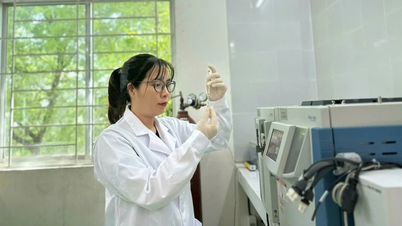
Training data is measured and stored on a computer system to serve as a basis for evaluation and the development of appropriate training programs. These are specialized devices that focus on training the muscle groups that need improvement. Depending on the patient's condition, the training program will be designed with appropriate intensity, duration, frequency, and repetitions.
According to Dr. Lai Hai Binh, Head of the Medical Department at the Institute of Biomedical Physics, the training program is designed according to the guidelines of the American Association of Colleges of Sports Medicine (ACSM). However, to suit the physical condition of Vietnamese people, the training intensity should be set lower. Specifically, according to ACSM guidelines, beginners can initially train at 40-50% of their maximum muscle strength. However, the program in the initial phase with low load (10% or even no load) is designed for patients to get used to it, then gradually increase the load according to their ability to train.
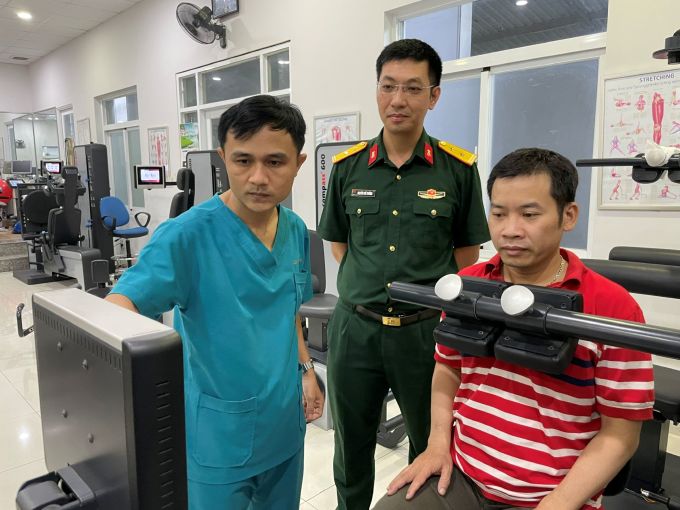
Medical professionals assess the patient's scoliosis using specialized exercise equipment. Photo: Ha An
Based on the training progress, the program increases the number of training sessions to enhance recovery according to each individual's specific needs. "During the training process, the machine will record the patient's training data to suggest increasing the load and difficulty of the exercises accordingly," Dr. Binh said.
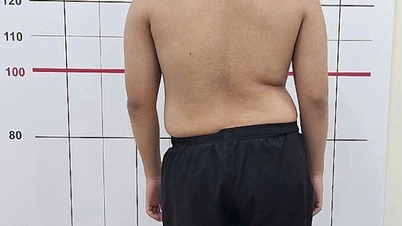
The program was tested on an 18-year-old male patient in Ho Chi Minh City with 40-degree lumbar scoliosis. After 3 months of training, the scoliosis decreased from 40 degrees to 36 degrees in the lumbar region, and from 29 degrees to 26 degrees in the thoracic region.
According to physiotherapist Le Van Thong from the Medical Department of the Institute of Biomedical Physics, for the training process to be effective, in addition to the exercises, medical staff need to support patients psychologically, helping them become more interested in training through companionship and conveying positive emotions.
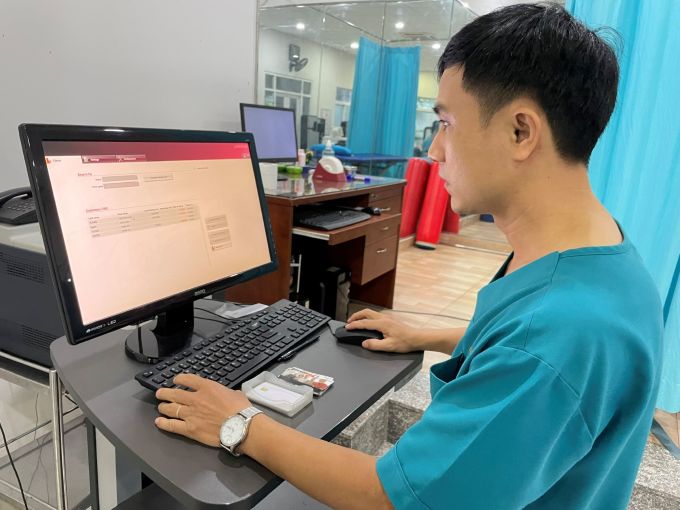
Monitoring patients' exercise data on a computer. Photo: Ha An
According to Lieutenant Colonel Dr. Nguyen The Thuong of the Institute of Biomedical Physics, rehabilitation exercises are common and widely used worldwide. However, in Vietnam, rehabilitation exercises are limited due to a lack of specialized training equipment and the high initial investment costs for facilities. Treatment with medication and surgery usually provides immediate results. Rehabilitation exercises, on the other hand, take several months to show improvement, requiring patient perseverance and proper training methods.
In addition to developing training programs, Dr. Thuong stated that the unit focuses on researching and developing new technological solutions and specialized modern equipment in the field of physiotherapy and rehabilitation. The Institute is ready to cooperate and transfer research results to units inside and outside the military, contributing to improving the physical health of Vietnamese people and supporting students and young people with scoliosis.
Scoliosis is a condition characterized by a curvature of the spine to one side of the body's axis and a deviation of the vertebral bodies along the horizontal plane. Approximately 1-4% of the population suffers from this condition at all ages. Currently, the disease is tending to affect younger teenagers aged 10-18, during their bone development stage. "About 80% of cases are idiopathic, while others are congenital or due to other neuromuscular diseases," said Dr. Binh. In addition, many cases of scoliosis are caused by prolonged incorrect posture, especially in school-aged children.
According to the research team, rehabilitation exercises help patients strengthen weak and unbalanced muscles, thereby changing the spinal structure in a way that promotes recovery. This is considered a safe and effective method for adolescent scoliosis with a Cobb angle of 20-40 degrees.
Ha An
Source link

![[Photo] Prime Minister Pham Minh Chinh presides over a meeting on private sector economic development.](/_next/image?url=https%3A%2F%2Fvphoto.vietnam.vn%2Fthumb%2F1200x675%2Fvietnam%2Fresource%2FIMAGE%2F2025%2F12%2F20%2F1766237501876_thiet-ke-chua-co-ten-40-png.webp&w=3840&q=75)


![[Photo] Prime Minister Pham Minh Chinh presides over the conference announcing the establishment of the International Finance Centre in Vietnam.](/_next/image?url=https%3A%2F%2Fvphoto.vietnam.vn%2Fthumb%2F1200x675%2Fvietnam%2Fresource%2FIMAGE%2F2025%2F12%2F21%2F1766309817714_ndo_br_dsc-3400-jpg.webp&w=3840&q=75)













































































Comment (0)