

Scoliosis and hunchback are quite common conditions in children today. With the development of technology, children spend a lot of time on electronic devices, leading to increasing spinal problems.
Sitting in the wrong posture for a long time directly affects the health of the spine, easily causing hunchback and turtle neck, especially because children's spines are very susceptible.
Signs of scoliosis and hunchback in children
Scoliosis can occur at any age, but often develops most rapidly during puberty: between 10 and 17 years of age in girls (especially when menstruation begins) and between 12 and 18 years of age in boys.
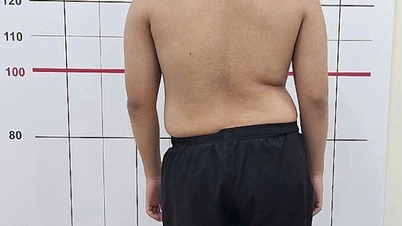
In a normal child, the spine is straight when viewed from behind; when viewed from the side, the spine is slightly curved in the back and slightly arched in the waist. If the child has scoliosis, when standing straight, the shoulders will sag on one side, the chest or the hip-lumbar region will protrude abnormally; the pelvis and hips may be high and uneven; the spine will be deviated to one side. When the child bends over, the protruding parts of the chest or hips will be more obvious.
This is a fairly simple early detection method that parents can check for their children themselves before taking them to see a specialist.
Some signs of hunchback are visible to the naked eye, while others are more subtle. Children often experience vague discomfort. Common symptoms include:
- A hump appears on the upper back.
- Abnormally high upper back when bending forward.
- Head always bowed forward.
- Excessively rounded shoulders.
- Uneven shoulder or shoulder blade height.
- Severe cases can cause pain, back stiffness, difficulty breathing, or muscle tension in the back of the thigh during movement.

Scoliosis and hunchback are quite common conditions in children today.
What should parents do?
When abnormalities are detected, the child should be taken to a medical facility for examination and timely treatment. To determine the degree of scoliosis, the doctor will order an X-ray to measure the curvature angle (Cobb angle). Based on this index and the risk of progression, the doctor may require the child to do rehabilitation exercises, wear a brace or, in severe and rapidly progressing cases, prescribe orthopedic surgery.
Prevent hunchback and scoliosis in children
- Adjust your sitting posture; choose a suitable desk and chair that is not too high.
- Use a chair or anti-hunchback support pad.
- Avoid letting children study on the bed or use the phone too much.
- Increase outdoor activities and sports ; ensure proper and adequate sleep according to each age.
Parents should take their children for a spinal examination every 6 months to screen and correct abnormalities early, reducing pressure on the spine and areas with incorrect posture.
Kyphosis and turtle neck are difficult to treat without early intervention. The more the spine develops, especially after the age of 15, the more difficult it is to correct compared to children.
In addition, parents need to establish a reasonable study and living regime, limiting the time children spend on electronic devices, even when studying online. Every 30-45 minutes of screen time, children should exercise to relax and improve their physical condition.
In addition, supplementing foods rich in calcium and vitamin D is essential for children's bone development during the rapid growth period.
Source: https://suckhoedoisong.vn/lam-gi-khi-tre-gu-lung-cong-veo-cot-song-do-dung-dien-thoai-qua-nhieu-169251203222505557.htm

![[Photo] General Secretary To Lam receives the Director of the Academy of Public Administration and National Economy under the President of the Russian Federation](/_next/image?url=https%3A%2F%2Fvphoto.vietnam.vn%2Fthumb%2F1200x675%2Fvietnam%2Fresource%2FIMAGE%2F2025%2F12%2F08%2F1765200203892_a1-bnd-0933-4198-jpg.webp&w=3840&q=75)

























































































Comment (0)