

On November 2, Master, Doctor, Specialist II Dang Khai Minh - Department of Trauma and Orthopedics, Children's Hospital 1 (HCMC) said that the hospital has just coordinated with the HCMC Trauma and Orthopedics Hospital to perform two-stage scoliosis surgery for two children with very severe scoliosis, who had been rejected by many specialized hospitals due to the high risk.
Correcting scoliosis of more than 100 degrees for 2 children
The first case is MNCL (12 years old, residing in Hoc Mon district). The patient's scoliosis progressed abnormally quickly. At the time of surgery, the child had two large curves, the main curve was 104 degrees and the second curve was 80 degrees. During the 7 months waiting for surgery, the spinal structure continued to deform rapidly and severely.
L.'s mother said: "My child has had many congenital diseases since childhood such as myasthenia gravis, genetic disorders and developmental delays. He started showing signs of scoliosis early on, but the family did not think the disease would progress so quickly. Two years ago, the doctor advised a spinal examination and discovered severe scoliosis. Although he had been treated in many places, his scoliosis became more and more severe, so the family decided to take him back to Children's Hospital 1 for treatment."
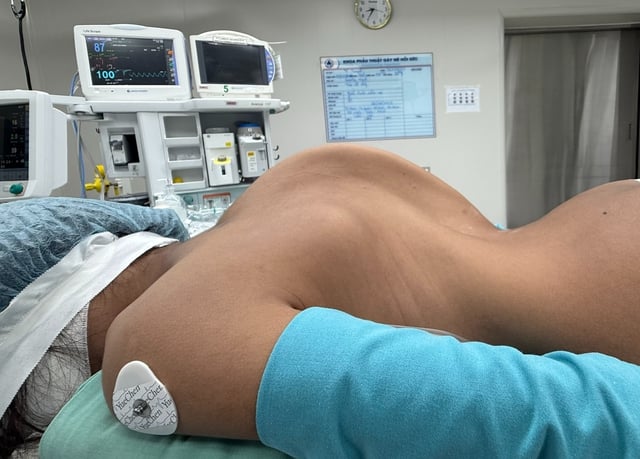
When admitted to Children's Hospital 1, the patient had a 128-degree scoliosis and a 108-degree hunchback. Photo: BSCC.
According to Master, Doctor, Specialist II Dang Khai Minh, the worrying thing is that baby L. has a very severe scoliosis on the basis of myasthenia gravis, accompanied by a gene mutation that causes malignant hyperthermia, a condition that is very dangerous when under anesthesia. If not operated on, the spine will continue to rapidly curve, compressing the spinal cord, with a very high risk of paralysis and respiratory failure. However, surgery for the child faces many risks and can be life-threatening.
Before the surgery, the hospital organized a hospital-wide consultation and coordinated with multiple hospitals and specialties, including the support of the Ho Chi Minh City Orthopedic and Trauma Hospital, Children's Hospital 1, the Anesthesia and Resuscitation Department and related units.
To prevent complications, the team prepared many treatment scenarios, especially a plan to prevent malignant high fever, mobilized all special drugs from the city and stored them in the operating room before performing surgery.
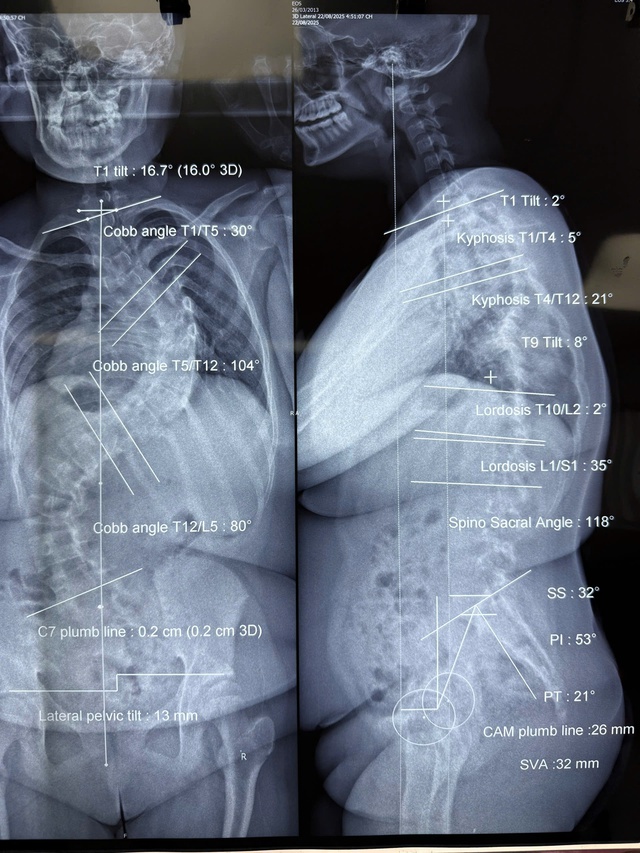
Spinal condition of MNCL patient before surgery. Photo: BSCC.
Doctor Phan Huynh Bao Nghi said: "Patient L. carries a gene mutation that causes malignant high fever. When malignant fever breaks out, the possibility of cure is almost very low, so preparation to prevent complications is extremely important. We must eliminate all factors that can trigger the fever, develop response scenarios, prepare adequate specific drugs and treatment plans to reduce the risk of complications to the lowest level."
The surgical team included Associate Professor, Dr. Vo Quang Dinh Nam - Head of the Department of Pediatric Orthopedics, Ho Chi Minh City Orthopedic Hospital, directly performing the surgery with the spinal surgery team of the Department of Orthopedics, Children's Hospital 1, closely coordinating with the Department of Anesthesia and Resuscitation.
According to the original plan, the surgery was scheduled to be performed in one phase. However, during the surgery, the doctor noted that the patient's hands and feet began to swell due to loose muscles, making direct manipulation unsafe. Therefore, the team decided to switch to a two-phase surgery, closing the incision and applying weights for 2-4 weeks to stretch the spine, creating favorable conditions for the next surgery.
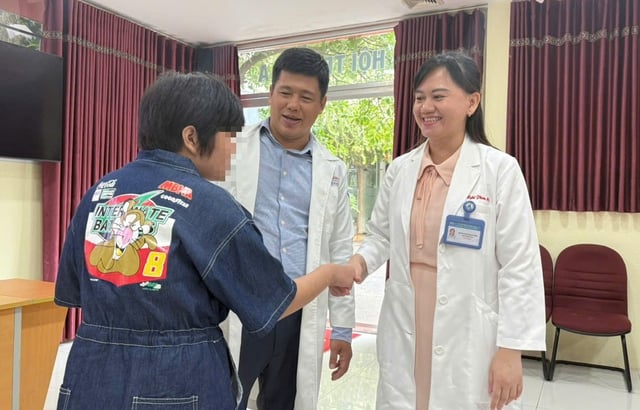
MNCL patients are healthier and happier after surgery.
After three weeks of weightlifting, patient L. underwent a second surgery. The second surgery went smoothly and was a success after 7 hours. Notably, during the anesthesia process, the patient did not experience a malignant high fever as initially feared.
The second case is YT (13 years old, Quang Ngai ), when admitted to Children's Hospital 1, the child had a 128 degree curvature and 108 degree hunchback.
The baby’s mother said that her baby was born completely normal, but at the age of 3, she had a fever and pneumonia, and then began to show signs of scoliosis. The family was poor, so they took her to a local clinic and she was diagnosed with scoliosis. At that time, the baby was not in pain and was able to function normally, but could only sleep in a side-lying position.
Doctors determined that this was a very severe scoliosis condition, with a risk of paralysis if the correction was incorrect. The surgical team decided to perform a two-stage surgery on the patient. However, the patient only weighed 26 kg, so he needed nutritional support to qualify for surgery. After 3-4 months of nutritional treatment, his weight increased by 3 kg, qualifying him for intervention. Finally, the 5-hour surgery was a success.
According to Dr. Phan Huynh Bao Nghi, the biggest risk for baby YT is respiratory and cardiovascular failure after surgery. Thanks to the application of the ERAS program (multidisciplinary care before, during and after surgery), the baby's respiratory and motor functions have improved significantly.
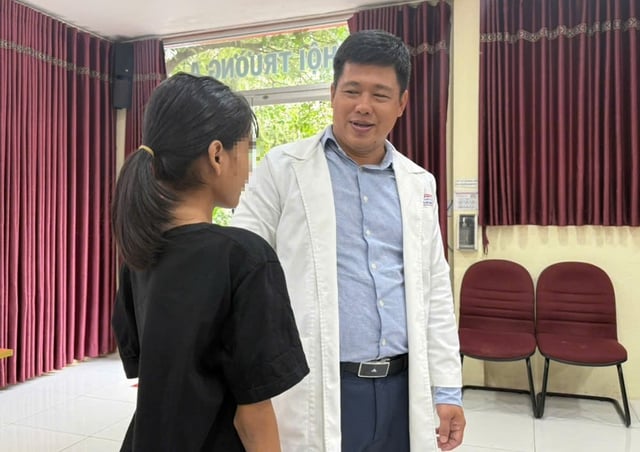
The patient is now stable, walking normally and growing 10cm taller.
Master, Doctor, Specialist II Dang Khai Minh said that after the surgery, the child grew 10 cm taller, walked normally, had balanced shoulders and hips, was happier, and confidently returned to school.
Idiopathic scoliosis: A dangerous disease in puberty
Dr. Minh said that idiopathic scoliosis is a common form of the disease, which cannot be prevented and often starts when children enter puberty. If not detected and treated promptly, the condition can progress rapidly.
Intervention levels are classified according to the degree of curvature, below 20 degrees mainly physical therapy; from 20-35, 40 degrees need to wear a brace and exercise under specialist supervision; above 40-45 degrees consider surgery; and above 50 degrees almost always require surgery.
If screened and detected early, children can be treated with braces and physical therapy, avoiding surgery. However, most screening in children is done mainly by school health workers , but school health workers and doctors are not specialized enough to examine and detect the disease. Therefore, when parents suspect their child has scoliosis, they should take the child to a specialized hospital for examination and accurate assessment.
Early detection signs for parents are that the baby has shoulder deviation, meaning one shoulder is higher than the other, or the back has a deformed lump.
Source: https://suckhoedoisong.vn/hanh-trinh-nan-lai-xuong-song-khung-long-cho-hai-be-gai-169251202153031997.htm


![[Photo] Parade to celebrate the 50th anniversary of Laos' National Day](/_next/image?url=https%3A%2F%2Fvphoto.vietnam.vn%2Fthumb%2F1200x675%2Fvietnam%2Fresource%2FIMAGE%2F2025%2F12%2F02%2F1764691918289_ndo_br_0-jpg.webp&w=3840&q=75)

![[Photo] Worshiping the Tuyet Son statue - a nearly 400-year-old treasure at Keo Pagoda](/_next/image?url=https%3A%2F%2Fvphoto.vietnam.vn%2Fthumb%2F1200x675%2Fvietnam%2Fresource%2FIMAGE%2F2025%2F12%2F02%2F1764679323086_ndo_br_tempimageomw0hi-4884-jpg.webp&w=3840&q=75)





































































Comment (0)