

In Phja Chang hamlet, Quang Uyen commune, next to a small stilt house, Mr. Nong Minh Tuan, one of the artisans still works hard at the forge, hoping to preserve the traditional forging techniques of the Nung An people. Having been involved in the profession for nearly 30 years, witnessing many changes as modern life and industrial products appear everywhere, Mr. Tuan cannot help but worry.
Thanks to the perseverance of artisans like Mr. Tuan and the attention and support of the government, the blacksmithing profession in Phja Chang has gradually revived and become an attractive destination for tourists. Mr. Tuan shared: What I hope most is that the blacksmithing profession of the Nung An people will be passed on to the next generation. Preserving the profession means preserving the identity and if done well, the profession will also help people have more livelihoods right in their homeland. In particular, many young people come to the village to see the blacksmithing process, buy traditional products and start to come back to learn the profession.

Mr. Tuan's story is just a slice of the larger picture of identity preservation in the province. In fact, in the context of deep integration, the culture of ethnic minorities in Cao Bang faces many challenges of modern lifestyle, causing traditional customs and cultural identity to gradually be forgotten, elderly artisans to become increasingly rare, while resources for preservation are limited. Many festivals, melodies, and traditional craft villages only exist in the memories of the elderly.
In Thanh Cong commune, the biggest concern of the people is how to preserve the cultural soul through traditional costumes. Ms. Ly Thi Moi, 73 years old, Dao Tien ethnic group shared: In the past, hand-embroidered costumes were used by Dao Tien people every day, each pattern had a sacred meaning. But now, most women in the village only wear them on holidays and Tet; the young generation almost no longer knows how to embroider. Today's youth are exposed to a lot of technology and modern lifestyles, seeing traditional costumes as "cumbersome", not knowing who will remember the ancient embroidery patterns of the Dao people.
The concerns of Mrs. Moi and the local people are also challenges for the local government. Thanh Cong Commune People's Committee proactively intervened, creating more motivation for cultural preservation work. Vocational training classes are organized periodically, specialized seminars on preserving identity are implemented for each household group, along with support resources for preservation projects, thereby rekindling the cultural source in the community.
Thanks to these efforts, the commune still maintains important footholds in cultural preservation. Currently, the whole commune has 18 elderly artisans who are preserving hand embroidery techniques and many valuable indigenous knowledge. Notably, about 340 households are still attached to the craft of making traditional costumes, considering it not only a livelihood but also a way to maintain the craft for future generations.
Head of the Department of Culture and Society of Thanh Cong Commune, Trieu Thi Kim Anh, said: The biggest difficulty now is connecting generations and resources. There needs to be a mechanism to adequately support artisans so that they can make a living from their profession, thereby motivating young people to be passionate about traditional crafts. If only relying on enthusiasm, teaching will not be sustainable. In addition, more funding is also needed to carry out projects to survey, record and digitize heritages that are on the brink of disappearing.

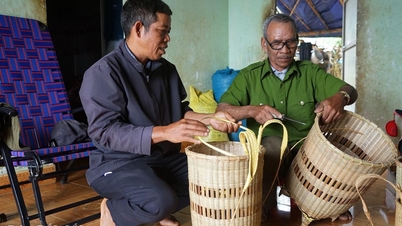
Regarding handicrafts, the whole province currently has about 70 traditional handicraft heritages. Besides some of the Nung An's crafts that are still well maintained such as: blacksmithing, incense making, paper making, many other crafts are threatened with extinction due to the difficulty in competing with mass-produced products, eye-catching designs and low prices. Crafts such as: brocade weaving, silver carving... are all in a state of serious decline.
Faced with that situation, the province issued a plan to implement breakthrough contents on sustainable tourism and service development for the period 2022 - 2025. On that basis, many activities of teaching and preserving heritage have been deployed synchronously. Up to now, the province has organized 6 classes to teach Lo Lo ethnic language; 4 classes to teach weaving; 4 classes to teach weaving, indigo dyeing and embroidery; and 53 classes to teach folk songs, Then singing, Tinh lute, attracting over 400 students to participate.
Efforts to preserve and promote indigenous culture associated with community tourism have brought about clear results, at experience points such as: Phja Thap incense village, Pac Rang blacksmith village, Dia Tren paper village, Giuong village, Hoai Khao, Khuoi Ky... increasingly attracting a large number of tourists. In just the first 10 months of 2025, Cao Bang welcomed more than 2.4 million visitors (up 59.4%), international visitors increased by 193.1%, revenue reached 2,390 billion VND (up 106%).
Deputy Director of the Department of Culture, Sports and Tourism Nong Thi Tuyen affirmed: The consistent viewpoint of the industry is that "preservation must go one step ahead", tourism exploitation can only be carried out on the basis of preserving indigenous culture and respecting the ownership of local communities. In recent times, the industry has synchronously deployed many projects and scientific research to preserve and promote the value of cultural heritage in the province. All tourism activities associated with heritage must have the consensus and direct participation of the community to ensure authenticity and identity. Along with that, focus on teaching the younger generation, supporting artisans, developing models of conservation, restoring festivals and strengthening supervision to avoid any manifestations of distortion and commercialization of heritage.
Preserving cultural identity is a collective journey, where artisans, people, communities and the government join hands to preserve traditional values. In the context of integration, culture is not only preserved but also becomes a resource connecting the community, creating a driving force for sustainable development and deepening its own mark, bringing pride to every Cao Bang person.
Source: https://baocaobang.vn/bao-ton-ban-sac-van-hoa-trong-thoi-ky-hoi-nhap-3182722.html


![[Photo] Parade to celebrate the 50th anniversary of Laos' National Day](/_next/image?url=https%3A%2F%2Fvphoto.vietnam.vn%2Fthumb%2F1200x675%2Fvietnam%2Fresource%2FIMAGE%2F2025%2F12%2F02%2F1764691918289_ndo_br_0-jpg.webp&w=3840&q=75)
![[Photo] Worshiping the Tuyet Son statue - a nearly 400-year-old treasure at Keo Pagoda](/_next/image?url=https%3A%2F%2Fvphoto.vietnam.vn%2Fthumb%2F1200x675%2Fvietnam%2Fresource%2FIMAGE%2F2025%2F12%2F02%2F1764679323086_ndo_br_tempimageomw0hi-4884-jpg.webp&w=3840&q=75)















![[Video] Protecting World Heritage from Extreme Climate Change](https://vphoto.vietnam.vn/thumb/402x226/vietnam/resource/IMAGE/2025/12/03/1764721929017_dung00-57-35-42982still012-jpg.webp)












































Comment (0)