

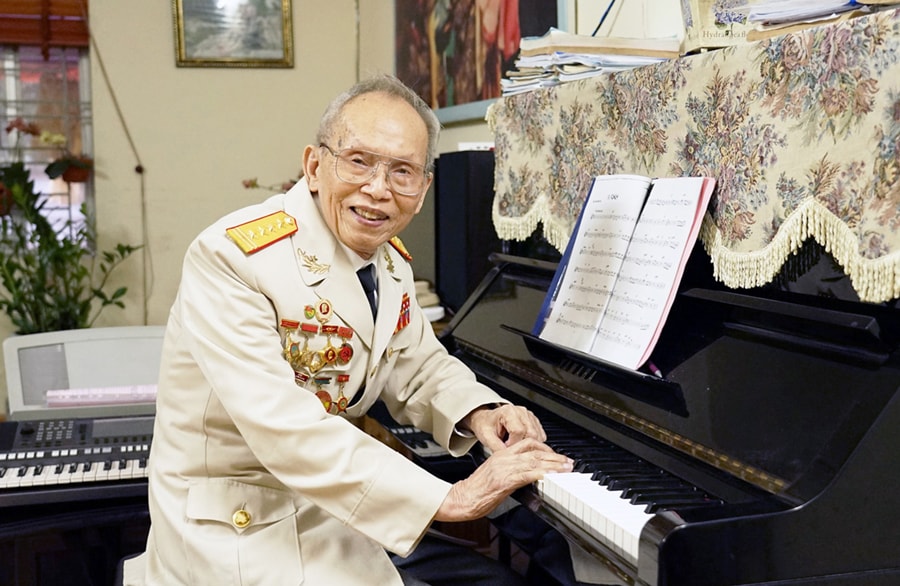
Army musician
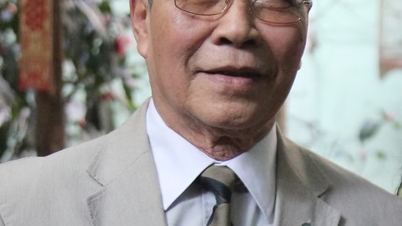
In the Mai Dịch residential area (Hanoi), many people know the family of musician Huy Thục. At 93 years old, the musician and army colonel, though weaker than before and unable to remember many details, still clearly displays the calm and dignified demeanor of a seasoned soldier, along with the gentle touch of an artist who dedicated his life to music .
Composer Huy Thục, whose full name is Lê Huy Thục, was born in 1933 in Lý Nhân, Hà Nam (now Ninh Bình province) and grew up in Hanoi . During the August Revolution of 1945, he joined the Children's National Salvation Team on Mai Hắc Đế street. In 1946, he enlisted in Company 1, Battalion 105, fighting in Nam Định.
Thanks to his musical talent, he was sent to study violin, then worked at the Military Arts Troupe of Military Region 3 and the General Political Department's Arts Troupe. From 1954 to 1956, he worked at the Right Bank Military Region Arts Troupe, and later became one of the first students in the composition class of the Vietnam Music School (now the Vietnam National Academy of Music). After a while, he was sent to study at the Liszt Conservatory in Hungary. Upon returning to Vietnam, he taught at the Military Arts School (now the Military University of Culture and Arts).
During the war against the US to save the country, composer Huy Thuc went to the battlefield, traveling along Ha Tinh - Quang Tri - Hue, composing and performing for the soldiers and people, while also participating in combat and agricultural production. After the country was unified, the composer continued his artistic activities, teaching, and leading the Song and Dance Troupe of the General Political Department (Vietnam People's Army). He was a member of the Executive Committee of the Vietnam Musicians Association, terms III and IV.
Composer Huy Thục has a legacy of over 450 works in various genres. His songs are closely associated with the fighting life and daily activities of soldiers, leaving a deep impression on the public. Notable examples include: "The Trumpet for Battle" (poem by Tô Đức Chiêu), "The Song on the Homeland Road," "Oh, La La Stream," "The Sound of the Ta-lư Guitar," "Forward, Soldiers and Compatriots" (set to a poem by Hồ Chí Minh), "Uncle Ho is Marching with Us," "Waiting" (poem by Vũ Quần Phương)...
Regarding instrumental works, he wrote the zither solo "For the South," and the traditional drum solo "Rhythm of the Homeland." He composed the choral piece "Hail to the Soldiers of Dien Bien," music for the ballet "The Flame of Nghe Tinh" (written with composers Nguyen Thanh and Luong Ngoc Trac), "Advance to Achieve Total Victory" (Chapter I)... In addition, he also wrote music for stage and film, published anthologies and albums…
For his outstanding contributions to Vietnamese revolutionary music, composer Huy Thục was awarded the State Prize for Literature and Arts (first round), the Second Class Order of Military Merit, the Third Class Order of Independence, and many other prestigious medals and awards. His ballet "The Flame of Nghe Tinh" (music co-written) received the Ho Chi Minh Prize for Literature and Arts.
Going to the front lines to serve in the fierce battle.
In his creative journey, the time spent on the battlefield left the deepest mark on the memory and music of composer Huy Thuc, and it was also the period when he created many songs that had a strong impact on Vietnamese music. Composer Huy Thuc shared that in December 1964, after finishing the music composition for the ballet "The Flame of Nghe Tinh," he decided to put aside large-scale composition projects to go to the front lines and directly write songs to serve the intense fighting taking place.
His journey into the battlefield began with harsh experiences. Arriving in Ha Tinh, witnessing a fierce bombing raid and the devastating losses, he couldn't sleep. Coincidentally, he read the poem "The Trumpet Call to Arms" by To Duc Chieu in an old magazine, set it to music, and immediately sang it for the officers and soldiers. The song was quickly recorded, broadcast, and spread throughout the front lines. This success further strengthened his resolve to continue venturing deeper into the battlefield and composing.
Composer Huy Thuc recounted that the more intense the war became, the more it spurred him to compose. When he arrived in Quang Tri, he wrote "The Song on the Homeland Road," depicting a soldier overcoming hardships and standing firm amidst bombs and bullets. At the Route 9 - Khe Sanh front, after the victory of Bui Ngoc Du's squad at the Nameless Hill, the image of the La La stream appeared in his mind like a vivid painting. In just two days, he completed "Oh, La La Stream." "I never imagined that the song I wrote on the front, immediately arranged for a small orchestra for the mobile performing arts troupe to perform continuously, would be so beloved by the soldiers on Route 9, who sang it loudly wherever they went," composer Huy Thuc confided.
One of the most profound milestones during this period was the creation of "The Sound of the Ta-lu Guitar." After witnessing the sacrifice of an engineering company, overwhelmed with grief, composer Huy Thuc took up his pen to compose. He said that he had to write an optimistic song so that everyone could overcome their loss. Drawing inspiration from Van Kieu folk songs, the bright and cheerful song was born. "Even though the enemy wanted to crush life here, amidst the ferocity, optimism still sprouted and flourished on Highway 9 - Khe Sanh," the composer shared. The song was completed on September 6, 1967, right on the battlefield. At the end of 1968, "The Sound of the Ta-lu Guitar" was performed before President Ho Chi Minh, with a performance by People's Artist Tuong Vi. For this song, composer Huy Thuc was awarded the Second Class Military Merit Medal.
Following that inspiration, he continued to write "The Gio An Heroic Regiment," "Train Stations and Train Journeys," "The Revolutionary Militia," "I Am a Soldier Supporting the Troops," "Come and See My Squad Fighting the Americans," "Vehicles Entering the Battlefield," "The Pa Ko Girl Carrying Ammunition"... In preparation for the 1969 Lunar New Year, he set to music the song "Forward, Soldiers and Compatriots" from President Ho Chi Minh's New Year's greeting poem.
In particular, the song that left a great mark on the songwriting career of composer Huy Thuc is "Uncle Ho is Marching with Us," with its heroic melody, expressing the fervent spirit of the victorious army, vowing to forever follow the revolutionary path of the Party and Uncle Ho: "Tonight on the march to the front lines / Countless troops advance along Uncle Ho's path / Thousands of flowers of victory bloom, we offer to Him / We offer to the Party all our shining faith."
Composer Huy Thục recounted that on the day President Ho Chi Minh passed away, the entire land was drenched in tears. After accompanying a delegation of military musicians to pay their respects to President Ho, he returned to the battlefield and witnessed the soldiers overcoming their grief, firmly holding their weapons, and maintaining their fighting spirit. This inspired him to compose the song "President Ho is Marching with Us." The song quickly became widely popular throughout the country and is one of the 10 prescribed songs in the People's Army (now 15 songs).
"My songs were born from the pain and pride of soldiers on the front lines. These are songs written with blood, with the sacrifices that the entire nation has experienced. I would never have been able to create those songs without the years I spent with soldiers on the battlefield," affirmed composer Huy Thuc.
Composer Huy Thuc is currently living happily with his extended family, where the values he accumulated throughout his life are passed down to future generations. His musical legacy is not only comprised of works associated with a time of "fire and glory," but also a lasting source of inspiration, contributing to the nurturing and dissemination of revolutionary cultural and artistic values in contemporary life.
Source: https://hanoimoi.vn/nhac-si-huy-thuc-va-nhung-ca-khuc-di-cung-nam-thang-747831.html
![[Image] Hanoi's urban life under the challenge of a "scorching hot" environment](https://vphoto.vietnam.vn/thumb/1200x675/vietnam/resource/IMAGE/2026/05/25/1779706979265_nang-nong-t5-2026-minh-duy-7-4636-jpg.webp)


![[Image] Close-up view of the interchange connecting the two expressways and Long Thanh Airport.](https://vphoto.vietnam.vn/thumb/1200x675/vietnam/resource/IMAGE/2026/05/25/1779703378210_ndo_br_z7863716673926-224453a31600126cce10622af6290afd-4549-jpg.webp)





















































Comment (0)