

Speaking with a reporter from Dan Viet newspaper, Phoebe Tran revealed the trends, how to choose schools, and her experience in winning scholarships to study in the US in 2025.
Phoebe Tran (Tran Mai Phuong), the female MC of one of Vietnam's top-rated English teaching and experience-sharing programs on VTV - IELTS Face-off, is currently the director of an organization specializing in advising students on studying in the US, with 10 years of experience in 30 countries.
In an interview with Dan Viet newspaper, Phoebe Tran revealed the trends, how to choose a school, and her experience in winning scholarships to study in the US in 2025. According to her, studying in the US has always been a top choice for many Vietnamese students due to its high-quality education , diverse range of academic programs, and relatively wide job opportunities.
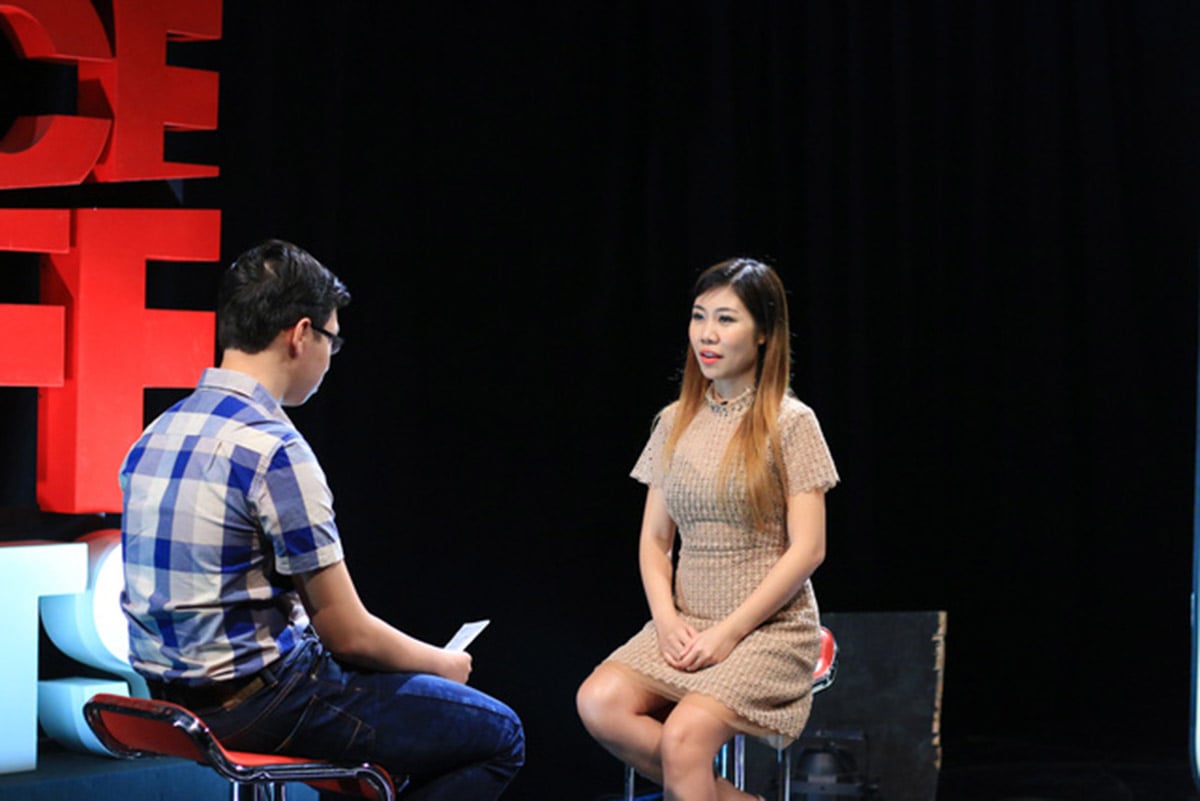
Phoebe Tran speaks four foreign languages and is the host of a popular English-language program on VTV. Photo: Provided by the interviewee.
Trends in studying in the US in 2025
2025 is predicted to continue to be a competitive year for admissions to American universities. Key trends include:
Comprehensive review of applications: Besides the most important factor, academics, schools also value two other factors in applicants: leadership ability, soft skills, and personal qualities demonstrated through essays, letters of recommendation, and interviews, if any.
The competition for admission to top universities is increasingly fierce: Over the past 10 years, acceptance rates at top US universities have declined significantly. For example, Harvard's acceptance rate has fallen from 6% in 2014 to 3.4% in 2024. Similarly, Yale's has dropped from 7.1% to 4.5%, and Columbia's from 7.4% to 3.9%. This reflects the increasingly intense competition, especially for international students.
Studying in the US offers attractive job opportunities: Graduates from American universities have a significant advantage in the global job market. Statistics show that the average starting salary for graduates from Ivy League universities is $85,000-$120,000 per year. Large technology corporations like Google, Amazon, and Microsoft frequently recruit with average salaries of $100,000-$150,000 per year for entry-level positions in engineering and technology fields.
The field of study determines career potential and salary: According to data from the U.S. Bureau of Labor Statistics, Vietnamese students graduating in STEM ( Science , Technology, Engineering, and Mathematics) fields in 2023 had an average annual income of approximately $116,000, significantly higher than the average of $62,000 for other fields. The figure for business graduates was $104,000. This clearly demonstrates the ROI (return on investment) when investing in higher education in the United States.

Phoebe Tran stated: Studying in the US has always been a top choice for many Vietnamese students due to its high-quality education, diverse range of academic programs, and relatively wide job opportunities. (Photo: Provided by the interviewee)
Group of schools and costs of studying in the US
The American higher education system is diverse, with different groups of schools catering to the academic needs and financial capabilities of each student.
Private universities: These include the renowned Ivy League schools and other prominent names such as Stanford, MIT, and the University of Chicago. Top private universities offer a flexible, high-quality academic environment, with relatively high tuition fees. The cost of studying (including room and board, books) ranges from $80,000 to $90,000 per year.
However, many private schools have strong financial aid policies for international students. On average, top private universities provide international students with financial aid ranging from $50,000 to $70,000 per year.
Public Universities: Some prominent public universities include UC Berkeley, UCLA, and the University of Michigan. These universities have tuition fees ranging from $30,000 to $70,000 per year, depending on the university's ranking. Most public universities do not offer financial aid to international students, and scholarship opportunities are limited. Parents and students applying to public universities must be prepared to pay the full tuition and living expenses for four years.
Liberal arts colleges: Focus on liberal arts education, suitable for students who want to study multiple disciplines, examples include Amherst College and Williams College. Costs range from $50,000 to $90,000 per year; however, liberal arts colleges offer very high levels of financial aid. If students want to study at smaller institutions with ample space for direct interaction with professors and require substantial financial support, this is a sensible option.
Community colleges: A cost-effective option, with tuition ranging from $5,000 to $10,000 per year. Students can transfer to major universities after two years of study.
Advice on opportunities to win scholarships to study in the USA.
Studying in the US doesn't have to be expensive if students know how to find and prepare for scholarship and financial aid opportunities.
First, it's important to understand the difference between scholarships and financial aid. There are two types of aid: merit-based scholarships. The school will evaluate a student's application, and if they see a high-achieving, competitive student, they may offer a scholarship even if the student doesn't request it, increasing the student's chances of choosing to study at the school.
Financial aid is based on need. The school will assess the necessary costs of attending the school, subtract the amount the family can afford, and then determine the amount of financial assistance the student needs. The school will then provide this money to the student so they can continue their education.
Financial aid is further divided into two types: "need-blind" and "need-aware." Need-blind: Admission is not based on financial ability. The need for financial aid does not affect a student's chances of admission. Schools that use need-blind include Harvard, Brown (starting Fall 2025), Princeton, Dartmouth, MIT, Amherst College, Bowdoin College, and Pomona College. Students are highly encouraged to apply for financial aid when applying to these schools.
Need-aware: Admissions based on financial ability. A student's need for financial aid affects their chances of admission. Simply put, between two students of equal ability, the admissions committee may prioritize the student who needs less financial aid.
The question is, what do you need to do to get a scholarship or receive good financial aid for an American university?
There are no shortcuts; students need to work hard to build an outstanding and exceptional application. Admissions committees will consider scholarships during the application review process. And as mentioned above, schools will also consider whether a student is truly exceptional when considering financial aid. So, what are the elements that make an application capable of winning the hearts of admissions committees?
According to Crimson Education, a specialized US study abroad consulting organization, there are three main factors. Students start their journey early. Admissions committees will evaluate all of a student's activities over the four years from grades 9 to 12. Therefore, they will know the difference between a student who procrastinates until the last minute and one who plans and executes early on.
The application tells a clear story: A common mistake many students make when preparing their applications is simply copying what their friends are doing, resulting in disjointed and unconnected activities in the application; admissions committees are left with only a vague impression after reading it.
Instead, students need to identify early on what direction they want to pursue and who they want to present to the admissions committee. For example, if you want to tell the story of "I am a female student interested in STEM fields and want to help other girls enter this field," then your extracurricular activities should include projects supporting female students in accessing computer science, and your chosen courses should include Computer Science and Mathematics. If you want to tell the story of "I want to pursue Architecture to create designs that protect against natural disasters," then your extracurricular profile should focus on architecture and the environment, and awards related to this direction are a plus.
Seek support from those who have gone before: Finally, to increase their chances of success, students should seek support from those with experience in studying in the US.
"2025 marks many changes in the trend of studying in the US, requiring Vietnamese students to be well-prepared and have a clear strategy. Choosing the right group of schools, considering costs, and seizing scholarship opportunities will be key to helping students realize their dream of studying in the United States," said Phoebe Tran.
Phoebe Tran is a " Hanoi girl" but by the age of four, she had lived with her family in the United States, Canada, and Switzerland. She has received scholarships such as: the ASEAN Scholarship (2003-2008) - a scholarship program funded by the Singaporean government for nine Southeast Asian countries for secondary, high school, and university education; and a scholarship from the University of Micro Chemistry (2008-2012).
Having studied in many countries and earned numerous degrees, the female MC returned to Vietnam in 2012 and has remained there ever since. Currently, in addition to hosting programs, Phoebe is involved in business and various other activities related to culture and education.
Source: https://danviet.vn/nu-mc-biet-4-ngoai-ngu-cua-chuong-trinh-tieng-anh-hot-บน-vtv-nhieu-thay-doi-trong-xu-huong-du-hoc-my-2025-20241222105120898.htm

























![[Photo] Reception to welcome General Secretary and President To Lam and his wife on their State visit to the Philippines](https://vphoto.vietnam.vn/thumb/1200x675/vietnam/resource/IMAGE/2026/06/01/1780295488620_vna-potal-chieu-dai-chao-mung-tong-bi-thu-chu-tich-nuoc-to-lam-va-phu-nhan-tham-cap-nha-nuoc-toi-philippines-8798060-7855-jpg.webp)







































































Comment (0)