General Secretary Nguyen Phu Trong's contributions to the Party's theoretical development on human rights.
VietNamNet•31/07/2024
The General Secretary 's views will continue to be an important source of inspiration and guidance for human rights activities in the new era.
Throughout his life and career, General Secretary Nguyen Phu Trong has made profound contributions to the Party's theoretical development on human rights. His views will continue to be an important source of inspiration and guidance for human rights activities in the new era.
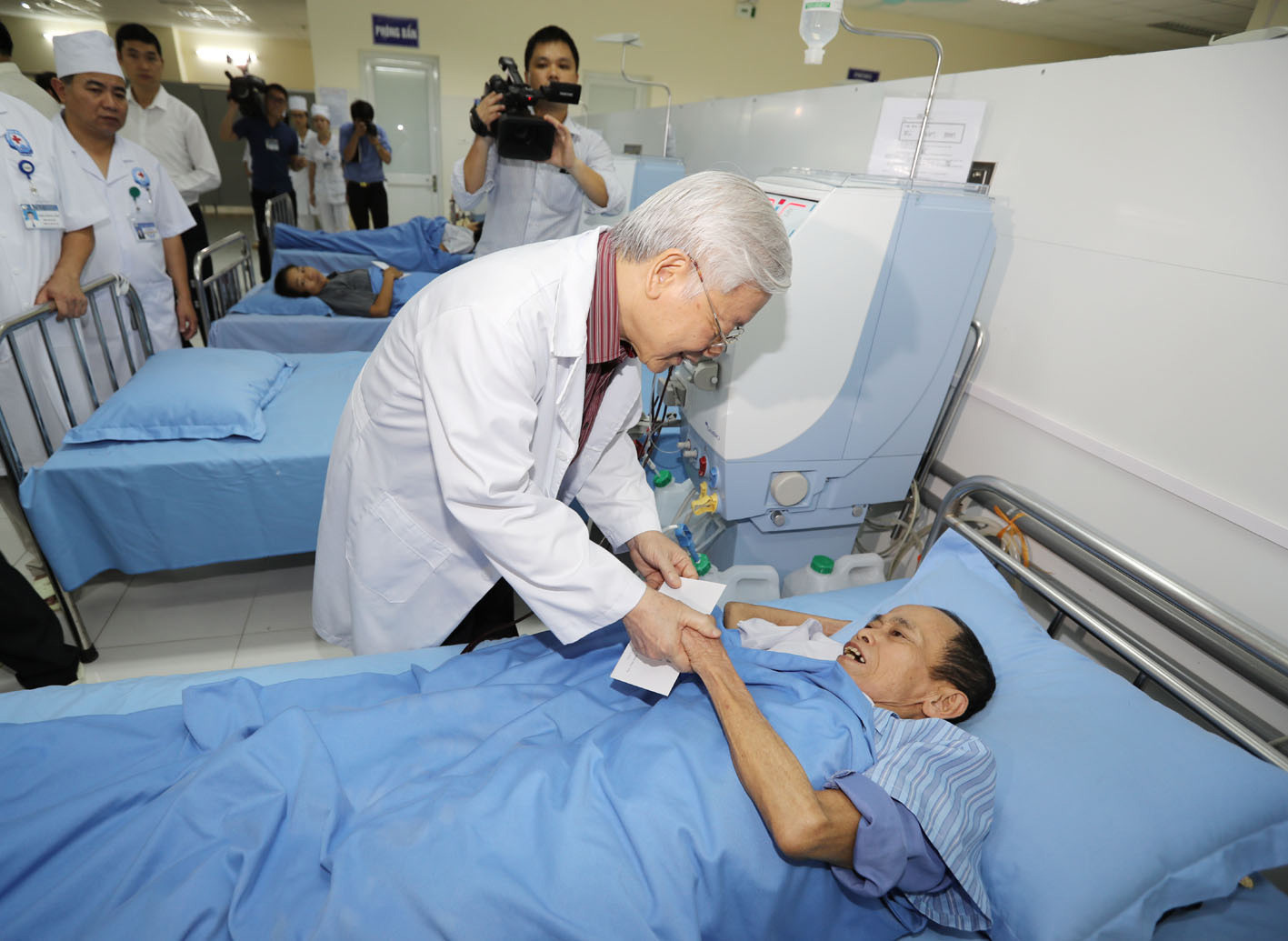
General Secretary Nguyen Phu Trong visits and presents gifts to patients receiving treatment at the Hemodialysis Department of Bac Kan Provincial General Hospital. Photo: Archival material.
1. Human rights are sacred and noble values of every nation, people, and all of humanity. In the history of the Communist Party of Vietnam , it wasn't until the establishment of the United Nations in 1945, the adoption of the Universal Declaration of Human Rights in 1948, and the establishment of international standards on human rights in the civil, political, economic, social, and cultural spheres, as well as the rights of vulnerable groups in society, that the Party adopted a perspective on human rights. From its very beginning, in the documents of the Party's founding conference in February 1930 (the Party's brief political program), the Party already set forth the principle of a bourgeois democratic revolution and an agrarian revolution to move towards a communist society. Socially, this would mean the freedom of the people to organize; gender equality; and universal education based on the worker-peasant model.
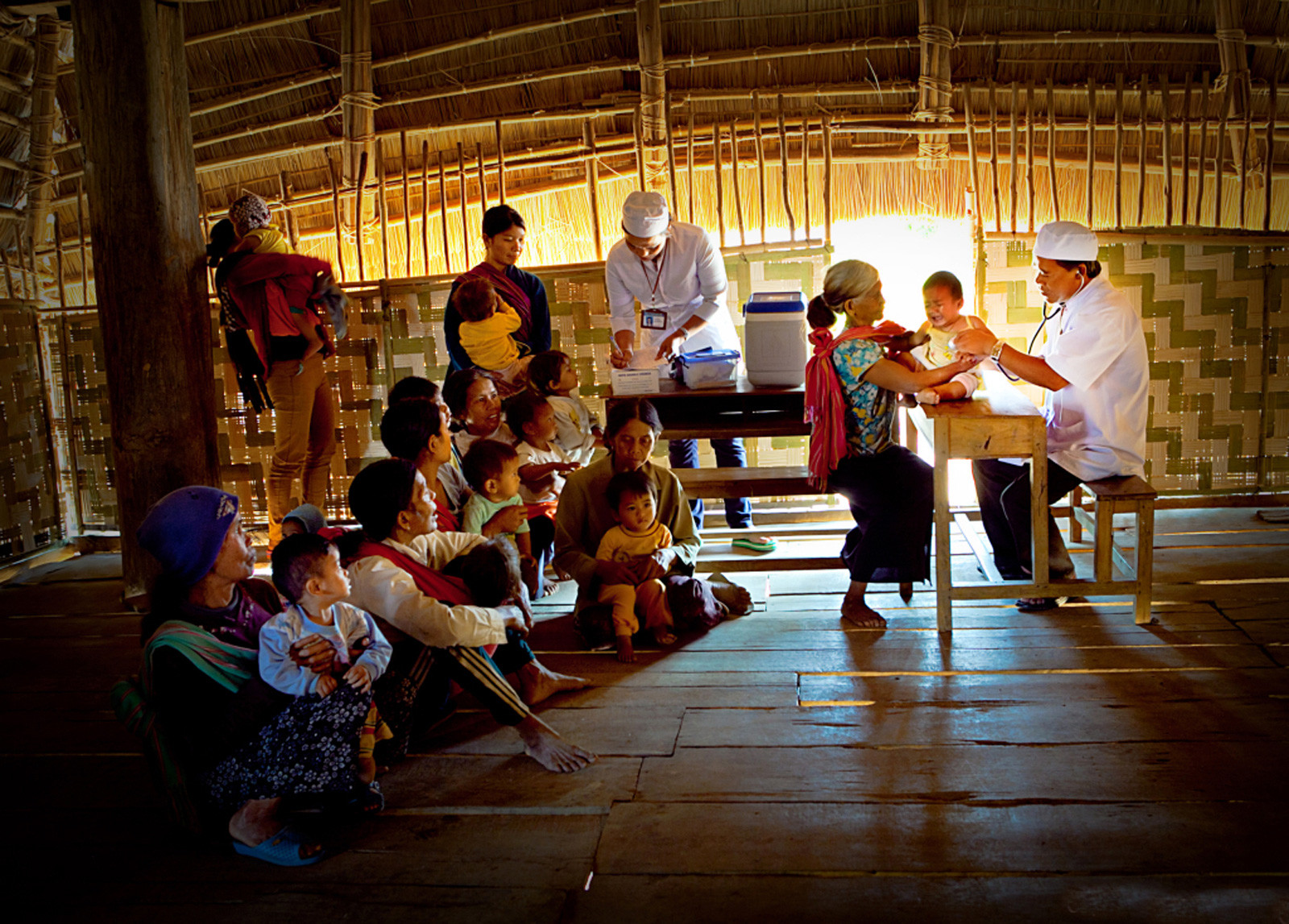
Following the success of the August Revolution in 1945, core human rights principles and values, such as the right to equality, the right to life, the right to liberty, and the right to the pursuit of happiness, as stated in the American Declaration of Independence of 1776 and the French Declaration of Human Rights and Citizen Rights of 1789, were proclaimed by President Ho Chi Minh in the Declaration of Independence that established the Democratic Republic of Vietnam in 1945. These core human rights values were incorporated into the first constitution of the new state – the 1946 Constitution. After completing the national democratic revolution, the entire country moved towards socialism. The Sixth National Congress of the Party (1986) marked a historical turning point when the Party formulated a comprehensive reform policy, leading the country through difficulties and challenges. Although the concept of human rights was not explicitly stated in the Party's Sixth Congress documents, the viewpoint that "Along with caring for the people's lives, state agencies must respect and guarantee the civil rights stipulated in the Constitution" and "...ensure the genuine democratic rights of the working people, while resolutely punishing those who violate the people's right to self-governance" has been established. After nearly 40 years of implementing the reform policy, building a socialist-oriented market economy, a socialist rule of law state of the people, by the people, and for the people, practicing socialist democracy, and actively and proactively integrating into the international community, the Communist Party of Vietnam has built a fundamental and comprehensive system of theoretical viewpoints on the issue of human rights, respecting, guaranteeing, and protecting human rights. The theoretical viewpoints on human rights of our Party, as they exist today, have been built, developed, and perfected thanks to the great contributions of General Secretary Nguyen Phu Trong. 2. In his capacity as Chairman of the Central Theoretical Council, Chairman of the National Assembly of the Socialist Republic of Vietnam, and especially as General Secretary of the Communist Party of Vietnam (2011-2024), he directly participated in directing the summary of 25 years of implementing the reform policy, 20 years of implementing the Platformfor building the country during the transitional period to socialism (1991), Head of the Editorial Team for the documents of the 11th Party Congress and head of the subcommittee for Party documents (Documents of the 12th and 13th Party Congresses). Among the Party documents adopted during the reform period, the viewpoint on human rights is most clearly and comprehensively expressed in the Platform for building the country during the transitional period to socialism (Supplemented and developed in 2011) adopted at the 11th Party Congress. Along with the Party's previous views on human rights expressed in the Platform for Building the Country during the Transition Period to Socialism (1991), Directive No. 12-CT/TW, dated July 12, 1992, of the Central Party Secretariat on "The Issue of Human Rights and the Party's Viewpoints and Policies," and in the Documents of the 12th and 13th Party Congresses, the Communist Party of Vietnam has developed a comprehensive system of theoretical views on human rights in the period of reform and international integration. Firstly, during the reform period, the Party has determined: " Human beings are the center of the development strategy and the subject of development. Respecting and protecting human rights, linking human rights with the rights and interests of the nation and the people's right to self-determination." Continuing this viewpoint, the 13th National Congress of the Party further clarified it by stating: “The people are the center and the subject of the renovation, construction, and defense of the Fatherland; all policies and guidelines must truly stem from the lives, aspirations, legitimate rights, and interests of the people, taking the happiness and well-being of the people as the goal to strive for.” Secondly, “The State respects and guarantees human rights and civil rights; cares for the happiness and free development of each individual. Citizens' rights and obligations are stipulated by the Constitution and laws. Citizens' rights are inseparable from citizens' obligations.” Thirdly, linking respect for and protection of human rights with the role and responsibility of the socialist rule of law state stems from the nature of our State as a State of the people, by the people, and for the people; The State operates for the people, ensuring and implementing human rights.” Fourth, “Pay more attention to caring for the happiness and free, comprehensive development of people, protecting the legitimate rights and interests of people, respecting and implementing international human rights treaties that Vietnam has signed.” Fifth, “Implement human rights, fundamental rights and obligations of citizens, in the spirit of the 2013 Constitution (...) perfecting the legal system, respecting, ensuring and protecting human rights, rights and obligations of citizens.” Sixth, “building a clean and strong judicial system, protecting justice, respecting and protecting human rights” to “building a professional, fair, strict, honest Vietnamese judicial system that serves the Fatherland and the people.” Judicial activities must bear the responsibility of protecting justice, protecting human rights, citizens' rights, protecting the socialist regime, protecting the interests of the State, and the legitimate rights and interests of organizations and individuals. Seventh, “being ready to dialogue with relevant countries, international and regional organizations on the issue of democracy and human rights; proactively and resolutely fighting to thwart all conspiracies and actions that interfere in internal affairs, infringe upon the independence, sovereignty, territorial integrity, national security and political stability of Vietnam.” Eighth, ensuring human rights in the process of advancing towards socialism. General Secretary Nguyen Phu Trong believes that socialism is the best model to ensure and protect human rights. The General Secretary emphasized: “The socialist society that the Vietnamese people are striving to build is a society where the people are prosperous, the country is strong, democratic, just, and civilized; where the people are the masters; "A highly developed economy, based on modern productive forces and appropriate progressive production relations; an advanced culture rich in national identity; people enjoying a prosperous, free, and happy life, with conditions for comprehensive development; all ethnic groups in the Vietnamese community are equal, united, respect and help each other to develop together; a socialist rule of law state of the people, by the people, and for the people, led by the Communist Party; and friendly and cooperative relations with countries around the world." The General Secretary emphasized, "a society in which development is truly for the people, not for profit that exploits and tramples on human dignity. We need economic development coupled with social progress and justice, not an increase in the gap between rich and poor and social inequality." We need a compassionate, united, and mutually supportive society, oriented towards progressive and humane values, not an unfair competition where "the big fish eat the small fish" for the selfish interests of a few individuals and factions. Thus, the goal and aspiration of building a society where freedom and human rights are respected and guaranteed can only be achieved under socialism. Therefore, ensuring the realization of human rights in social life, the correct path today is to advance towards socialism. Medical examination for people of ethnic minorities. Photo: Archival material.3. Thoroughly understanding and fully implementing the Party's and General Secretary Nguyen Phu Trong's views on human rights in Vietnam in the current period is of particular importance in fostering the aspiration for a prosperous and happy nation. First and foremost , this is the view that people are the center, the subject, the goal, and the driving force of national development. This view must be thoroughly understood and implemented in the organization and operation of state agencies, officials, and civil servants; requiring that all development programs and policies focus on the beneficiaries of rights, namely the people. The legitimate rights and interests of the beneficiaries should be the basis for building and formulating national development policies; and the happiness and well-being of the people should be the highest goal in all activities of state agencies, officials, and civil servants. The national development orientation until 2030 aims for Vietnam to become a high-middle-income country, and the vision for 2045 is to become a developed, high-income country, with a determination to improve the quality of life for its people, especially the poor and those living in remote areas. To achieve this goal and vision, priority must be given to human development, maximizing the human factor in national development strategy planning; this requires improving the effectiveness of respecting, guaranteeing, and protecting human rights in the activities of state agencies and socio-political organizations. For the National Assembly, as the legislative body, it has the specific task of concretizing the Party's views, policies, and guidelines on human rights into legal regulations; it must continue to prioritize the development of laws on human rights, creating a legal basis for respecting, guaranteeing, and protecting human rights and citizens' rights. For the Government, the goal is to build a state administration that serves the people, is democratic, rule of law, professional, modern, clean, strong, open, transparent, and respects, guarantees, and effectively protects human rights. Secondly, economic growth must go hand in hand with achieving social progress and equity, guaranteeing and protecting human rights in every step, every policy, and throughout the entire development process. According to the General Secretary's viewpoint, it is: "We should not wait until the economy reaches a high level of development before implementing social progress and equity, nor should we 'sacrifice' social progress and equity to pursue mere economic growth. On the contrary, every economic policy must aim at social development; every social policy must aim to create momentum to promote economic development; encouraging legitimate wealth creation must go hand in hand with sustainable poverty reduction, caring for those who have rendered meritorious services, and those in difficult circumstances. We need to promote economic, cultural, and social development, constantly improving and enhancing the material and spiritual lives of the people, ensuring good social security and human security, paying attention to strategic and key areas, remote areas, and areas inhabited by ethnic minorities. We must effectively implement policies on religion, ethnicity, land, labor, etc.; especially policies for vulnerable groups in the market economy. Security policies..." Social policies must ensure that economic development is linked to social development, that economic policies are unified with social policies, and that economic growth goes hand in hand with the achievement of social progress and equity in every step, every policy, and throughout the entire development process. It is necessary to strengthen propaganda to ensure that all cadres, Party members, and the people fully understand the Party's and the General Secretary's views on social policies, and to implement social policies that guarantee and protect human rights. The inseparable relationship between individuals and individuals within communities, groups, and collectives must be ensured: each individual must have their rights and interests best protected; each individual and citizen must be considered the subject and central driving force of social policies. Strengthening propaganda, education, training, and fostering awareness of the role of social policies in guaranteeing and protecting human rights is crucial, and requires a correct understanding of the importance of a human rights-based approach and the guarantee of human rights in every development policy. From planning and policy implementation to organization and execution. Thirdly, linking respect for and protection of human rights with the role and responsibility of the socialist rule of law state. Resolution No. 27-NQ/TW, dated November 9, 2022, "On continuing to build and perfect the socialist rule of law state of Vietnam in the new period" continues the viewpoint that human beings are the center, goal, subject, and driving force of national development; the State respects, guarantees, and protects human rights and citizens' rights. It sets out the overall goal of the socialist rule of law state of Vietnam as upholding the Constitution and laws, respecting, guaranteeing, and effectively protecting human rights and citizens' rights; the goal by 2030 is to fundamentally complete the mechanisms for ensuring the people's right to self-governance, and guaranteeing and protecting human rights and citizens' rights. Fourthly, continue to improve the legal systemon guaranteeing and protecting human rights, and the rights and obligations of citizens. The people. Respect, guarantee, and protect human rights, and the rights and obligations of citizens, in order to continue building a rule of law institution for human rights and citizens' rights, ensuring equality and proportionality with the authority of the state apparatus, thereby further concretizing and perfecting the institution of democratic practice, ensuring that all state power belongs to the people. This will promote and compel state officials and public employees to interact with the people through the rule of law, while gradually eliminating distorted relationships such as "community-friendship," "individual-individual," "group interests," and the mentality of granting or bestowing power and benefits. Along with the requirement to improve the effectiveness of ensuring and protecting human rights within state institutions, it is necessary to continue building and perfecting a comprehensive legal system in line with the orientation of building a socialist rule of law state by 2030 and with a vision to 2045. The legal system must be comprehensive, unified, feasible, open, transparent, stable, and prioritize the legitimate rights and interests of the people, emphasizing effective prevention, ensuring humanity, and promoting good deeds in every legal provision. Thus, the legal system must be built and exist for the benefit of people and protect human rights. Continue to concretize the provisions on human rights in the 2013 Constitution, ensuring compliance with international human rights standards to which Vietnam has ratified them, paying attention to building laws to protect the rights of vulnerable social groups, such as the rights of children, women, the elderly, and ethnic minorities… Continue to institutionalize the expansion of mechanisms to guarantee democracy and democratic rights, “ensuring that the people participate in all stages of the process of making decisions related to the interests and lives of the people,” linking the right to participate with the right to enjoy the fruits of development and the achievements of the reform process . This is a direct solution to respect, guarantee, and protect human rights and ensure the enjoyment of civil, political, economic, social, and cultural rights of citizens as enshrined in the Constitution. It is necessary to disseminate and thoroughly explain to all levels, sectors, and all citizens the importance of the Law on Implementing Democracy at the Grassroots Level in 2022; Moving towards building a law that implements democracy, not just at the grassroots level; researching and developing a Law on Transparency and Accountability in Public Service. Fifth, the judicial system must bear the responsibility of protecting justice, human rights, and citizens' rights, protecting the socialist system, protecting the interests of the State, and the legitimate rights and interests of organizations and individuals. In the spirit of Resolution No. 27-NQ/TW, the goal and task of building a judicial system with the responsibility of protecting justice and human rights requires that criminal proceedings be conducted correctly, with the right person, the right crime, and in accordance with the law, ensuring that no innocent person is wrongly convicted and no criminal goes unpunished. In judicial activities, attention should be paid to perfecting policies and laws related to the judiciary, ensuring respect for and protection of human rights and citizens' rights, including researching and promptly perfecting mechanisms for preventing, deterring, and handling all acts of unlawful interference in judicial activities. Research suggests that a law prohibiting interference in judicial proceedings could soon be enacted; ensuring the independence of courts according to their jurisdiction, with judges and jurors acting independently and only bound by the law; building a judicial procedure system centered on trial and adversarial proceedings; ensuring democratic, fair, civilized, modern, rigorous, accessible judicial proceedings that guarantee and protect human rights and civil rights. Effectively applying simplified judicial procedures; combining non-judicial procedural methods with judicial procedural methods. Given the nature of a socialist rule of law state of the people, by the people, and for the people, it requires continued innovation and improvement in the effectiveness of mechanisms for people's participation in court proceedings. In summary, practical experience and research should be used to refine legal regulations on initiating civil lawsuits in cases where the subjects of civil rights are vulnerable groups or cases involving public interests but where no one comes forward to initiate legal action, in order to ensure genuine justice for the people and that no one is left behind. Sixth, respect and implement international human rights treaties that Vietnam has signed or participated in. Applying a human rights approach with an inclusive development perspective in the development and implementation of human rights ensures the unity, interconnectedness, and interdependence of human rights, so that people can enjoy their rights in the development process. At the same time, it affirms that people are the subjects of human rights, enjoying the fruits of the development process they themselves create; this is the enjoyment of rights, not charity, humanitarian aid, or handouts from anyone. In policy planning, ensuring human rights aims to continuously improve and enhance the material and spiritual lives of the people. Human rights policies must ensure that economic development is linked to social development, that economic policies are unified with social policies, and that economic growth goes hand in hand with the realization of social progress and equity at every step, in every policy, and throughout the development process. Vietnam has participated in most international human rights treaties. As of 2024, Vietnam has ratified and joined 7 out of 9 fundamental United Nations conventions on human rights; and ratified and joined 25 conventions of the International Labour Organization (ILO), including 7 out of 8 fundamental conventions. In the coming period, it is necessary to continue to implement and execute synchronously and effectively international human rights treaties such as the United Nations Convention on the Rights of the Child (UNCRC), the Convention on the Rights of Persons with Disabilities (CRPD), the Convention on the Elimination of All Forms of Discrimination Against Women (CEDAW), the International Covenant on Civil and Political Rights (ICCPR), the International Covenant on Economic, Social and Cultural Rights (ICESCR); ILO conventions, labor standards, and labor rights in new generation free trade agreements... It is necessary to develop national plans and action programs on human rights; establish criteria for assessing the impact of human rights, especially the rights of those directly affected by draft laws, before their adoption; incorporate the human rights approach into social development management; and ensure that the planning and implementation of socio-economic development policies, programs, plans, and strategies effectively utilize the human rights approach. Vietnam is committed to ensuring the effective implementation of human rights and civil rights as enshrined in the 2013 Constitution and international human rights commitments to which Vietnam is a signatory. Seventh, Vietnam is ready to engage in dialogue with relevant countries, international and regional organizations on issues of democracy and human rights; and to proactively and resolutely fight against and thwart all conspiracies and actions that interfere in internal affairs, infringe upon Vietnam's independence, sovereignty, territorial integrity, national security, and political stability. With the Party's viewpoint being: "Actively participate, make positive contributions, and enhance Vietnam's role in building and shaping multilateral institutions and the international political and economic order, fully implementing international commitments and signed trade agreements," in recent years, with its proactive integration policy and "bamboo diplomacy" approach, Vietnam has not only strived to fulfill international commitments but has also made significant contributions to promoting and protecting human rights in the region and the world. This is clearly demonstrated by the high level of trust and approval ratings Vietnam received on its membership in the United Nations Human Rights Council and as a non-permanent member of the United Nations Security Council. Vietnam actively participates in bilateral and multilateral dialogues with countries and international organizations, such as maintaining dialogue channels with the United States, Australia, Norway, Switzerland, and the European Union (EU). Simultaneously, Vietnam promotes dialogue within the framework of the Human Rights Council among relevant countries, regional organizations, and United Nations mechanisms on human rights to address specific concerns regarding human rights and humanitarian issues; this is linked to coordinating with developing countries to ensure that the United Nations Human Rights Council operates according to principles and procedures, without politicization or interference in the internal affairs of other countries. As a member of the United Nations Human Rights Council (term 2023-2025), Vietnam has initiated many successful resolutions with Bangladesh and the Philippines on human rights and climate change; resolutions on commemorating the 75th anniversary of the Universal Declaration of Human Rights and the 30th anniversary of the Vienna Declaration and Programme of Action; initiatives on human rights and immunization; and actively protects the rights of developing countries. The rights of vulnerable groups… are highly valued by countries. (Associate Professor, Dr. Tuong Duy Kien -Director ofthe Institute of Human Rights, Ho Chi Minh National Academy of Politics (According to Communist Magazine))




![[Photo] Prime Minister Pham Minh Chinh attends the Conference on the Implementation of Tasks for 2026 of the Industry and Trade Sector](/_next/image?url=https%3A%2F%2Fvphoto.vietnam.vn%2Fthumb%2F1200x675%2Fvietnam%2Fresource%2FIMAGE%2F2025%2F12%2F19%2F1766159500458_ndo_br_shared31-jpg.webp&w=3840&q=75)











































































Comment (0)