

Therefore, ensuring the right to education is not simply a task for the education sector, but the clearest answer a nation can give to the international community regarding the extent to which it respects and protects human rights.
In Vietnam, the decision to waive tuition fees for public primary and secondary education starting from the 2025-2026 school year has caused a major stir. This marks a shift from a legal commitment to a substantive one: the State is proactively removing all economic barriers so that all children can attend school.
In the context of a challenging economic environment, especially after the Covid-19 pandemic, this decision reflects a unique choice of our nation: prioritizing education, prioritizing the future of the entire nation.
The right to education was present in our 1946 Constitution, which recognized education as a fundamental right of citizens. Through each historical period, that right has been increasingly expanded in the spirit of modernization and integration. The 2013 Constitution clearly stated: “Education development is the top national policy”. That is the consistent orientation in the strategy for developing Vietnamese people.
By joining the International Covenant on Economic, Social and Cultural Rights (ICESCR), Vietnam has seriously implemented these commitments through a series of specific policies. The telling figures are clear evidence: By 2024, 100% of provinces and cities will maintain universal primary and lower secondary education; many localities will achieve over 80% universal upper secondary education. This is not only an achievement of the education sector but also the result of a long-term, consistent strategy: not to leave any child behind due to circumstances.
Support for poor students, tuition fee waivers and reductions, special policies for ethnic minority students… have created a strong “educational safety net,” and are also a very humane approach of Vietnam in protecting human rights.
One notable point is that the fundamental innovation in education according to Resolution No. 29-NQ/TW and the 2018 General Education Program is not just about reforming the content. It is a shift in thinking about the right to learn. Learners are no longer considered as “knowledge recipients” but as creative subjects.
When the 2019 Education Law set “lifelong learning” as a fundamental principle, Vietnam entered the group of countries promoting the learning society model, which is a condition for every citizen to learn not only during school age but throughout life.
Of course, long-standing problems such as regional differences in education quality, lack of uniformity in facilities, and loose training links are all challenges in the development process. The core issue is that Vietnam has been continuously making efforts and adjusting policies in a more progressive direction. When a country prioritizes education, it prioritizes human rights in the strongest way.
Because in the end, human rights only have meaning when each person has the opportunity to become the best version of themselves. The shortest and most sustainable path to that goal is education - a foundation that Vietnam is gradually ensuring through policies, resources and consistent political determination.
Source: https://www.sggp.org.vn/quyen-hoc-tap-va-cam-ket-quyen-con-nguoi-cua-viet-nam-post827802.html


![[Photo] Explore the US Navy's USS Robert Smalls warship](/_next/image?url=https%3A%2F%2Fvphoto.vietnam.vn%2Fthumb%2F1200x675%2Fvietnam%2Fresource%2FIMAGE%2F2025%2F12%2F10%2F1765341533272_11212121-8303-jpg.webp&w=3840&q=75)


















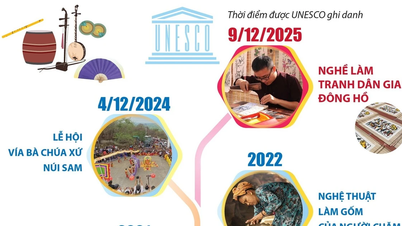
![[Video] The craft of making Dong Ho folk paintings has been inscribed by UNESCO on the List of Crafts in Need of Urgent Safeguarding.](https://vphoto.vietnam.vn/thumb/402x226/vietnam/resource/IMAGE/2025/12/10/1765350246533_tranh-dong-ho-734-jpg.webp)










































Comment (0)