


In order to resolve the difficulties and problems in assessing the conformity of investment projects with planning, the law has provided a mechanism allowing special or urgent investment projects to be implemented even when the content of the investment decision is different from the relevant planning.
After a project is decided to be invested in (especially special and urgent public investment projects), relevant planning with conflicting contents will be promptly reviewed and adjusted according to simplified procedures to ensure flexibility and meet the country's development requirements.
Furthermore, the law promotes decentralization and delegation of power in planning activities, in line with the Party's policy of "local authorities decide, local authorities act, and local authorities are responsible." Accordingly, the authority to approve provincial plans is decentralized to the Chairman of the Provincial People's Committee. However, before approval, the provincial plan must be reviewed and approved by the Provincial People's Council.
Along with decentralization, the law supplements regulations on planning supervision and inspection activities to ensure post-inspection work, planning quality, timely detection of overlapping and contradictory contents, and enhancement of accountability of agencies after decentralization of approval authority.
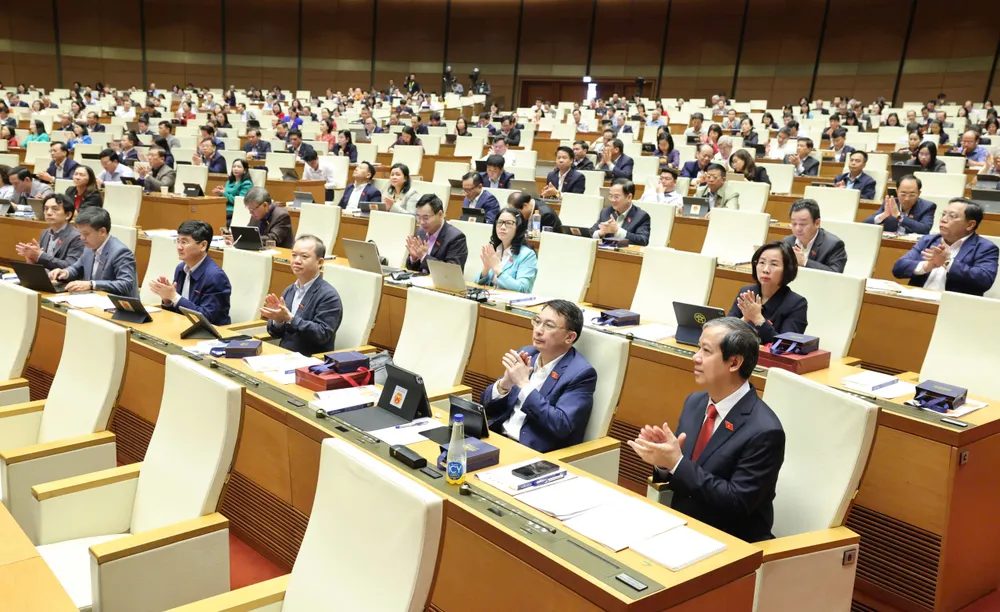
Furthermore, the law has focused on resolving conflicts and overlaps between different types of planning by clarifying the system and relationships through regulations on the relationships between plans arranged to ensure compliance, continuity, inheritance, stability, and hierarchy within the planning system. This hierarchical arrangement is an important basis for resolving conflicts between plans.
The mechanism for handling conflicts has also been clarified. For example, in cases where regional planning conflicts with sectoral planning, the Prime Minister will decide which planning needs to be adjusted and the planning will be implemented.
The amended Planning Law also includes policies to encourage the application of advanced technologies, promote digital transformation, and strengthen international cooperation in planning activities through regulations on the construction, management, operation, and exploitation of the national information system on planning, including the national planning database.
The plan must be published and made public in a timely, complete, convenient, and synchronized manner with the national planning information system after it has been decided or approved. The planning agency is responsible for publicly disclosing comments and the process of incorporating and explaining those comments on its website and the national planning information system.
Source: https://www.sggp.org.vn/chu-tich-ubnd-tinh-co-tham-quyen-phe-duyet-quy-hoach-tinh-post827873.html




































































































Comment (0)