

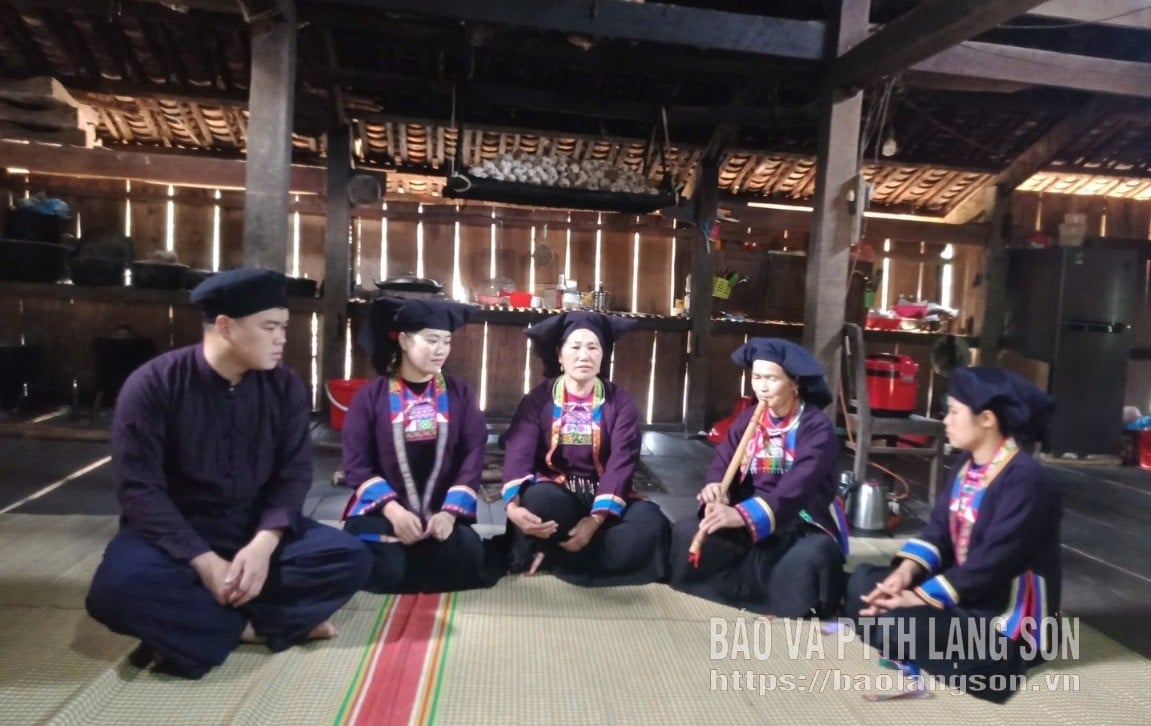
Hmong folk songs are collective creations of the people, passed down from generation to generation. Unlike the Tay, Nung, Cao Lan, and San Chi ethnic groups, whose folk song lyrics are usually written in seven-syllable verse, Hmong folk songs are short five-syllable poems.
These include lyrical love songs between men and women, songs about daily life and labor, songs of moral teachings for children, lullabies, and ceremonial songs… Mong folk songs also include songs with new lyrics sung to traditional folk melodies. This valuable intangible cultural heritage is still clearly preserved in Doan Ket commune – the area with the largest concentration of Black Mong people in the province. Here, boys are still passionate about making bamboo flutes, and both young and old love singing folk songs, playing flutes, and playing leaf horns… In the villages, men and women sing call-and-response songs and love songs on moonlit nights, during festivals, holidays, wedding ceremonies, funerals, and housewarming ceremonies… Currently, the commune has a Mong ethnic culture preservation club with about 50 members.
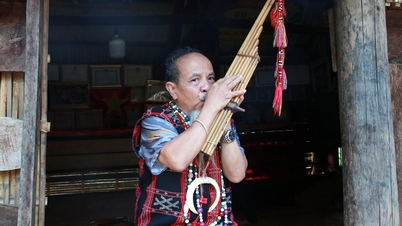
As a lover of Hmong folk songs, Mrs. Trinh Thi Nhinh (60 years old) from Khuoi Lam, Doan Ket commune, particularly enjoys playing the flute and leaf horn. From a simple, self-made four-hole bamboo flute, she can play many melodies to accompany the Hmong's Tu Si Na Mieo songs, producing clear and melodious sounds. For the Hmong, the leaf horn is a heartfelt call to a friend, a secret rendezvous between young men and women; it expresses the joy or the quiet melancholy of the elderly... Mrs. Nhinh is someone who can skillfully use the leaf horn to convey these various emotions. The sounds of the flute and leaf horn echoing through the mountains like the echoes of their roots, a truly impressive cultural feature of the Hmong people in the highlands of Doan Ket.
From a young age, Trinh Thi Khen, a Mong woman (born in 1968) from Khuoi Lam, listened to lullabies and folk songs sung by her grandparents and parents. She has been passionate about preserving her ethnic group's cultural heritage. During her leisure time, she and her son carefully transcribed the lyrics of these songs into notebooks and translated them into the common language. Furthermore, she paid attention to and copied the lyrics of folk songs circulating in her locality to perform in cultural events, teaching them to others and passing them on to her descendants.
In 2024, at the request of the Department of Culture, Sports and Tourism, Ms. Trinh Thi Khen, Ms. Trinh Thi Nhinh, and several others collaborated with department officials to compile and translate the lyrics of folk songs collected and recorded over many years to serve research, preservation, and promotion of the value of the Mong people's folk song heritage. At the end of 2024, the book "Nha Mieo Folk Songs of the Black Mong People in Trang Dinh District, Lang Son Province" was completed and published by the Department of Culture, Sports and Tourism. The 300-page book contains 33 Mong songs translated into Vietnamese. Essentially, the familiar and popular folk songs in Doan Ket have been comprehensively compiled. This is a valuable resource for research into ethnology, literature, and folk culture of the Mong people in general and the Black Mong in Lang Son in particular. On December 23, 2025, the authors of the book were awarded the Encouragement Prize (in the field of Research - Theoretical Criticism, Folk Arts) at the first Lang Son Provincial Literature and Arts Award – 2025 by the Provincial People's Committee. As a member of the book's compilation team, Mr. Do Tri Tu, an official from the Department of Culture, Sports and Tourism, stated: Compiling a book written in the mother tongue of the smallest ethnic group in the province, residing in a remote and isolated area, was a very difficult task. During the compilation process, the Department of Culture, Sports and Tourism received enthusiastic and active cooperation from the group of artisans in Khuoi Lam. They not only provided the lyrics in the Mong language but also translated and edited the text to achieve the most satisfactory and perfect translations.
As possessors of a rich knowledge of Hmong folk songs, these artisans are frequently invited to participate in competitions and performances organized by the cultural sector and mass organizations; in festivals and cultural events of ethnic groups inside and outside the province; and to serve local political events. They are also pioneers in teaching folk singing, flute playing, and leaf horn playing within the Hmong community, serving visitors from afar who come to experience their culture. The enduring and ever-shining Hmong culture, and the ever-resonating Tú sỉ Na Miẻo melody, owes a significant part of its success to those who are deeply committed to preserving their ethnic culture.
Source: https://baolangson.vn/nhung-nguoi-luu-giu-von-dan-ca-mong-xu-lang-5069718.html






































![[Infographic] Vietnam's Economic Situation Report, Q1 2026: Strong Growth Momentum](https://vphoto.vietnam.vn/thumb/402x226/vietnam/resource/IMAGE/2026/04/04/1775298512042_tang-truong-kinh-te-viet-nam.jpeg)

![[Image] Close-up view of the 10-lane road connecting to Long Thanh Airport](https://vphoto.vietnam.vn/thumb/402x226/vietnam/resource/IMAGE/2026/04/04/1775291871988_ndo_br_1-resize-5690-jpg.webp)















Comment (0)