

Party resolutions always carry significant direction. But for these policies to truly take root in daily life, it requires people who know how to transform dry, abstract concepts into something relatable, easy to remember, and easy to implement. At the grassroots level, the team of propagandists are precisely such "bridges." They actively go from village to village, attend every meeting, and bring resolutions to the people using everyday language and sincerity.

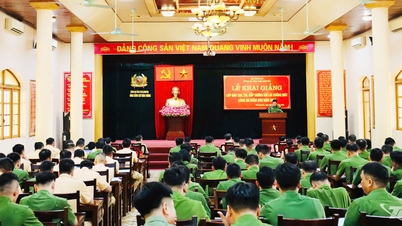
Entry for the excellent propagandist competition by the Military Command of O Lam commune. Photo: DUC TOAN
The recent 2026 Excellent Propagandist Competition in O Lam Commune is a vivid example. Gone are the days of simply reading and copying; many entries were meticulously prepared, utilizing information technology, visual aids, and video clips to make the resolution's content more relatable to the audience. 32 contestants from various Party branches participated in three parts of the competition: outlining, presentation, and answering questions. The content revolved around the Resolution of the 14th National Party Congress, the Resolution of the An Giang Provincial Party Congress, and the Resolution of the O Lam Commune Party Congress for the 2025-2030 term. However, what was noteworthy wasn't the resolution itself, but how the propagandists "translated" the resolution into a story of real life.
Many presentations by the teaching staff left a strong impression due to their "gentle" and approachable nature. From the Politburo 's Resolution 71 on breakthroughs in education and training development, the candidates directly related it to improving the quality of teaching in ethnic minority areas. Instead of grand pronouncements, they spoke about keeping students in class, encouraging parents to let their children continue their education, and instilling aspirations in children in mountainous regions facing many difficulties. Candidate Huynh Cong Thuc from the Party cell of An Tuc "B" Primary School shared: "For me, each lesson is not only about imparting knowledge but also about contributing to the formation of awareness and aspirations for advancement in ethnic minority students. When the quality of education is improved, it also forms the foundation for the long-term development of the locality." This way of speaking didn't sound like a formal speech. But it was precisely this simplicity that made the resolution more relatable to the people.
In another segment of the competition, contestant Chau Soc Khon from Phuoc Long hamlet Party branch brought a very authentic glimpse into the life of the Khmer people. He spoke about the importance of propaganda in accordance with customs and traditions; that to get people to listen, one must first understand them. When people understand the policies, they will agree and voluntarily follow them. This is also the most important aspect of grassroots propaganda work: speaking in a way that the people believe and follow.
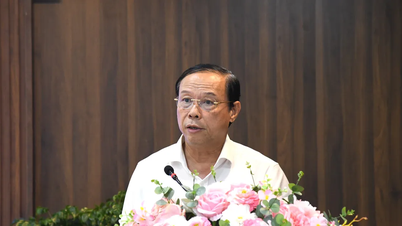
Deputy Secretary of the Party Committee of O Lam Commune, Tieu Dinh Hieu Nhan Trung, commented that many entries closely reflected reality and could be immediately applied in Party branch activities and in propaganda in residential areas. The competition was not only a place for competition but also an opportunity for propagandists to learn new and more suitable ways of communicating with the people. People might not remember lengthy sentences, but they will remember things related to their lives.
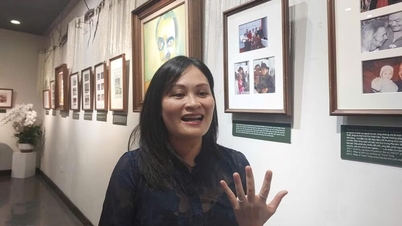
The story of Ms. Tran Thi Bao Ngoc, a teacher at Long Kien "B" Primary School, is another example of how to "soften" the resolution. With the theme of disseminating information related to social welfare policies, health insurance, and population work, she chose to speak through real-life stories. Ms. Ngoc shared: "Propaganda isn't difficult; the important thing is choosing a method that suits each target audience. Technology can support it with images, clips, leaflets, etc., but the communicator remains central because they decide how to explain things so that listeners understand and agree."
During parent-teacher meetings, instead of reading dry regulations about health insurance, Ms. Ngoc recounts cases of poor students whose medical expenses were covered by insurance, helping their families overcome difficult times. This "real people, real stories" approach resonates more deeply than any slogan. In schools, the "piggy bank" savings program is also maintained to support disadvantaged students. These small but practical actions transform the resolution from a distant concept into concrete actions every day.
When farmers understand why they need to switch crops; when parents voluntarily buy health insurance for their children; when ethnic minority youth see the path of education to change their future… that's when the resolution begins to show its practical value. And behind these changes are the figures of grassroots propagandists – those who are actively “softening” the resolution with dedication, responsibility, and love for their homeland.
DUC TOAN
Source: https://baoangiang.com.vn/nhung-nguoi-mem-hoa-nghi-quyet-o-co-so-a485820.html
![[Image] Hanoi's urban life under the challenge of a "scorching hot" environment](https://vphoto.vietnam.vn/thumb/1200x675/vietnam/resource/IMAGE/2026/05/25/1779706979265_nang-nong-t5-2026-minh-duy-7-4636-jpg.webp)
![[Image] Close-up view of the interchange connecting the two expressways and Long Thanh Airport.](https://vphoto.vietnam.vn/thumb/1200x675/vietnam/resource/IMAGE/2026/05/25/1779703378210_ndo_br_z7863716673926-224453a31600126cce10622af6290afd-4549-jpg.webp)












































































Comment (0)