

QUANG TRI: Organic rice production is like a revolution. Many 'enlightened' farmers have abandoned old farming practices and entered a new chapter in agricultural production.
"Country bumpkin" Vinh Lam and his story of applying for permission to grow organic rice.
After migrating to the South to escape the hardships of farming, and trying his hand at various jobs to make a living, Nguyen Van Tuan from Tien My 2 village, Vinh Lam commune (Vinh Linh district, Quang Tri province ) eventually returned to the fields to start his own business. Many thought he would "abandon farming." But no, with 8 hectares of rice paddies, after 5 years of starting his business, he has built a property that many people dream of.
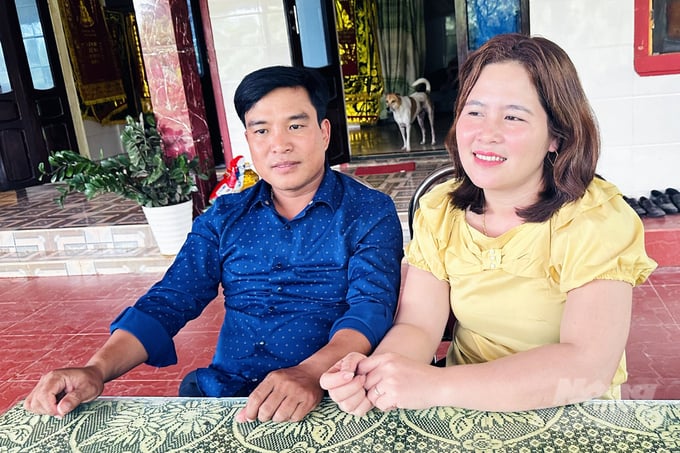
"Country bumpkin" Vinh Lam Nguyen Van Tuan and his wife share their story of growing organic rice. Photo: Vo Dung.
In 2018, when the organic rice farming movement began to emerge in Quang Tri, Mr. and Mrs. Tuan drove to Dong Ha City to meet Mr. Ho Xuan Hieu, Chairman of the Board of Directors of Quang Tri Trade Corporation (Sepon Group), to request a partnership in organic rice production, specifically the ST25 rice variety. After surveying the quality of the growing area, Sepon Group decided to partner with Mr. Tuan to conduct a trial planting of 0.5 hectares of safe rice for two seasons. This was also a process of soil improvement, detoxification, and nutrient supplementation before entering the organic rice production process. By 2019, Mr. and Mrs. Tuan officially met the requirements to produce organic rice on their 0.5-hectare plot.
Producing safe rice was already easy, but when he officially started producing organic rice, Mr. Tuan felt that farming had never been so effortless. The farmer only had to plow the land and prepare the ground. Tasks such as planting, fertilizing, spraying biological pesticides to control pests and diseases, and harvesting were all done by machine. Sepon Group employees handled most of these tasks, including replanting. The organic straw was also baled and purchased directly from the field by the company using machines.
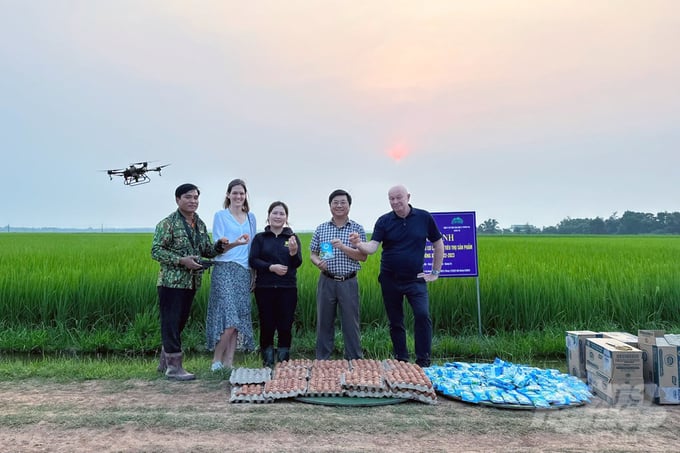
Many foreign experts have visited the organic rice fields of farmers in Quang Tri province who are affiliated with Sepon Group. Photo: Vo Dung.
“Growing organic ST25 rice requires sparse planting, which reduces pests and diseases. All stages of planting, caring for, and harvesting are mechanized, making things much easier for farmers. Instead of having to bring the rice home to dry, farmers sell the fresh rice directly to Sepon Group in the field at a contracted price of 12,000 VND/kg,” Mr. Tuan shared.
The yield of ST25 rice in Quang Tri province only ranges from 6 to 6.4 tons/ha (fresh rice), and the growing season is long. However, with a selling price of 12 million VND/ton of fresh rice at the field, farmers consistently earn a net profit of 30 million VND/ha/season. Meanwhile, all stages of planting, caring for, and harvesting are mechanized, so farmers no longer have to work in the mud like with traditional rice farming methods.
In total, with 8 hectares of safe and organic rice cultivation, Mr. Tuan's family earns a net profit of over 200 million VND per year. With the high income from rice farming, Mr. Tuan has been able to buy a luxury car, a tractor, a harvester, and an unmanned aerial vehicle for spraying pesticides…
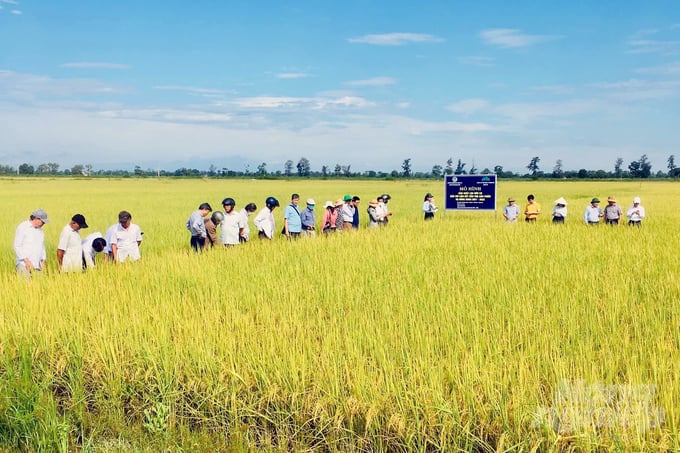
These rice fields are what make up the brand of organic rice in Quang Tri. Photo: Vo Dung.
Starting from the 2023-2024 winter-spring crop season, all 8 hectares of rice fields belonging to Mr. and Mrs. Tuan will transition to organic rice production. What makes them happiest is not only proving that farmers can absolutely get rich from their fields, but also ensuring environmental protection and maximizing profits through organic rice production. This is the motivation behind Vinh Lam's pioneering efforts to encourage other farmers to participate in organic rice cultivation.
“Organic rice production yields safe products for consumers, fetches high and stable prices, and allows farmers to become wealthy if they can consolidate land. Producers also have an easier time and avoid future health risks. Recently, I successfully persuaded 14 households to partner with Sepon Group to grow organic rice on a total area of 9 hectares. Starting from next harvest season, Tien My 2 village alone will have 17 hectares of ST25 organic rice in partnership with Sepon Group,” Mr. Tuan said enthusiastically.
Applying nitrogen fertilizer to rice plants, the farmer nearly got fined…
Organic rice production is a revolution. It requires farmers to temporarily forget about yield and focus on producing according to extremely strict standards. This is truly difficult to change for farmers who spend their lives working in the fields.
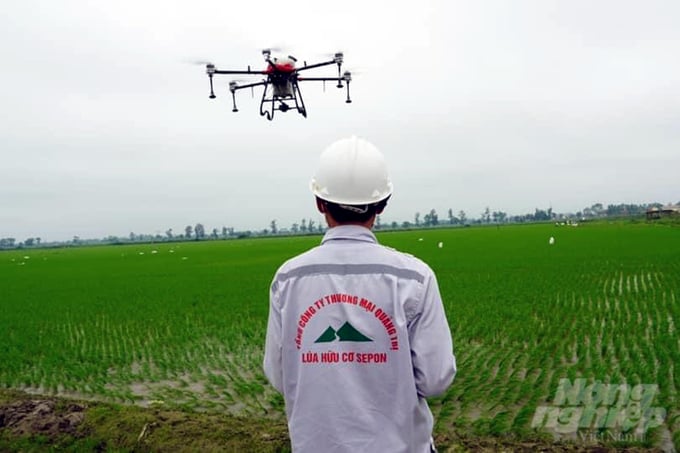
Farmers have never had such an easy time participating in the Sepon Group's organic rice farming partnership. Photo: Vo Dung.
“Normally, in this area, the yield of dry rice reaches 6-6.4 tons/ha. But when growing organic ST25 rice, the yield of fresh rice only reaches about that much. This makes many farmers worried. Along with the fragmentation of farmland and the farmers' mindset not yet keeping pace with market demands, these are two of the reasons why organic rice production is facing difficulties,” Mr. Tuan continued.
But once we've committed to writing the story of organic rice, community spirit is extremely important. Organic rice production leaves no room for dishonesty because inputs and outputs are rigorously inspected before reaching consumers.
“A farmer producing safe rice, affiliated with Sepon Group, was on his way to fertilize his fields with composted manure when he was stopped by the monitoring team, who ordered him to return or they would issue a report. If even with safe rice production, the strict regulations are so stringent, everyone understands how crucial adherence to farming procedures is when producing organic rice,” Mr. Tuan said with a bright smile.
Strict cultivation processes produce organic rice that meets export requirements. Photo: Vo Dung.
The farmer (who wishes to remain anonymous) was worried when he saw a rice field being ravaged by buffaloes and cows, so he mixed some chemical fertilizer with well-rotted manure to fertilize the rice. When he got close to the field, other farmers discovered the act and reported it to the monitoring team. As a result, the farmer had to take the fertilizer and nitrogen back home.
“The monitoring team is allocated 100,000 VND per ton of finished fresh rice to supervise the rice cultivation process. If violations are detected, we will issue a warning; if they are repeated, we will issue a violation report and request Sepon Group to terminate the contract. In addition, the farmers are very worried about the quality of rice in this area, so they conduct cross-monitoring among themselves. This ensures that organic rice cultivation adheres to Sepon Group's procedures,” said Mr. Nguyen Hai Tien, Director of Tien My Agricultural Service Cooperative (Vinh Lam commune) - a member of the monitoring team.
According to Mr. Tuan, producing organic and safe rice with Sepon Group involves strict not only care procedures but also careful control over the type of machinery used. When pests or diseases are detected, the farmer is responsible for reporting it so Sepon Group can send drones to spray biological pesticides.
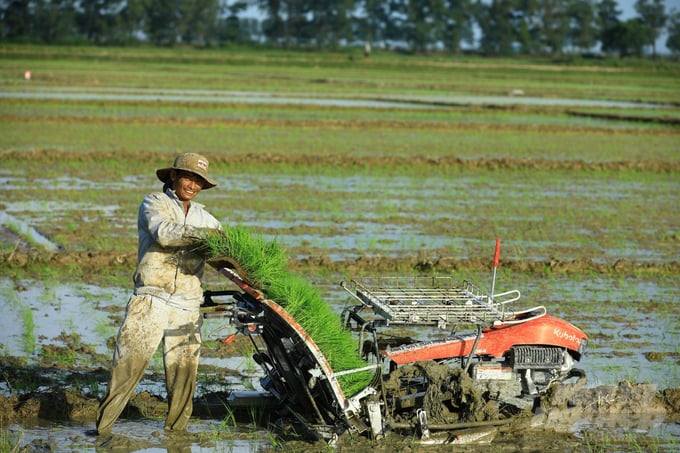
Almost all stages, from planting to caring for organic rice, are mechanized. Photo: Vo Dung.
Mr. Tuan is just one of hundreds of households belonging to 20 cooperatives in Quang Tri province that have collaborated with Sepon Group in producing organic rice over the years. However, few people know that Sepon Group has invested considerable effort in "enlightening" farmers to grow organic rice. The story of producing and creating a brand for Quang Tri organic rice is not something that can be done overnight.
After years of collaboration with the Vietnam Union of Science and Technology Associations for surveys, Sepon Group found that, out of over 20,000 hectares of rice production in Quang Tri province, 5,000 hectares meet the requirements for producing rice that meets VietGAP safety standards. Of these, 3,000 hectares meet the requirements for organic rice production, concentrated in districts such as Trieu Phong, Hai Lang, Gio Linh, and Cam Lo…
However, to produce organic rice, this area must undergo two seasons of safe rice production, along with a process of soil improvement, detoxification, and replenishment of natural nutrients. The water used in organic rice production must be one-way water; after use, it is discharged and not reused.
It also took years for Sepon Group's technical team to successfully trap and breed native microorganisms to produce organic fertilizers for crops.
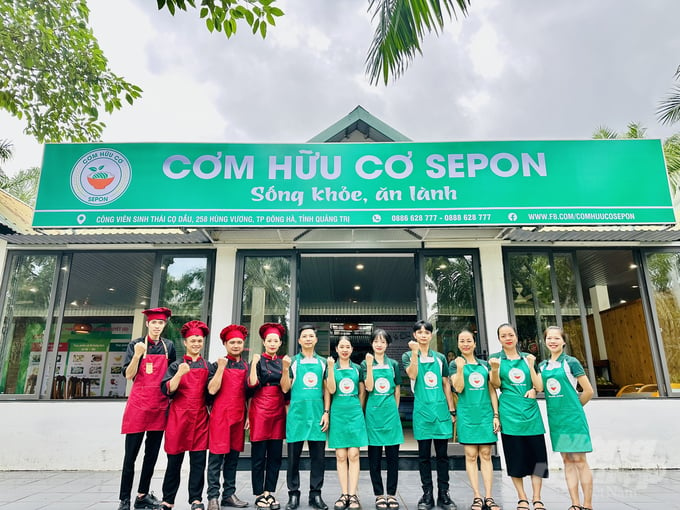
Sepon Group aims to build a nationwide chain of Sepon organic rice restaurants. Photo: Vo Dung.
Since 2022 alone, Sepon Group has partnered with 700 farmers in four districts—Hai Lang, Trieu Phong, Cam Lo, and Vinh Linh—to cultivate 410 hectares of safe and organic rice, yielding a total of 24,000 tons of fresh rice per year. The Sepon rice brand, with its VietGAP-certified safe rice and organic rice, is available in many Sepon supermarket chains across 12 provinces and cities nationwide and is eligible for export to Europe. But for Mr. Ho Xuan Hieu, Chairman of the Board of Directors of Sepon Group, that's a story for the future.
“We leave 10% of our rice for farmers to use. According to the plan, 40% will be sold in the domestic market, and 50% exported. But that's a story for the future. Sepon organic rice must first and foremost be for Vietnamese people to consume,” Mr. Hieu said enthusiastically.
Mr. Ho Xuan Hieu, Chairman of the Board of Directors of Sepon Group, said that the company has just opened a Sepon organic rice restaurant in Dong Ha City, using 100% organic ST25 rice and food that meets VietGAP standards. At the Sepon organic rice restaurant, customers will have the opportunity to experience, receive advice, and have their health indicators such as body fat percentage, water content, bone mass, and current biological age assessed individually.
Source

















![The Essence of Viet Bac Villages: [Part 3] The Precious Fragrance of Nghinh Tuong](https://vphoto.vietnam.vn/thumb/402x226/vietnam/resource/IMAGE/2026/05/29/1780020600366_5237-tinh-tuy-ban-lang-viet-bac-bai-3-chuyen-o-nghinh-tuong-050626_700.jpeg)
![The Quintessence of Northern Vietnam's Villages: [Part 2] The Famous Cassava Noodles of Kunming](https://vphoto.vietnam.vn/thumb/402x226/vietnam/resource/IMAGE/2026/05/28/1779937455892_3929-3144-mien-dong-15-nongnghiep-023138.jpeg)
![The Essence of the Village: [Part 1] Wine on the mountain, tea in the clouds - Bang Phuc](https://vphoto.vietnam.vn/thumb/402x226/vietnam/resource/IMAGE/2026/05/27/1779841729178_3821-1jpg-nongnghiep-103814.jpeg)




















































Comment (0)