

 |
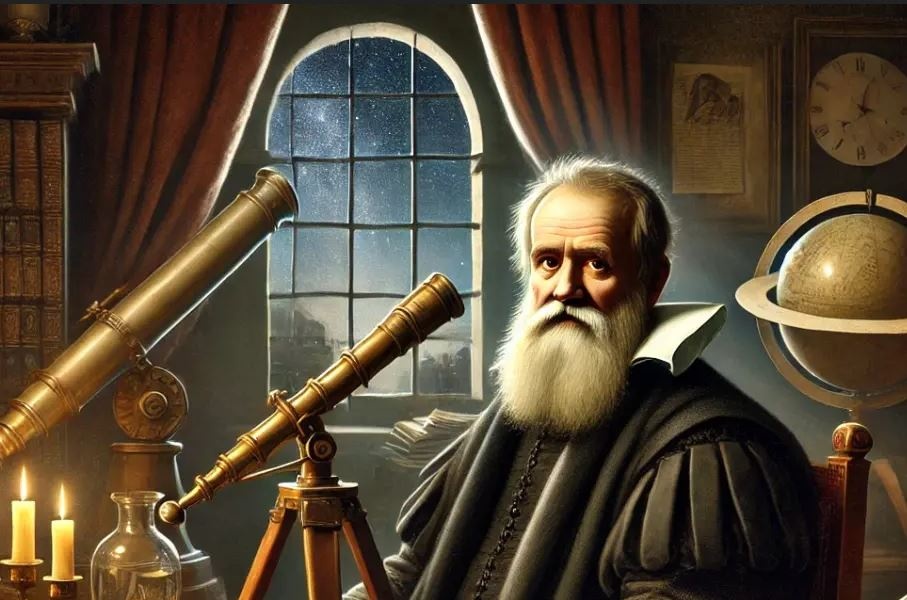
Galileo continuously improved the telescope to observe very distant stars. (Illustration: PE) |
In October 1604, Galileo observed a new star (“nova,” Latin for “new”)—a newly visible star that had briefly brightened. In keeping with Aristotle’s theory that the heavens were perfect and unchanging, the philosophers of Padua assumed the new star must be closer to Earth than the Moon, meaning it was not high in the sky.
However, Galileo argued that because the new star appeared to move against the starry sky when viewed from different altitudes above the horizon, it was farther from Earth than the Moon.
Galileo, anonymously, criticized a book by Florentine philosophers that stated that new stars had always existed in the sky, but had not been discovered until a lens in a "crystal sphere" unexpectedly shifted in the sky, causing them to appear. Interestingly, Einstein's general theory of relativity at the end of the 20th century explained a phenomenon called gravitational lensing, which makes some extremely distant celestial objects that should otherwise be invisible appear.
In 1609, Galileo heard that the Dutchman Hans Lippershey had invented an instrument that made distant objects appear closer. That August, using a plano-convex lens as the objective lens and a plano-concave lens as the eyepiece, Galileo constructed a telescope with nine times magnification.
He demonstrated the improved second model to the governors of Venice. They gathered atop the San Marco bell tower and saw sailors appear in a much greater distance than before. They rewarded him with a lifetime position at the University of Padua for this achievement.
Within months Galileo had built a telescope with 20x magnification, then 30x. He used the latter to observe the Moon, Jupiter's moons, and stars. His discoveries , recorded in his *Sidereus nuncius* ( The Messengers of the Stars ), published in 1610, which included depictions of the Moon's rugged, mountainous surface and four moons orbiting Jupiter, challenged Aristotle's principles.
Galileo's description of the Moon's rough surface contradicts Aristotle's notion that all celestial bodies are perfect, and Galileo's observation of satellites orbiting Jupiter refutes the assertion that everything revolves around the Earth.
Galileo's discoveries through his telescope led him to believe that the Copernican system was more reasonable than the Aristotelian system. He thanked God, "so merciful as to make me the only one to observe the wonders hidden in obscurity for centuries."
The astronomical community was not unanimous in its acceptance of Galileo's observations or conclusions. Prominent among those who supported him was Johannes Kepler, then the court mathematician of the Holy Roman Emperor in Prague.
Source: https://znews.vn/dam-me-chay-bong-cua-cha-de-kinh-vien-vong-post1654098.html

![[Image] Hanoi's urban life under the challenge of a "scorching hot" environment](https://vphoto.vietnam.vn/thumb/1200x675/vietnam/resource/IMAGE/2026/05/25/1779706979265_nang-nong-t5-2026-minh-duy-7-4636-jpg.webp)


![[Image] Close-up view of the interchange connecting the two expressways and Long Thanh Airport.](https://vphoto.vietnam.vn/thumb/1200x675/vietnam/resource/IMAGE/2026/05/25/1779703378210_ndo_br_z7863716673926-224453a31600126cce10622af6290afd-4549-jpg.webp)
























































































Comment (0)