

My image of the Netherlands is of endless tulip fields, romantic canals, giant windmills and wooden clogs, colorful bicycles parked by bridges over the canals, and gentle, friendly people always greeting me with warm smiles…
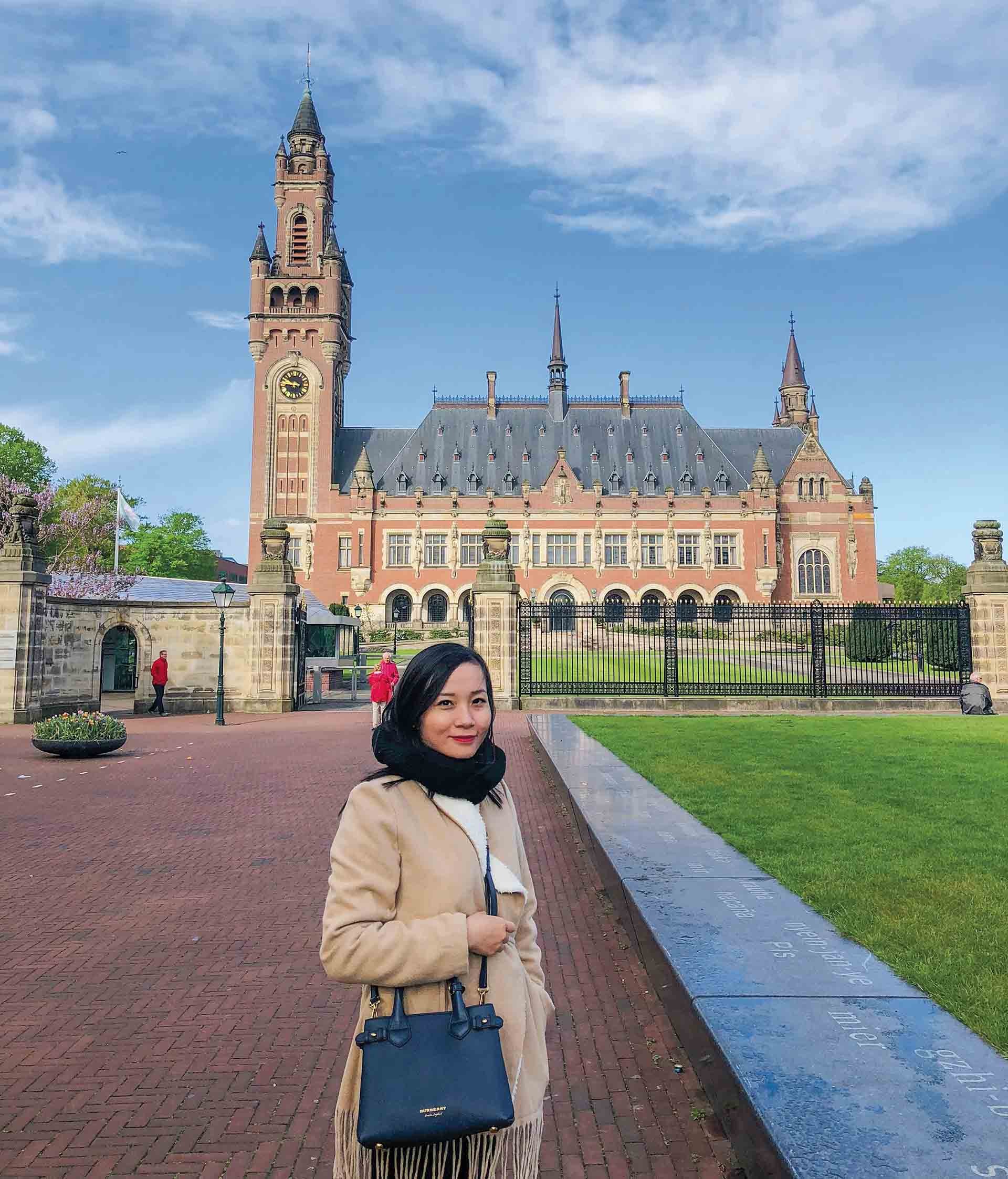 |
| The author in front of the International Court of Justice headquarters in The Hague. (Photo: TGCC) |
I arrived in the Netherlands in late April during the cool, fresh spring weather. Occasionally, a chilly breeze carried the scent of the sea, reminding me that this is a coastal country. I visited The Hague, Amsterdam, the tulip festival at Keukenhof Park, Zaanse Schans, and Giethoorn, places considered "specialties" of the Netherlands.
Unforgettable memories in The Hague
My first day in The Hague coincided with King's Day (April 27th), the birthday of King Willem-Alexander of the Netherlands. Therefore, all citizens had the day off and went out to celebrate this important occasion. The streets of the Netherlands were bustling and filled with the color orange. Orange represents the pride of the Dutch royal family (the House of Orange - Nassau), and the Dutch wear this vibrant color to express their boundless love for their country.
After strolling through the streets and immersing myself in the festive atmosphere, I stopped at a small roadside pastry shop and pointed to a tompouce cake decorated with orange sauce and topped with a small Dutch flag. The baker gave a thumbs-up in approval and said, "You made the right choice! This is a tompouce, a traditional Dutch pastry, and King's Day wouldn't be complete without it."
Another particularly meaningful experience in The Hague for someone like me, studying international law, was visiting the headquarters of the International Court of Justice (ICJ), a picturesque, ancient building where cases between countries are adjudicated and legal advice on international law issues is provided. I had seen images of the ICJ on the covers of law textbooks many times, but seeing the main judicial body of the United Nations in person still evoked an indescribable feeling.
It's hard to imagine the countless decisions and conclusions made inside that historic building, resolving legal disputes between United Nations member states concerning crucial and long-standing issues of borders, territorial sovereignty, diplomatic relations, asylum rights, nationality, and economic rights. In his speech at the first session of the Court on April 18, 1946, the first President of the UN General Assembly, Paul Henri Spaak, said: “I wouldn’t venture to say that the ICJ is the most important organ of the United Nations, but I can say that there is no organ more important than it.” The Hague left me with such memorable experiences!
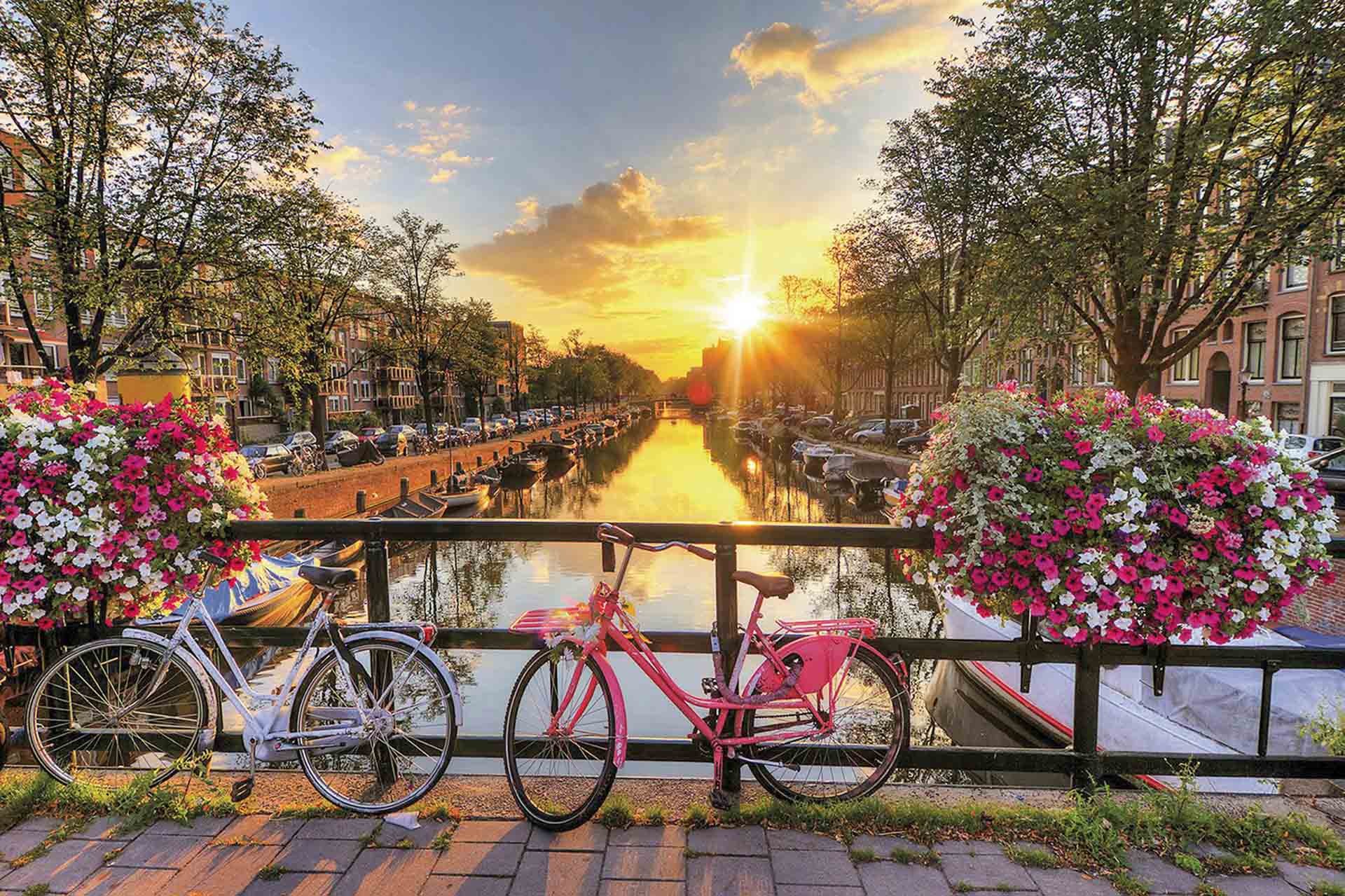 |
| A view of Amsterdam at sunset. (Source: Hotels.com) |
Vibrant and dazzling
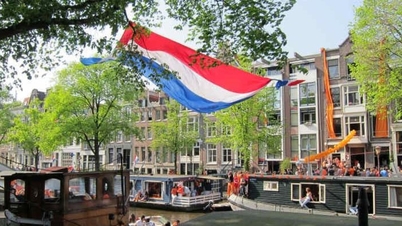
In contrast to The Hague, the capital Amsterdam is much more vibrant, modern, and bustling. Stepping out of the crowded train station, I encountered a stream of cyclists on their own dedicated lane.
Vulnerable to global warming, the Netherlands is a pioneer in environmental protection efforts. With 22.5 million bicycles for a population of only 17.5 million, the Netherlands has the highest per capita bicycle ownership rate in the world . According to the Dutch Cycling Association, the country accounts for 2.3% of the world's 1 billion bicycles, averaging 1.3 bicycles per person. Cycling has become a daily habit and a part of Dutch culture.
Meanwhile, Amsterdam boasts a vast canal system; the combined surface area of all its waterways and canals covers approximately a quarter of the city's total surface. Amsterdam's canals consist of three main canals: the Prince Canal, the Emperor Canal, and the Gentlemen's Canal. In 2011, UNESCO officially recognized the canal system, encompassing these three main canals built in the 17th century in Amsterdam, as a World Heritage Site, along with over 1,000 monumental structures along the canals.
Therefore, it's not uncommon to see people cycling leisurely along the canals or a couple of brightly colored bicycles casually parked by the bridges over the canals, making Amsterdam truly romantic, especially in the late afternoon. To experience being a true Amsterdam resident, I rented a bicycle and cycled around the city center, visiting some famous landmarks such as the Rijksmuseum, Rembrandtplein Square, De Wallen red-light district, Dam Square, Begijnhof Gardens…
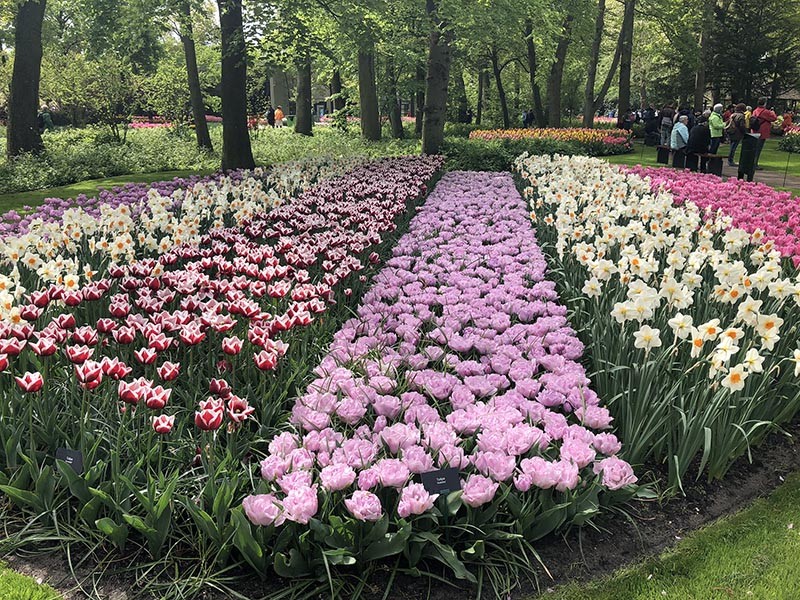 |
| A carpet of colorful tulips at Keukenhof Park. (Photo: Provided by the artist) |
Leaving Amsterdam, I visited Keukenhof Park – the world's largest flower garden, located in the southwestern town of Lisse. I was fortunate to visit Keukenhof during the festival, when the tulips were in full bloom. Upon entering the park, I was overwhelmed by the thousands of vibrant tulips, beautifully arranged in rows like colorful ribbons under the spring sunshine.
Having existed for over a century, Keukenhof Park spans 32 hectares and boasts over seven million temperate flowers, meticulously cared for daily by hundreds of skilled gardeners. The park is divided into several sections, each decorated and designed in a different style, creating a novel experience that sparks visitors' curiosity. Besides the characteristic tulips, the festival also features many other flowers such as daffodils, lilies, and orchids.
Mesmerized by the myriad of colorful flowers, I also enjoyed various cultural and artistic programs, performances showcasing the rich traditions of the Netherlands. It was a truly relaxing feeling to stroll with loved ones through the vibrant flowerbeds, immerse ourselves in country music, and gaze at the clear streams flowing gently into the large lake, where beautiful swans gracefully glided across the water.
Beautiful villages
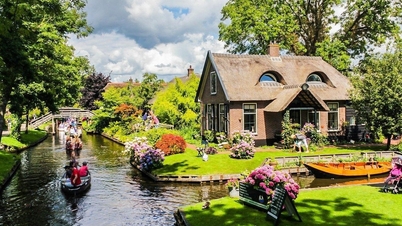
When mentioning the Netherlands, it would be a mistake not to mention Giethoorn, a small, historic village in the province of Overijssel. With its intricate network of canals and hundreds of wooden bridges, Giethoorn is also known as the "Venice of the Netherlands." Here, visitors can choose to kayak, canoe, take a motorboat, or stroll along the winding canals to admire the thatched-roof houses surrounded by lush greenery and flowers, with wooden bridges leading to them.
In stark contrast to the bustling, hectic pace of life outside, free from the honking horns and exhaust fumes of traffic, the village of Giethoorn is incredibly peaceful and ancient. Sitting quietly on a motorboat, savoring the rare beauty of this place, I wondered if I had stumbled into a fairytale world in real life.
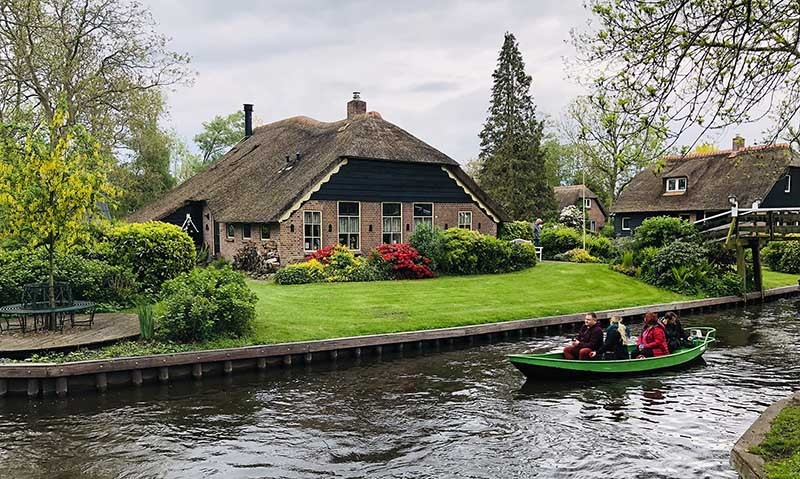 |
| Giethoorn village. (Photo: Provided by the interviewee) |
Last but not least is the Zaanse Schans windmill village, located about 15km northwest of Amsterdam. It presents the typical image of the Netherlands that tourists imagine: windmills, wooden clogs, dairy cows, and farms.
Seen from afar, the ancient windmills stand majestically against the blue sky, each with its own unique color and style. The village of Zaanse Schans has a total of 13 windmills, six of which are ancient and located along the Zaan River. These windmills are over 300 years old. On average, a windmill completes one rotation every 16 seconds, but in strong winds, it only takes 10 seconds. Witnessing the windmills in operation is a truly fascinating experience.
Besides its famous windmills, the village of Zaanse Schans is also home to the production of traditional Dutch wooden clogs – one of the symbols of the Netherlands, often worn with traditional multi-layered skirts or wide-legged trousers.
Visiting the Wooden Clog Museum in the village, I was able to admire a very unique collection of wooden clogs in various styles and colors, displayed from the entrance to the inside of the museum. Here, craftsmen directly make the wooden clogs, starting from a pair of plain wooden clogs, then painting, drawing, or carving patterns to enhance their aesthetic value. Certainly, after seeing them, it would be hard for anyone to resist buying a few pretty little wooden clogs as souvenirs.
After these wonderful experiences, I could list many reasons to love the Netherlands and understand why this country consistently ranks among the top 10 happiest countries in the world. For me, the Netherlands can be summed up as the happiness found in a peaceful and idyllic life.
Source
![[Image] Hanoi's urban life under the challenge of a "scorching hot" environment](https://vphoto.vietnam.vn/thumb/1200x675/vietnam/resource/IMAGE/2026/05/25/1779706979265_nang-nong-t5-2026-minh-duy-7-4636-jpg.webp)

![[Image] Close-up view of the interchange connecting the two expressways and Long Thanh Airport.](https://vphoto.vietnam.vn/thumb/1200x675/vietnam/resource/IMAGE/2026/05/25/1779703378210_ndo_br_z7863716673926-224453a31600126cce10622af6290afd-4549-jpg.webp)









































































Comment (0)