

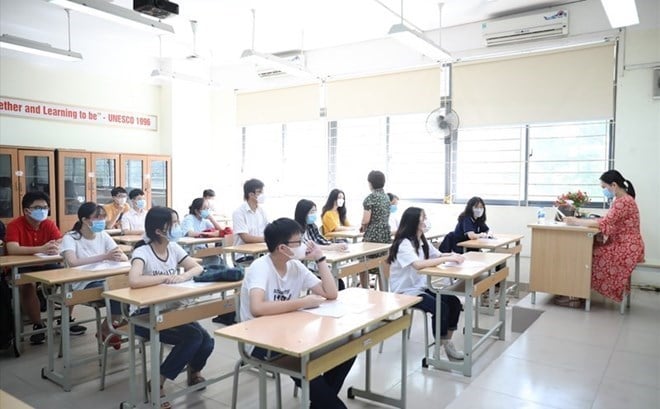
Currently, Article 4 of Circular 17/2012/TT-BGDĐT stipulates that the following cases are prohibited from providing supplementary tutoring:
- No extra tutoring is allowed for students who already receive two teaching sessions per day organized by the school.
- No extra tutoring is allowed for primary school students, except for: enrichment in arts, physical education and sports , and life skills training.
- Higher education institutions, colleges, vocational schools, and training centers are prohibited from organizing supplementary classes or tutoring sessions covering content from the general education curriculum.
- For teachers receiving salaries from the payroll fund of a public non-profit organization:
Organizing extracurricular tutoring outside of school is prohibited, but participating in extracurricular tutoring outside of school is permitted.
Teachers are not allowed to provide extra tutoring outside of school hours to students they teach in regular classes without the permission of the head of the institution that manages those teachers.
However, in the draft of the new Circular on tutoring and supplementary classes issued by the Ministry of Education and Training , the clause regarding cases where tutoring is prohibited as mentioned above is no longer included.
According to Article 5 of the draft, teachers (including Deputy Principals) who are working and receiving salaries from the payroll fund of public general education or continuing education institutions are allowed to participate in extracurricular teaching outside of school, but must meet the following requirements:
- Report to the Principal about the subject, location, and time of participation in extracurricular tutoring, and commit to the Principal to complete assigned tasks and not violate the principles of extracurricular tutoring.
- If a teacher's extracurricular tutoring class includes students from the class the teacher is currently teaching at school, the teacher must report this, compile a list of those students (students' full names; current class) and send it to the Principal, along with a commitment not to use any form of coercion to force students to attend the extra classes.
- Principals participating in extracurricular tutoring must report to and obtain the approval of the Head of the Department of Education and Training (for lower secondary schools) or the Director of the Department of Education and Training (for upper secondary schools).
As can be seen, the draft of the new Circular has relaxed regulations on tutoring. Accordingly, teachers who provide tutoring to students they directly teach in the school do not need to ask permission from the head of the agency; they only need to report, create a list of students, and provide a commitment not to force students to attend tutoring.
The regulation prohibiting tutoring for elementary school students has also been lifted.
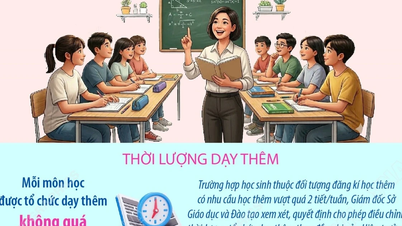
Regarding the principles of supplementary teaching and learning, Article 3 of the draft new Circular of the Ministry of Education stipulates that supplementary teaching and learning can only be organized when students have a need for supplementary learning, voluntarily participate, and have the consent of their parents or guardians. No form of coercion should be used to force students to participate in supplementary learning.
The duration, time, and location of tutoring and supplementary classes should be appropriate to the psychological and physiological development of the age group, ensure the health of students, and comply with legal regulations on security, order, safety, and environmental hygiene in the area where the tutoring and supplementary classes are held.
The draft regulations stipulate that extra classes or tutoring are not allowed within schools that already offer two-session-per-day teaching.
Extracurricular classes are not allowed to cut down on the curriculum content of subjects in the school's educational plan to include it in supplementary classes. Furthermore, they must not teach content ahead of the curriculum distribution in the school's educational plan; nor should they use examples, questions, or exercises from supplementary classes for testing or evaluating students.
In particular, the content of supplementary teaching and learning must contribute to consolidating and enhancing students' knowledge, skills, and character education; it must not violate Vietnamese law, and must not be prejudiced based on ethnicity, religion, occupation, gender, social status, customs, and traditions of Vietnam.
Source: https://laodong.vn/giao-duc/noi-long-quy-dinh-ve-day-them-cho-giao-vien-1386005.ldo
![[Image] Hanoi Police officially crowned champions of V-League 2025/2026](https://vphoto.vietnam.vn/thumb/1200x675/vietnam/resource/IMAGE/2026/05/31/1780244769054_ndo_br_039d561b692be875b13a-jpg.webp)




















![[Photo] The General Secretary, President and his wife begin their state visit to the Philippines.](https://vphoto.vietnam.vn/thumb/1200x675/vietnam/resource/IMAGE/2026/05/31/1780230559452_anh-man-hinh-2026-05-31-luc-19-28-11.png)









































Comment (0)