Before dedicating himself to farming, Thang graduated with a degree in International Business Administration from Tay Do University. After graduating in 2017, he worked in Binh Duong, then switched to the pharmaceutical field and worked for a pharmaceutical company in Dong Thap . After two years away from home, he decided to return to his hometown to care for his elderly parents while continuing the family's farming tradition. His father entrusted him with cultivating 12 acres of land. Initially, he faced many difficulties. Thanks to his father's detailed guidance on each step, from fertilizing to monitoring the rice fields at each stage of growth, Thang gradually accumulated experience.
In his first crop, Mr. Thang produced OM34 rice seeds, achieving a yield of approximately 1.1-1.2 tons per hectare. According to Mr. Thang, rice seed production requires "clean" and standardized fields. Therefore, he regularly weeds and keeps the fields well-ventilated. To reduce costs, he maintains the "1 must, 5 reductions" and "3 reductions, 3 increases" farming processes, while also participating in training and following technical guidelines correctly. Currently, he has switched to growing Dai Thom 8 rice, linking with purchasing businesses to stabilize output. Mr. Thang said that from 12 hectares of land, he earns about 120-150 million VND per year.
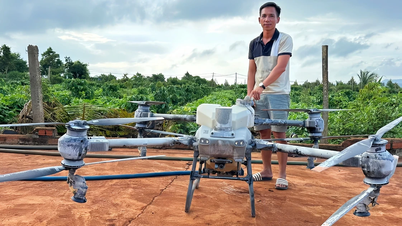
The turning point that helped Mr. Thang expand his income was the development of drone services for spraying pesticides and sowing rice, applying technology to agricultural production. In 2023, when he saw drones starting to be used in some localities, he proactively researched and rented them for trial spraying on a few fields. Seeing the clear results, he decided to invest. “Each drone set costs from 650 million VND upwards, which is a considerable amount of money for farmers. In the initial stage, my family supported part of the capital, and I managed the rest myself. After about a year of accumulating capital from the service, I bought a second drone, thus proactively serving the crop season and gradually expanding the scale of the business,” Mr. Thang recounted.

Mr. Thang inspects and prepares the drone for spraying pesticides in the rice field.
According to Mr. Thang, the most obvious benefit of using drones is saving time and labor. Simultaneously, drone spraying ensures even distribution of pesticides, reducing waste by controlling dosage. Mr. Thang calculated that previously, hiring workers to spray at a cost of 30,000 VND per tank would cost approximately 360,000 VND and take a whole day for 12 workers. Using drones, the total cost is only about 250,000 VND, and spraying takes about 10 minutes. Besides the time and cost savings, Mr. Thang believes that using drones also reduces the need to wade through fields, minimizing the risk of disease spread and contributing to improved farming efficiency.
Thanks to efficient scheduling and optimized processes, Mr. Thang can spray pesticides on approximately 50 hectares per day, peaking at 70 hectares per day. The current service price is around 160,000 VND per hectare. On average, income from this service can reach approximately 300 million VND per season, depending on the farmers' demand. To ensure smooth operation, Mr. Thang hires additional workers to handle tasks such as mixing pesticides and preparing batteries. Each worker earns around 500,000-600,000 VND per day.
Mr. Thang plans to invest in more drones to serve farmers in a timely manner during the planting season, while also continuing to participate in rice seed production with his family. "I want to do things more systematically to both improve service quality and stabilize rice seed production," Mr. Thang confided.
Text and photos: KIEN QUOC
Source: https://baocantho.com.vn/nong-dan-tre-dua-drone-ra-dong-a197144.html


![[Image] Hanoi's urban life under the challenge of a "scorching hot" environment](https://vphoto.vietnam.vn/thumb/1200x675/vietnam/resource/IMAGE/2026/05/25/1779706979265_nang-nong-t5-2026-minh-duy-7-4636-jpg.webp)

![[Image] Close-up view of the interchange connecting the two expressways and Long Thanh Airport.](https://vphoto.vietnam.vn/thumb/1200x675/vietnam/resource/IMAGE/2026/05/25/1779703378210_ndo_br_z7863716673926-224453a31600126cce10622af6290afd-4549-jpg.webp)






























































Comment (0)