

To protect expensive smartphones, costing tens of millions of dong, from accidental drops, most consumers choose to encase them in protective cases. These cases are usually made from hard plastic or thick layers of leather. However, from a technology expert's perspective, equipping a phone with such a robust protective layer can sometimes be detrimental, directly damaging the lifespan of the battery inside.
A protective coating or an insulating 'incinerator'?
Physically, when a phone handles demanding tasks such as playing high-graphics games, editing videos , or while charging, the processor (CPU and GPU) has to work at full capacity and generate a significant amount of heat. For a phone without a case, this heat quickly dissipates through the casing and escapes into the surrounding environment.
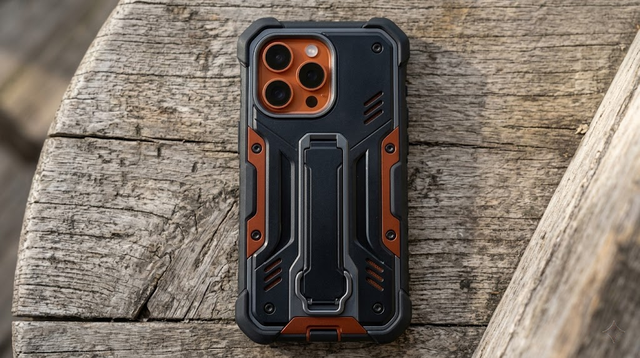
An iPhone completely encased in a bulky, thick protective case.
PHOTO: GEMINI
However, when we put a thick, dense case on the phone, it immediately becomes a perfect thermal barrier. Blocking airflow, it slows down the phone's heat dissipation. This trapped heat causes the phone's operating temperature to constantly rise. To perform the same task in that 'stifling' environment, the internal components are forced to consume more energy, causing the lithium-ion battery to drain quickly. The frequency of charging increases proportionally with the rate of premature battery degradation and aging.
Skin stickers are even more 'harmful' than phone cases.
To clarify the extent to which accessories affect phone temperature, popular tech YouTuber Mrwhosetheboss conducted an in-depth experiment and obtained surprising results. Contrary to popular belief, applying decorative skins directly to the back of the phone actually causes more severe heat buildup than even thick, bulky phone cases. This is because the skin adheres tightly, leaving no space for the phone's body to "breathe."
Meanwhile, some high-end shockproof phone cases today have been designed with aerodynamics in mind. They feature raised ridges, heat dissipation grooves, or ventilation slots on the inside to ensure the case doesn't completely press against the back of the phone, creating space for heat to dissipate.
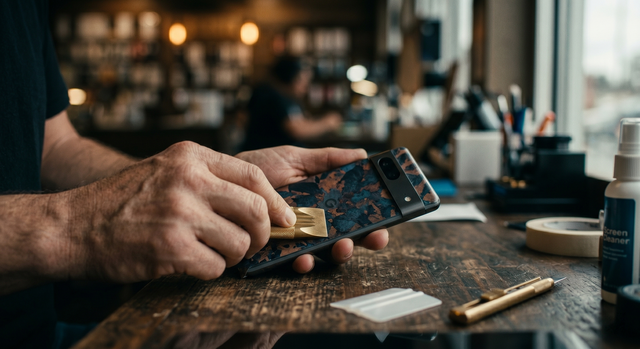
Applying phone skins may look nice, but it can damage your device.
PHOTO: GEMINI
The self-defense mechanism of modern smartphones
However, users shouldn't worry too much, as modern smartphones are equipped with intelligent self-defense systems. When the temperature exceeds a safe limit due to being "suffocated" by the phone case, the thermal protection mechanism will immediately activate: the device will automatically reduce the chip's clock speed (thermal throttling), decrease screen brightness, or even automatically shut down to protect the battery from the risk of fire or explosion. This is why you sometimes find your high-end phone suddenly becoming unusually laggy, slow, and dim when playing games continuously.
Experts advise that users can certainly use thick phone cases to protect their devices, but they should choose products with clearly defined heat dissipation vents. Especially if you frequently play games or use fast charging, temporarily remove the case to allow the phone to cool down naturally. Remember, a cool battery is key to a long-lasting phone.
Source: https://thanhnien.vn/op-lung-co-the-gay-hai-cho-pin-smartphone-185260527095059815.htm

































![[Photo] Reception to welcome General Secretary and President To Lam and his wife on their State visit to the Philippines](https://vphoto.vietnam.vn/thumb/1200x675/vietnam/resource/IMAGE/2026/06/01/1780295488620_vna-potal-chieu-dai-chao-mung-tong-bi-thu-chu-tich-nuoc-to-lam-va-phu-nhan-tham-cap-nha-nuoc-toi-philippines-8798060-7855-jpg.webp)



































































Comment (0)