

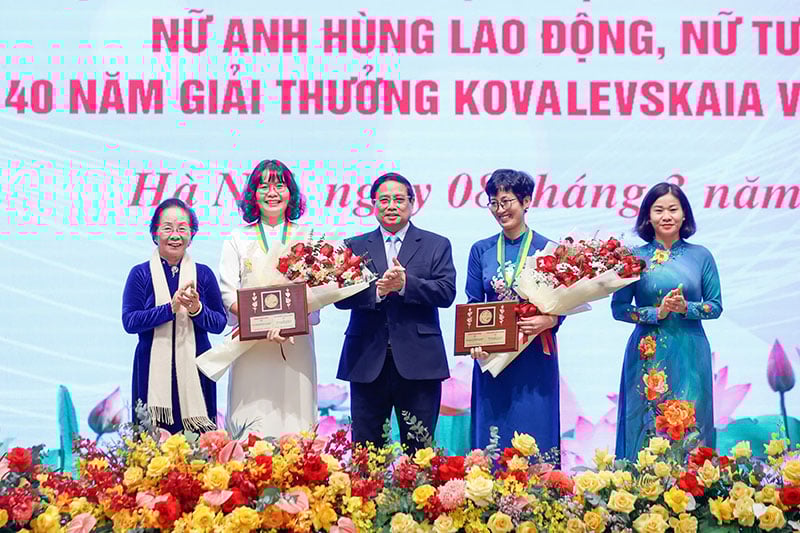
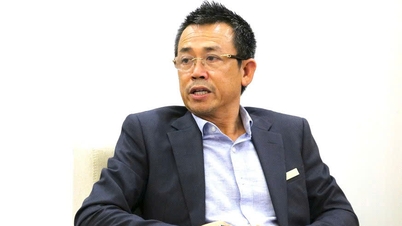
Associate Professor Dr. Dang Thi My Dung is one of two individuals awarded the Kovalevskaia Prize 2024.
My encounter with nano-ink droplets.
For many scientists , the journey to research is often the result of a long process of accumulation and selection. But for Associate Professor Dr. Dang Thi My Dung, Deputy Director of the Institute of Nanotechnology (INT), her connection to nano-inkjet technology began with a chance encounter.
In 2009, as a young researcher, she had the opportunity to collaborate with Eric Fribourg-Blanc, a French expert in inkjet printing. These direct working sessions with her foreign mentor not only gave her access to cutting-edge technology but also opened up a vast horizon of research.
"It was my teacher's dedicated guidance, along with the vast potential of nano-inkjet technology, that ignited a special passion in me," she shared. At that time, there were almost no research materials available domestically, and she had to practically learn everything from scratch, from materials theory and fabrication techniques to experimental procedures and working with very limited equipment.
However, the deeper she delved into it, Associate Professor Dr. Dang Thi My Dung became increasingly captivated by the fascinating interdisciplinary nature of this technology, where physics, chemistry, engineering, and biomedicine intersect.
To pursue her passion to the fullest, Associate Professor Dr. My Dung has traveled to France and Japan many times, both to learn advanced technology and to accumulate practical experience from modern laboratories. These experiences have helped her build a solid foundation for nano-inkjet research in Vietnam.
Upon returning to Vietnam, she persistently pursued this research direction for over 15 years, despite a lack of equipment, personnel, and especially market interest.
The journey to mastering technology
Entering the world of nano-inkjet technology felt like destiny, but mastering it required Associate Professor Dr. Dang Thi My Dung to sacrifice many years of persistent research, fueled by a pure passion for science and an unwavering spirit of learning.
Her initial goal was quite clear: to develop inkjet technology for the fabrication of electronic and biological sensors. But that journey quickly expanded when she and her colleagues successfully created a series of nano-inks, ranging from silver (Ag), copper (Cu), carbon nanotubes (CNT), to organic inks and rare earth particle-based inks. Among these, the stable conductive silver nano-ink was a breakthrough. “That was the moment I knew I had truly found my path,” she recalled.
From those tiny drops of ink, Ms. Dung saw a vast world of applications, encompassing flexible electronic components, environmental sensors, medical devices, and more.
According to her, inkjet technology is a silent revolution, eliminating the need for expensive masks, reducing materials and chemicals by 80-90%, and nearly halving the cost of component production. More importantly, it allows scientists in Vietnam to design and control their own processes – something previously thought only possible in leading global technology centers.
In 2018-2019, INT implemented the Project to Promote Innovation through Research, Science and Technology, funded by the World Bank, with a focus on enhancing self-reliance through perfecting and mastering the technology for producing silver nano-ink used in the fabrication of microelectronic components and nano-sensor systems for assessing water quality in aquaculture ponds.
At that time, in her role as Deputy Director of INT, she participated in research on the development of a sensor system for monitoring salinity and assessing water quality in aquaculture ponds, and developing materials for applications in manufacturing sensors to measure heavy metals.
The project was successful and received approval, perfecting the technology, production, and commercialization of four products. These include silver nano-ink used in the manufacture of microelectronic components, a nano-sensor system for assessing water quality in aquaculture ponds, silver nano-materials for disinfecting water in aquaculture and fruit orchards, and an automatic salinity intrusion monitoring and warning system. The products have also been tested and commercialized in various localities.
Not stopping there, she continued to support the national program on developing sustainable shrimp farming models. The pond water treatment solution using silver nanoparticles developed by her team has proven effective in many shrimp farming households and businesses, contributing to minimizing disease risks in increasingly harsh conditions caused by climate change.
Despite facing numerous challenges regarding mechanisms and resources, Associate Professor Dr. Dang Thi My Dung has never faltered. From the laboratory, she persistently brings nano-inkjet printing technologies into real-world applications.
Research is the path to affirming Vietnam's position on the global scientific map.
After more than 15 years of dedicated research, Associate Professor Dr. Dang Thi My Dung has left many outstanding marks on the scientific community both domestically and internationally. She has published 60 scientific articles in prestigious international journals, led and completed 6 research projects at various levels, and participated in 11 scientific research projects and programs. These figures not only demonstrate her professional competence but also show the unwavering determination of a female scientist who is always eager to use her knowledge to serve the community.
In addition, she has been granted 3 patents, 2 utility model patents, and 5 industrial design patents. Recently, Associate Professor Dr. Dang Thi My Dung was honored to be one of two individuals awarded the Kovalevskaia Prize 2024 - a prestigious award for outstanding female scientists.
"Scientific research is a journey of discovering the unknown, fraught with risks and requiring great perseverance," she shared. Each research project undergoes countless trials and errors; some products require years of rework, even up to two years, before completion. Yet, she never gives up. "Each failure is a step closer to success," she said.
However, the research journey faces not only scientific challenges but also administrative obstacles. According to Associate Professor Dr. My Dung, many scientists are highly skilled but lack experience in procurement procedures, bidding processes, and project implementation. Even when creating products with high practical value, commercialization still faces obstacles due to legal procedures, especially when intellectual property rights belong to the State – the funding body for the research.
Another bottleneck is the gap between laboratories and the market. “Businesses are a crucial link in bringing research products to life, but the current mechanisms are not flexible enough to encourage cooperation,” Ms. Dung frankly acknowledged. As a result, many research results are “frozen,” leading to wasted resources and missed opportunities for development.
It was from these concerns that she highly appreciated Resolution 57 of the Politburo – a policy that creates a more open mechanism for scientific research and product commercialization. According to her, this is an important step forward, because accepting risks in research is a prerequisite for promoting innovation. When policies pave the way, scientists will dare to venture into new directions.
Associate Professor Dr. Dang Thi My Dung hopes that this resolution will soon be implemented effectively and efficiently, helping scientists access financial resources more easily and providing a clear mechanism for research products to be put into practice. She believes that when these barriers are removed, Vietnamese science will have more works and inventions bearing the distinct mark of Vietnamese intellect.
|

A CONVERSATION WITH ASSOCIATE PROFESSOR DR. DANG THI MY DUNG
How did you feel when you were honored with the Kovalevskaia Award – a prestigious award for female scientists?
The Kovalevskaia Award not only brings me joy, but also serves as an inspiration and motivation for me to continue my research and contribute even more to the national science scene. The award also places a greater responsibility on my shoulders – to become a role model and source of encouragement for the younger generation, especially women who love science.
Madam, what are the key advantages of conductive nano-inkjet technology compared to traditional solutions in the field of microelectronics?
Nano silver ink used in microelectronic component manufacturing is a new and valuable product for the Vietnamese market. Conductive nano inkjet inks can offer significant economic value in the field of manufacturing microelectromechanical systems (MEMS) using inkjet technology. They allow for the printing of micro-nano-sized conductive traces with high accuracy and low cost. This enables widespread application in various fields, such as the fabrication of circuit boards for the microelectronics industry, solar cell manufacturing technology, and in the near future, for connecting microcircuits in the production of chips and memory.
Source: https://baodautu.vn/pgs-ts-dang-thi-my-dung-sang-tao-gop-phan-khang-dinh-vi-the-viet-nam-tren-ban-do-khoa-hoc-toan-cau-d275213.html
![[Photo] Prime Minister Pham Minh Chinh presides over a meeting on private sector economic development.](/_next/image?url=https%3A%2F%2Fvphoto.vietnam.vn%2Fthumb%2F1200x675%2Fvietnam%2Fresource%2FIMAGE%2F2025%2F12%2F20%2F1766237501876_thiet-ke-chua-co-ten-40-png.webp&w=3840&q=75)





































































Comment (0)