

Reducing vibration, dust, and toxic gases in mining operations.
Carbon dioxide (CO₂) blasting is a new rock blasting technique that does not use industrial explosives. Accordingly, when blasted using this method, the blast chamber experiences a rapid and less complex chemical reaction than the chambers of conventional explosives. Therefore, less dust and toxic gases are generated during the blasting process, making it more environmentally friendly.
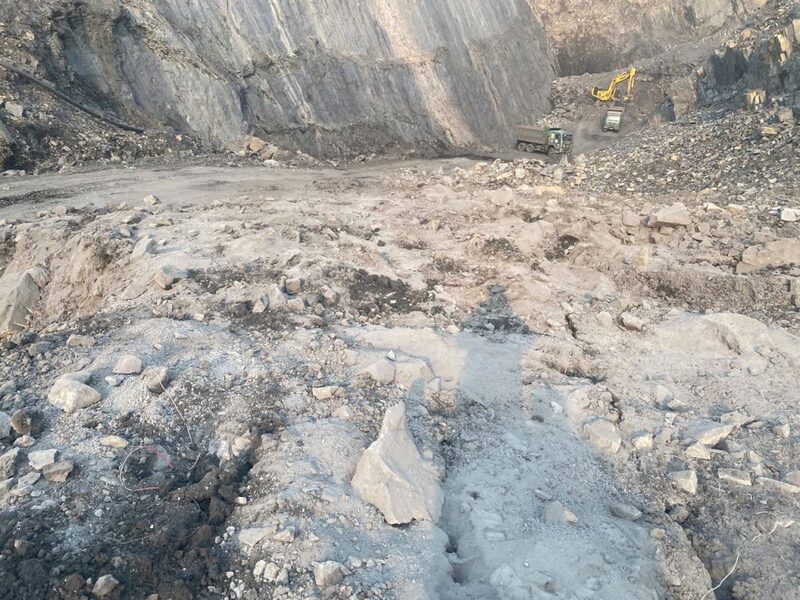
Image showing the results of rock and soil breaking after testing the use of CO2 gas instead of explosives at Mao Khe Coal Mine. Photo: Imsat
According to the Vietnam Association of Blasting Engineers, the characteristic of using CO2 gas for rock blasting is that it occurs in a supercritical state, meaning it is in a state between liquid and gas. When detonated, the supercritical CO2 gas injected into the rock expands the small pores within the rock, causing it to crumble. The size of the crumbled rock pieces depends on the amount of gas in the compressed gas cylinder and the layout of the blast holes. Typically, this method requires large-diameter boreholes.
According to Mr. Le Ngoc Ninh, Chairman of the Vietnam Blasting Engineering Association, the method of rock blasting using CO₂ gas has many advantages compared to other methods such as blasting with explosives, industrial explosives, or hydraulic hammers. After a CO₂ blast, the shock waves propagate less strongly through the rock, reducing noise, dust, and toxic substances, thus making it safer for workers and the surrounding environment. In particular, storage is simpler than storing industrial explosives.
" Currently, in China and many countries around the world, this technology is being widely applied in the construction of highways, railways, bridges, power plants, and other projects, " shared Dr. Le Ngoc Ninh.
Testing technology for breaking up rock and soil using liquid CO₂ at Mao Khe Coal Mine. Source: Imast
Faced with increasingly stringent demands for sustainable development, liquid CO₂ gas-assisted rock-breaking technology is emerging as an alternative to blasting in mining areas adjacent to residential areas and structures requiring protection, offering numerous advantages. " This technology utilizes the principle of sudden volume expansion of liquid CO₂ to create pressure for rock breaking, minimizing vibrations and noise, reducing rockfall, and eliminating the production of toxic gases, thereby enhancing safety and being more environmentally friendly, " shared Dr. Le Ngoc Linh.
Establishing a facility to replicate environmentally friendly mining technologies at TKV (Vietnam National Coal and Mineral Corporation).
In Vietnam, since the end of 2025, within the framework of the project "Research on the application of compressed air rock fracturing technology in areas near residential areas and structures requiring protection for coal mines under TKV", the Institute of Mining Science and Technology - Vinacomin has collaborated with Mao Khe Coal Company to conduct a trial application of liquid CO₂ rock fracturing technology at the open-pit mine of Mao Khe Coal Company.
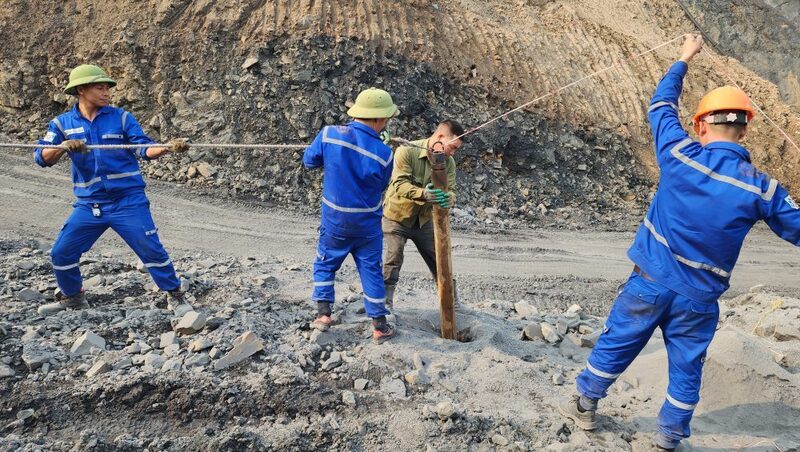
The process of loading liquid CO2 into boreholes at Mao Khe Coal Mine. Photo: Imsat
In fulfilling a project assigned by the Vietnam Coal and Mineral Industry Group (TKV), the Institute of Mining Science and Technology - Vinacomin has completed the research contents on schedule and is conducting trial applications of a technology solution for breaking up rock and soil using liquid CO₂ gas at an open-pit mine near residential areas and structures requiring protection of Mao Khe Coal Company - TKV, in order to evaluate the technical effectiveness, safety level, and applicability in actual production conditions.
Accordingly, TKV established an inspection team led by Mr. Luu Van Thuc – Deputy Head of the Science, Information Technology and Development Strategy Department, along with representatives from the Safety Department, the Mining Technology and Engineering Department, and the Environment Department to evaluate the results of the technology trial application.
The team conducted a field inspection of the test site with 20 boreholes, each 6m deep, with a distance of 2.2-2.5m between boreholes. The results showed that the liquid CO₂ rock-breaking technology was effective, separating the rock mass into cracks according to the borehole grid, and the excavation and transportation processes were carried out safely. Equipment productivity was significantly improved compared to current levels. On-site measurements also showed that the liquid CO₂ rock-breaking technology minimized environmental impact: Vibration 0.22 mm/s; CO₂ content = 0.05%; CO, NO₂, SO₂ content = 0 ppm. The test results indicate that the technology is feasible and can be considered for replication in coal mines with similar conditions.
Mr. Luu Van Thuc stated that researching and applying technology for breaking up rocks and soil using liquid CO₂ gas is a suitable approach, contributing to improving safety in mining operations, minimizing impacts on the environment and structures near the mining area.
To further establish a scientific basis, TKV has requested the Institute of Mining Science and Technology and other units to continue the planned testing, compile data, and fully assess technical and economic indicators and the level of environmental impact. Based on this, technical guidelines will be developed and technological parameters suitable for the geological conditions will be proposed, serving as a basis for considering widespread application at the Group's coal mines in the future.
Source: https://congthuong.vn/pha-da-bang-co-long-giai-phap-moi-cho-khai-thac-mo-tai-tkv-457863.html











































































Comment (0)