

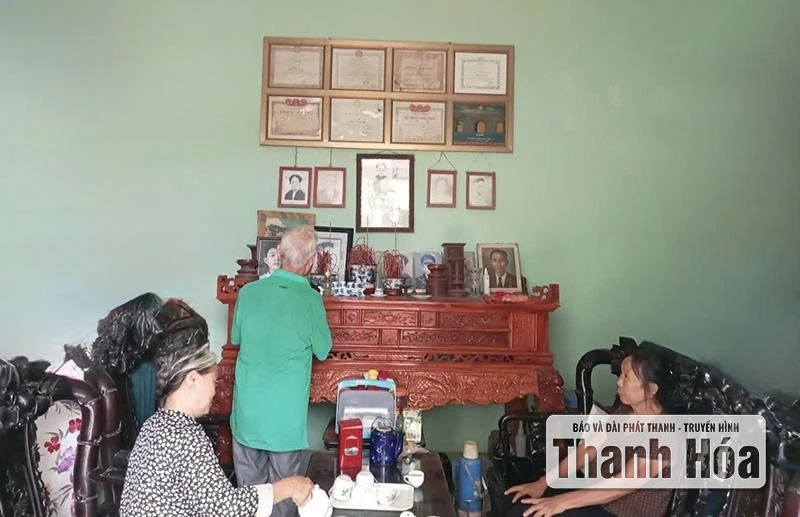
The house currently houses a memorial for martyrs Pham Van Hinh and Pham Van Dinh in Cam Bao village, Tay Do commune. Photo: PV
From May 1941, Pham Van Dinh enthusiastically participated in the self-defense force of Cam Bao village, working with the Youth in the Anti-Imperialist National Salvation Front, writing slogans, guarding, and escorting revolutionary comrades operating in the area such as Trinh Huy Lan (Tran Tien Quan), Dang Van Hy, and other guerrilla fighters to the Ngoc Trao War Zone. After the Ngoc Trao War Zone was surrounded and suppressed by the French imperialists, and cadres were arrested, in October 1941, the revolutionary fighters moved to the Cam Bao village area to gather and hide. Pham Van Dinh, suppressing his grief over the sacrifice of his older brother Pham Van Hinh, continued to participate in the tasks assigned by the organization, supplying daily meals to the fighters on the hill, and sharing the task of washing wet clothes.
Realizing they could not operate in Cam Bao village for long, the guerrilla leadership decided to disperse the team to other localities to operate and wait for the right opportunity. The self-defense forces and people of Cam Bao village did a good job preparing the means to safely transport the entire guerrilla team out of the village. As for weapons, supplies, and printed materials, the leadership had to leave them behind in Cam Bao village for safekeeping. Pham Van Dinh was assigned the task of hiding the knife commonly used by Comrade Dang Chau Tue – the commander of the Ngoc Trao War Zone – and newspapers such as: "Cut the Chains," "Break the Shackles," "Drive Out the Foreign Invaders," "Liberation Flag," along with many other books and propaganda materials of the Party, the Anti-Imperialist Front, and the Ngoc Trao War Zone. The enemy searched the area intensely many times, but the materials entrusted to him remained safe. After the success of the August Revolution, Pham Van Dinh handed them over to the Viet Minh of Thach Thanh district.
The village of Cẩm Bào was repeatedly surrounded and searched house by house by enemy forces in an attempt to capture guerrillas. During one intense search, they captured 14 people from Cẩm Bào and imprisoned them in Vĩnh Lộc, later in Thanh Hóa prison. Besides five villagers who were guerrillas in the Ngọc Trạo war zone, most were self-defense forces and anti-imperialist members. Phạm Văn Tuynh, Phạm Văn Dinh's older brother, was also captured.
After March 9, 1945, under the guise of a false independence orchestrated by Japan, the Tran Trong Kim government was forced to release political prisoners. The Thanh Hoa Party Committee gained additional cadres to expand and consolidate the movement, formulate strategies, and seize the opportunity for the uprising. Pham Van Dinh actively participated in the Viet Minh Front of Co Te commune, Thach Thanh district. He was tasked with establishing a committee to mobilize the people to raise funds to purchase weapons for the Co Te commune Viet Minh headquarters and participated in the command preparing for the general uprising. In August 1945, following orders from the Thach Thanh district uprising committee, along with other communes in the district, Co Te commune rose up en masse to gain independence and freedom, forcing the village headman to return the bronze seal, and returning power to the people. With the uprising achieving complete victory nationwide, Pham Van Dinh was appointed Chairman of the Provisional Revolutionary People's Committee of Co Te commune. When the commune level was abolished and villages were established, he was appointed Secretary of the Administrative Committee and Chairman of the Resistance Committee of Thach Long commune. On November 10, 1945, the Thach Thanh District Party Committee was established. In February 1946, Pham Van Dinh was admitted to the Communist Party of Vietnam and assigned the task of establishing the Thach Long Commune Party Branch. In October 1946, he became a District Party Committee member and Secretary of the Thach Long Commune Party Branch. He successively held the positions of Secretary of the Thach Thanh District Youth Union, Chief of the Thach Thanh District Party Committee Office, and General Secretary of the Thach Thanh District Lien Viet Committee. In September 1948, the Thanh Hoa Provincial Party Committee transferred him to the Nga Son District Party Committee. From December 1949 to 1952, Pham Van Dinh was transferred to work at the Party Cadre Committee of the Western Thanh Hoa Province, served as the interim District Party Secretary of Quan Hoa District, and participated in the Lien Viet Cadre Committee of the six mountainous districts of Thanh Hoa. Later, he returned to work in Thach Thanh District.
During the 1955 land reform, his family was accused of having a certain social class, and he was expelled from the Party. In June 1956, after rectifying the situation, his Party membership was restored, and he was assigned to work in Vinh Long commune, Vinh Loc district.
In early 1960, Pham Van Dinh was assigned by the Central Committee to work in the Northwest provinces, successively holding positions as an officer in the Propaganda Department of the Thai Meo Autonomous Region (Northwest), and Deputy Head of the Inspection Committee of the Lai Chau Provincial Party Committee. At the end of 1979, after 20 years of service in the Northwest, Pham Van Dinh retired to his hometown. He passed away on December 18, 2007 (November 9th in the lunar calendar), at the age of 84.
Pham Van Dinh's revolutionary life was closely linked to the local community, deeply connected with the ethnic minority people of western Thanh Hoa and the northwestern provinces of Vietnam. Loyal to the Party, the Fatherland, and the People, and enthusiastic in his work, he was ready to go anywhere to fulfill any task assigned by the Party and the State. His contributions to the revolutionary cause were recognized and rewarded by the Party and the State: the Third-Class Resistance Medal (1962); the First-Class Resistance Medal; the Third-Class Independence Medal; and the 60-Year Party Membership Badge.
Nguyen Huy Mien (Contributor)
* This article uses material from "History of the Thach Thanh District Party Committee" and other sources.
Source: https://baothanhhoa.vn/pham-van-dinh-cuoc-doi-hoat-dong-cach-mang-260043.htm
![[Photo] The courage of new recruits of Brigade 144 on the training ground.](https://vphoto.vietnam.vn/thumb/1200x675/vietnam/resource/IMAGE/2026/05/27/1779881651341_anh-man-hinh-2026-05-27-luc-18-32-52.png)

![[Photo] The heat at the fireworks display site on the opening night of the Da Nang International Fireworks Festival 2026](https://vphoto.vietnam.vn/thumb/1200x675/vietnam/resource/IMAGE/2026/05/27/1779889741485_ndo_br_z7872039145157-fecaba5112f39e8352544099d7ef4738-5140-jpg.webp)
































![[Photo] The courage of new recruits of Brigade 144 on the training ground.](https://vphoto.vietnam.vn/thumb/402x226/vietnam/resource/IMAGE/2026/05/27/1779881651341_anh-man-hinh-2026-05-27-luc-18-32-52.png)


















Comment (0)