

The Guardian reported on March 21st that scientists have discovered the fossilized skull of a giant dolphin species that once lived in the Amazon River 16 million years ago, believed to have left the ocean to inhabit the rivers of Peru.
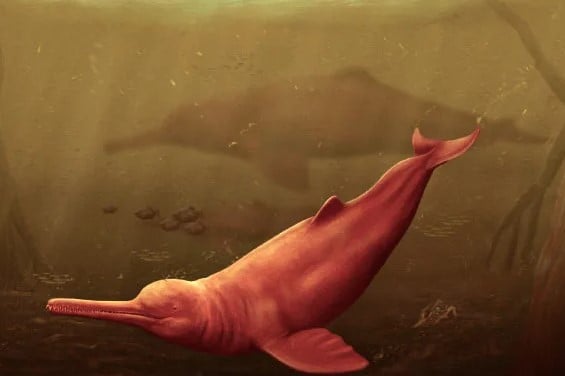
The newly discovered dolphin species, scientifically named Pebanista yacuruna, can grow up to 3.5 meters in length and is the largest freshwater dolphin ever known.
The unusually large size was also noted in other creatures of the same era in the area, including fish and crocodiles.
Pebanista yacuruna belongs to the Platanistoidea family, a group of ancient dolphins that lived between 24 and 16 million years ago.
Scientists initially thought they had found the ancestor of the ancient Amazon river dolphin, but were ultimately surprised when analyses revealed that the South Asian river dolphin was its closest relative.

Fossils of the species Pebanista yacuruna are currently on display at the National Museum of Natural History of Peru. Photo: AFP
The aquatic creature possessed all the characteristic features of Platanistoidea, including a face and specialized bone structures related to echolocation. Meanwhile, its elongated snout suggested it was a fish-eater.
Its fossils have helped to tell the story of the ancient Amazon region.
"Sixteen million years ago, the Amazon region of Peru was very different from today, with much of the present-day plains covered by a vast system of lakes and swamps called the Pebas," said Dr. Aldo Benites-Palomino, a paleontologist from the University of Zurich (Switzerland).
This ancient landscape encompassed aquatic, semi-aquatic, and terrestrial ecosystems, spanning the territories of present-day Colombia, Ecuador, Bolivia, Peru, and Brazil.
However, about 10 million years ago, the environment changed, and the Pebas system gave way to the modern Amazon, where the prey of these giant creatures was no longer available, and therefore they also became extinct.
The new findings reflect the threat to existing freshwater dolphin species, all of which face extinction within the next 20-40 years, according to scientist Aldo Benites-Palomino, who led the research team, in a paper published in the journal Science Advances .
Concurring with this view, Marcelo R. Sánchez-Villagra, director of the paleontology department at the University of Zurich, stated that a common problem facing river dolphins is the imminent threat of extinction, including for their closest fossil relatives, the Ganges and Indus river dolphins. Urban development, pollution, and mining are the main causes pushing the Yangtze River dolphin to the brink of extinction, according to Sánchez-Villagra.
Minh Hoa (compiled from Nguoi Lao Dong and Thanh Nien newspapers)
Source


![[Photo] General Secretary and President To Lam presides over a meeting on preparations for the review of one year of operation of the three-tiered government system.](https://vphoto.vietnam.vn/thumb/1200x675/vietnam/resource/IMAGE/2026/06/02/1780391821195_a1-bnd-4595-9717-jpg.webp)
































































































Comment (0)