

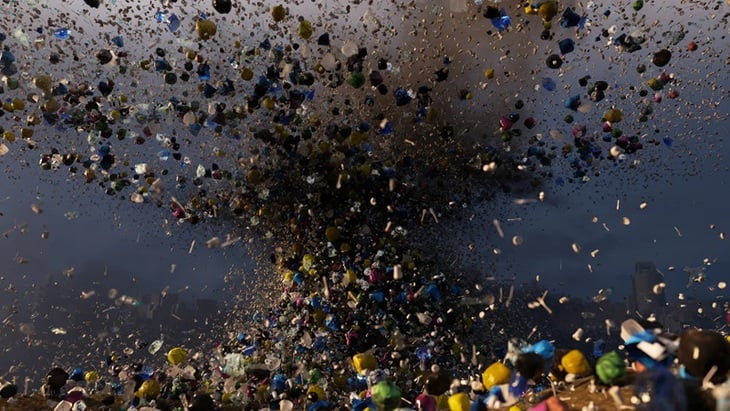
Microplastics and nanoplastics in the atmosphere could be potential contributors to global warming - Photo: ANDRIY ONUFRIYENKO
This finding adds another worrying impact of plastic waste on the Earth's climate system.
Microplastics are primarily known for their ability to infiltrate oceans, soil, air, and even the human body. However, scientists still don't fully understand how these tiny plastic particles affect the atmosphere.
New research shows that plastic particles suspended in the air can absorb sunlight and thermal radiation, thereby creating a warming effect on the planet, according to LiveScience on May 12.
According to the research team, this effect depends on the color of the plastic.
Light-colored plastics tend to scatter light back into space, creating a slight cooling effect. Conversely, dark-colored plastics absorb thermal energy and contribute to an increase in atmospheric temperature.
The team also discovered that even light-colored pieces of plastic gradually turned yellow and darker after prolonged exposure to sunlight, increasing their heat absorption capacity.
Professor Drew Shindell, co-author of the study and a researcher at Duke University (USA), said that the impact of microplastics is still much smaller than that of CO2 emissions from fossil fuels.
The level of warming is estimated to be equivalent to the emissions of a small country or a few percent of CO2 's contribution to climate change.
However, simulation results show that the heating effect from microplastics is about five times stronger than the cooling effect they produce.
To conduct the research, Shindell's colleagues in China collected different pieces of plastic and tested their reaction to light and radiation.
The research team in the US then combined this data with models of atmospheric plastic emissions to assess the global climate impact.
However, the research team acknowledges that there are still many uncertainties, particularly regarding the actual amount of microplastics in the atmosphere.
Most current measurements focus only near the ground for public health purposes, while climate impacts depend on the distribution of plastic particles throughout the entire atmosphere.
Scientists believe this new discovery provides another reason for humanity to take plastic pollution more seriously. Besides harming organisms and human health, plastic waste is now also seen as a contributing factor to exacerbating global climate change.
The study was published in the journal Nature Climate Change .
Source: https://tuoitre.vn/phat-hien-vi-nhua-lam-trai-dat-nong-len-20260514081406591.htm

![[Image] Close-up view of the interchange connecting the two expressways and Long Thanh Airport.](https://vphoto.vietnam.vn/thumb/1200x675/vietnam/resource/IMAGE/2026/05/25/1779703378210_ndo_br_z7863716673926-224453a31600126cce10622af6290afd-4549-jpg.webp)





























































































Comment (0)