

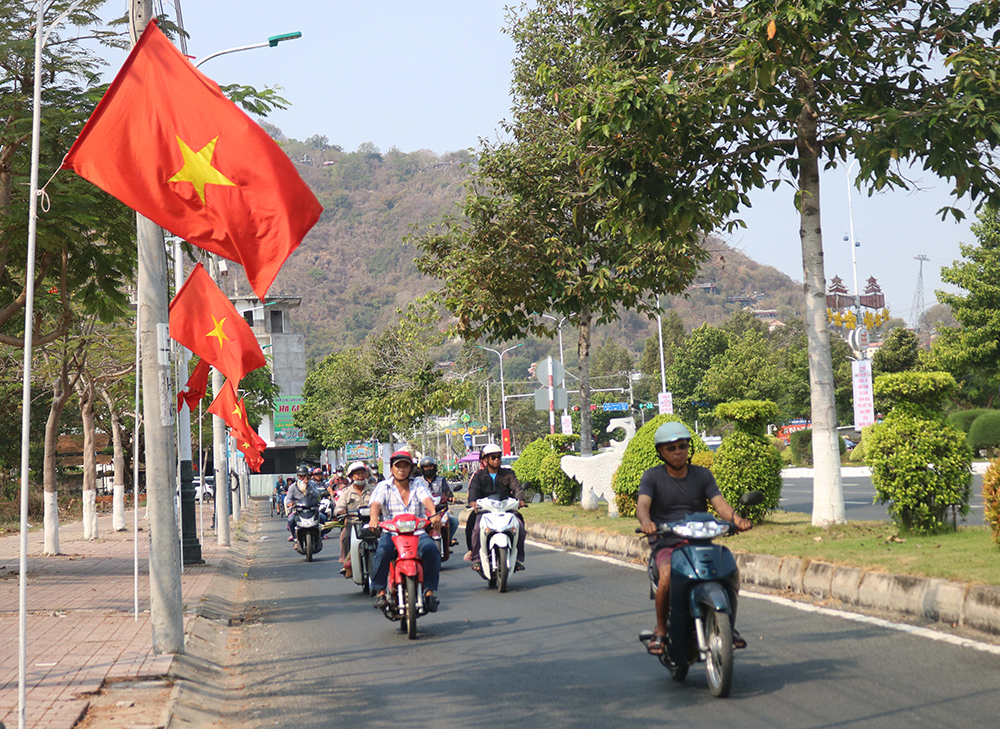
A key spiritual tourism area of the province.
From the beginning, Lord Nguyen established a border defense unit in Chau Doc. This was not yet a formal administrative organization, but merely served as a garrison guarding the Hau River under military rule. In 1788, after recapturing Gia Dinh from the Tay Son dynasty, Nguyen Anh reorganized the administration of Southern Vietnam, placing Chau Doc under the jurisdiction of Vinh Dinh province. In 1802, it was renamed Vinh Thanh province (comprising An Giang and Vinh Long). Documents from the Nguyen Dynasty's Historical Archives record: "Because many areas of that land were abandoned, at the beginning of the year, Gia Long recruited people to settle there, calling it Chau Doc Tan Cuong, and established a border defense unit in Vinh Long province."
During the resistance war against French colonialism, in 1948, the Southern Administrative Resistance Committee merged and demarcated the provinces of Long Xuyen and Chau Doc to form two provinces: Long Chau Tien and Long Chau Hau. The provincial capital of Chau Doc belonged to Long Chau Hau province. At the end of 1950, Long Chau Hau merged with Ha Tien to form Long Chau Ha province. At the end of 1954, the Southern Regional Party Committee re-established the two provinces of Long Xuyen and Chau Doc. After several reorganizations and stabilizations of the organization according to each revolutionary period, the main tasks of the Long Xuyen and Chau Doc Provincial Party Committees were to stay close to the land and the people, leading the masses in the struggle to demand the implementation of the Geneva Agreement, demanding better living conditions and democracy to protect the achievements of the resistance; to strengthen political and military mobilization efforts to recruit people into the enemy ranks; to build bases linked to the political struggle movement; to prepare forces in all aspects; and to proactively confront the enemy...
With the overwhelming momentum of the Great Victory of Spring 1975, on the morning of May 1st, local revolutionary forces rose up and seized the main government offices in the inner city of Chau Doc, combining with armed forces to seize power in the town by noon. Immediately afterwards, Resolution 19 of the Politburo established An Giang province. Chau Doc became the second town of An Giang province, after the provincial capital Long Xuyen. On July 19, 2013, the Prime Minister signed Resolution 86/NQ-CP, establishing Vinh Nguon ward in Chau Doc town; and establishing Chau Doc city in An Giang province.
Having once been the provincial capital of the ancient An Giang region, Chau Doc City is highly regarded for its important position in trade, services, tourism, and border economy. The city has maximized the use of mechanisms, policies, and solutions to mobilize capital from businesses, organizations, and individuals in implementing trade promotion activities. It has leveraged its advantage as a trading hub, with four border economic zones in the province, to promote market linkages within and outside the province. Regarding the new rural development program, Vinh Chau was the first commune in the city and province to achieve this goal in 2013. Chau Doc was also the first district-level unit in the province to complete the new rural development program in 2017; Vinh Te commune achieved the advanced new rural commune standard in 2021.
Using local budget funds and social contributions, the city focuses on investing in social welfare projects, such as: building bridges and inter-communal roads, and concreting all rural roads. The locality promotes investment in agricultural production in a way that serves and connects with tourism development, with products produced using high technology (vegetables, rice, fruits, ecological gardens, etc.). As a result, the rural landscape and environment are more attractive, and the living, working, production, and learning conditions of the people have improved significantly.
For a long time, Chau Doc has been a well-known destination, possessing a complex of ranked cultural and historical relics and unique natural landscapes. Most notably, at the end of 2024, the Via Ba Chua Xu Festival at Sam Mountain was inscribed by UNESCO as a Representative Intangible Cultural Heritage of Humanity. Every year, Chau Doc welcomes millions of domestic and international tourists and pilgrims. By linking culture (especially spiritual culture) with tourism development, the locality is continuously improving the spiritual life of its people; focusing on building a civilized urban lifestyle, with the people of Chau Doc being friendly, compassionate, and "every citizen is a tour guide." Through creative thinking and implementation, Chau Doc City is increasingly affirming its position as a pillar of tourism development in the province, and a key tourism and pilgrimage center of the Mekong Delta.
Looking back on the development journey after so many years of peace, Chau Doc City can truly feel reassured, as 100% of policy beneficiary households have stable lives; it has become the leading locality in the province in sustainably reducing poverty and near-poverty (it is the only district-level unit with no poor households since 2015, and will have no near-poor households by 2024). It is also the leading unit in the province in terms of schools meeting national standards continuously since 2015.
Building upon existing achievements and experiences, with aspirations, willpower, determination, courage, and creativity, the Party Committee and people of this border region will surely continue to write new chapters in history, glorify the century-old tradition, and reap many new milestones in the new era.
Source: https://baoangiang.com.vn/phat-develop-urban-city-of-the-coastal-continental-a419910.html


![[Photo] General Secretary To Lam receives the Special Envoy of General Secretary and President of China Xi Jinping](/_next/image?url=https%3A%2F%2Fvphoto.vietnam.vn%2Fthumb%2F1200x675%2Fvietnam%2Fresource%2FIMAGE%2F2026%2F01%2F30%2F1769759383835_a1-bnd-5347-7855-jpg.webp&w=3840&q=75)


![OCOP during Tet season: [Part 3] Ultra-thin rice paper takes off.](/_next/image?url=https%3A%2F%2Fvphoto.vietnam.vn%2Fthumb%2F402x226%2Fvietnam%2Fresource%2FIMAGE%2F2026%2F01%2F28%2F1769562783429_004-194121_651-081010.jpeg&w=3840&q=75)

![OCOP during Tet season: [Part 2] Hoa Thanh incense village glows red.](/_next/image?url=https%3A%2F%2Fvphoto.vietnam.vn%2Fthumb%2F402x226%2Fvietnam%2Fresource%2FIMAGE%2F2026%2F01%2F27%2F1769480573807_505139049_683408031333867_2820052735775418136_n-180643_808-092229.jpeg&w=3840&q=75)




Comment (0)