

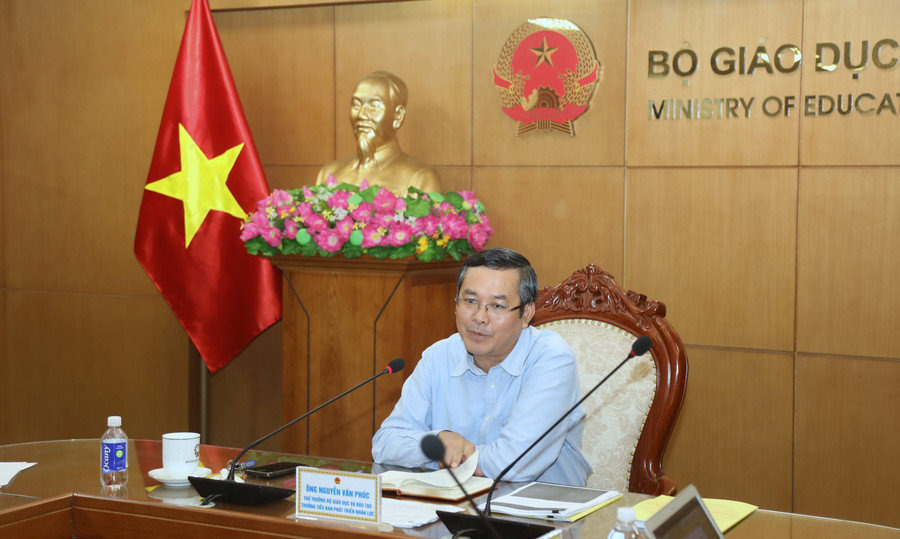
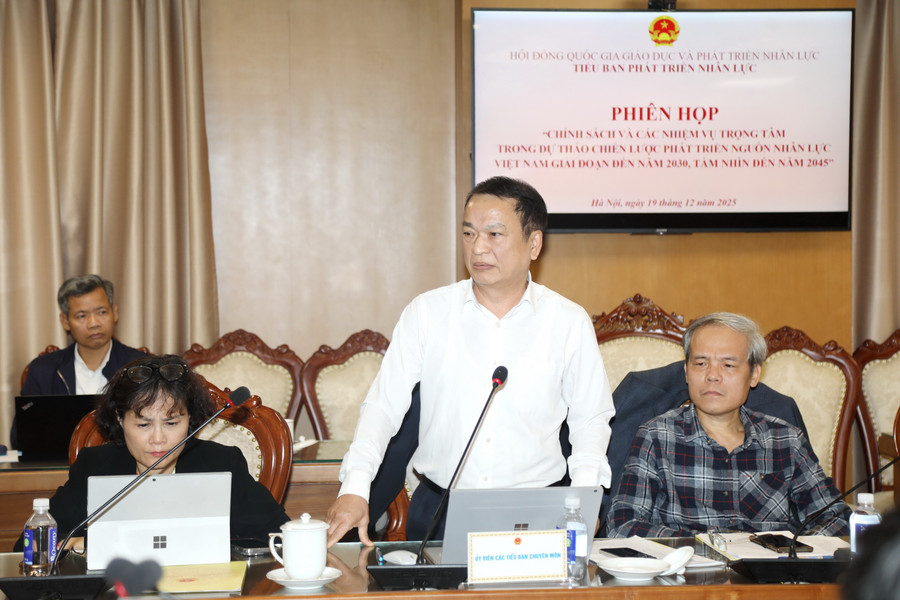
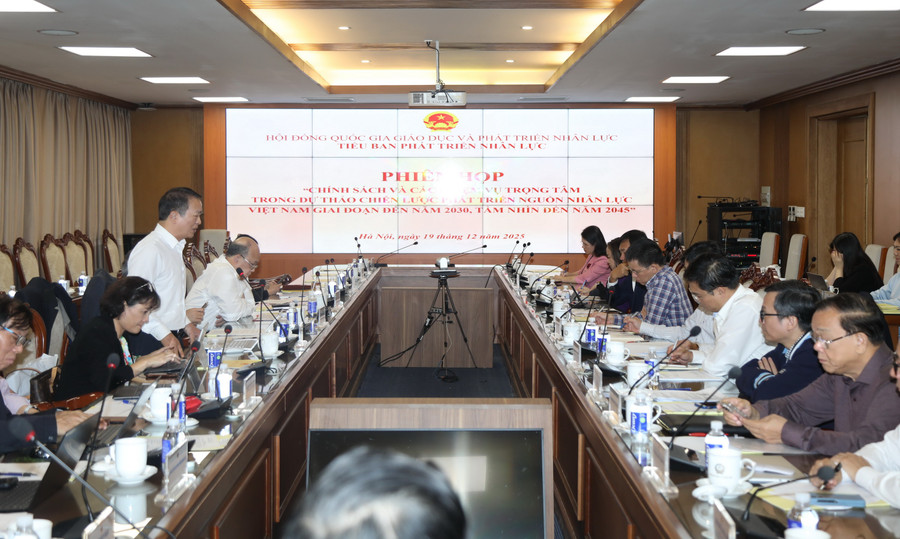
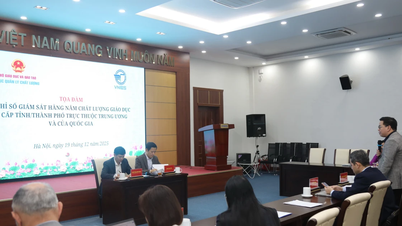
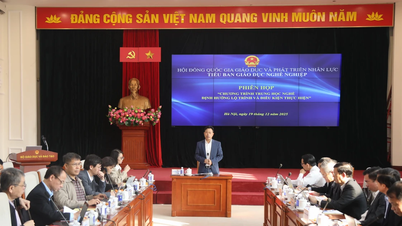
On December 19th, the National Council for Education and Human Resource Development held a meeting on the topic "Policies and key tasks in the draft strategy for human resource development in Vietnam for the period up to 2030, with a vision to 2045". Deputy Minister of Education and Training Nguyen Van Phuc - Head of the Human Resource Development Subcommittee, National Council for Education and Human Resource Development - chaired the meeting.
Human resources are a unique resource.
According to a report by the Ministry of Education and Training, human resources are considered a special resource, a competitive advantage, and a crucial resource for the development of each nation. Human resources play a particularly important role, acting as a breakthrough resource to promote socio-economic development, ensure national defense and security, and contribute to building and protecting the nation.
In terms of economic development, human resources are endogenous resources that dominate other resources. They are linked to intellect, skills, expertise, and the application of science and technology. A prominent characteristic is that they are inexhaustible if properly nurtured, exploited, and utilized, while other resources are finite and can only be effective when combined with human resources.
Human resource development plays a crucial role in shaping and developing social values, reducing poverty, ensuring equity, and creating new resources and impetus for socio-economic development. Therefore, human development, as a form of human resource development, occupies a central position in national resource development; investing in human resource development is a strategic investment and the most solid foundation for sustainable development.
Recognizing the importance of human resource development for economic and social development and the prosperity of the country, the Party and the State have always placed people at the center of the development process, considering them both the goal and the driving force of national development.
From 2021 to the present, Vietnam has been striving to recover its economy after the pandemic and accelerate the digital transformation, industrialization, and modernization process, requiring a higher quality workforce. The quality of the labor force has gradually improved through the increasing proportion of trained workers with degrees and certificates. This proportion has tended to rise in recent years.
Furthermore, the report indicates that, overall, the labor supply still has room for growth, but the quality of the workforce needs immediate improvement to serve the process of industrialization, modernization, and international integration in the context of accelerating digital transformation and the strong development of Industry 4.0 and artificial intelligence.
Although Vietnam's labor productivity has improved, it remains low compared to many countries in Southeast Asia, particularly in the private and state-owned sectors. Compared to the ASEAN-6 countries (Singapore, Malaysia, Thailand, Indonesia, Philippines, Brunei), Vietnam is among the lowest. This threatens the potential for sustainable improvements in quality of life and income.
In particular, the risk of failing to keep pace with and proactively participate in the global artificial intelligence revolution is increasing, leading to a widening gap in AI technology. This necessitates immediate action to leverage AI technology to promote national prosperity while ensuring inclusiveness and ethical use of the technology.
In line with the education and training strategy
The Ministry of Education and Training believes that building a systematic strategy, linking issues together, and providing specific, fundamental, and long-term solutions for national human resource development is extremely necessary and important.
The plan issued by the Government does not delve into analyzing and forecasting the human resource needs of specific industries, sectors, or localities, but rather builds a general policy framework based on human resource measurement indicators. Ministries and sectors are the agencies that best understand the structure, growth rate, and replacement/addition needs of human resources in their respective specialized fields.
Provinces and centrally-governed cities have a thorough understanding of their economic potential, investment structure, and labor needs. This allows for more accurate and timely forecasting of local workforce demand. Therefore, national-level workforce forecasting would be too broad and inaccurate for narrow specialized fields or specific economic sectors.
Against the backdrop of the rapidly evolving and unpredictable global labor market and the decentralization of management responsibilities, the Project serves as a guiding principle for human resource policies nationwide, focusing on three strategic pillars for the sustainable creation and utilization of human resources, and clarifying some fundamental directions for Vietnam's human resources in the coming period.
During the session, delegates unanimously agreed on the assessment that the national human resource development strategy must be linked to the education and training strategy, shifting from training based on learner needs to training based on labor market needs, diversifying levels and professions, including both mass training and retraining/career chuyển đổi.
Professor Pham Hong Quang, Chairman of the Council of Professors in the field of Educational Sciences, believes that the concept of human resources needs to refer to the United Nations Development Organization's concept of "Developing human nature and capabilities and utilizing those capabilities," and suggests the issuance of macro-level policies to govern it.
Resolution 71 of the Politburo on breakthroughs in education and training development mentioned the Human Development Index (HDI), which assesses a nation's development based on three main aspects: health (average life expectancy), knowledge (education), and living standards (per capita national income), emphasizing that people and their capabilities are the criteria for evaluating true development, not just economic growth.
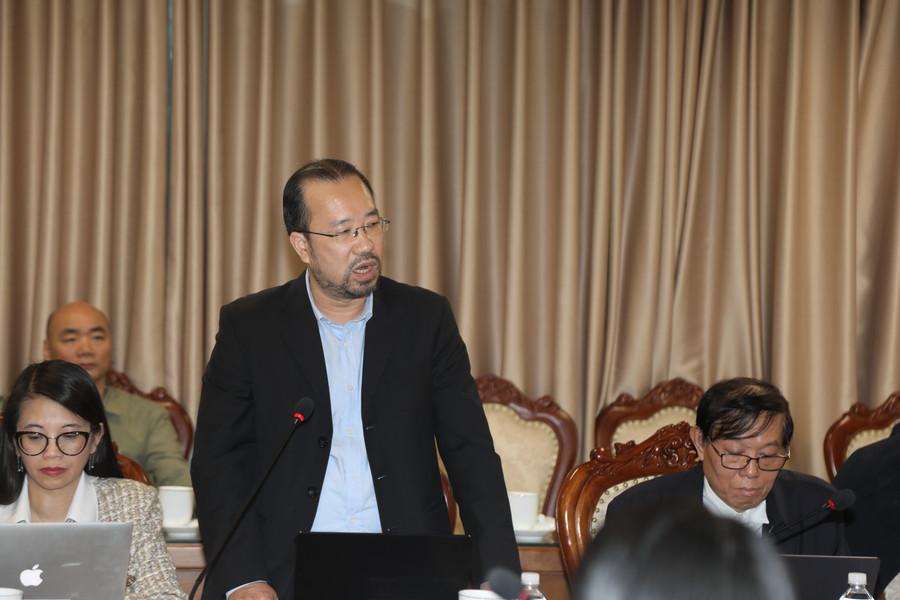
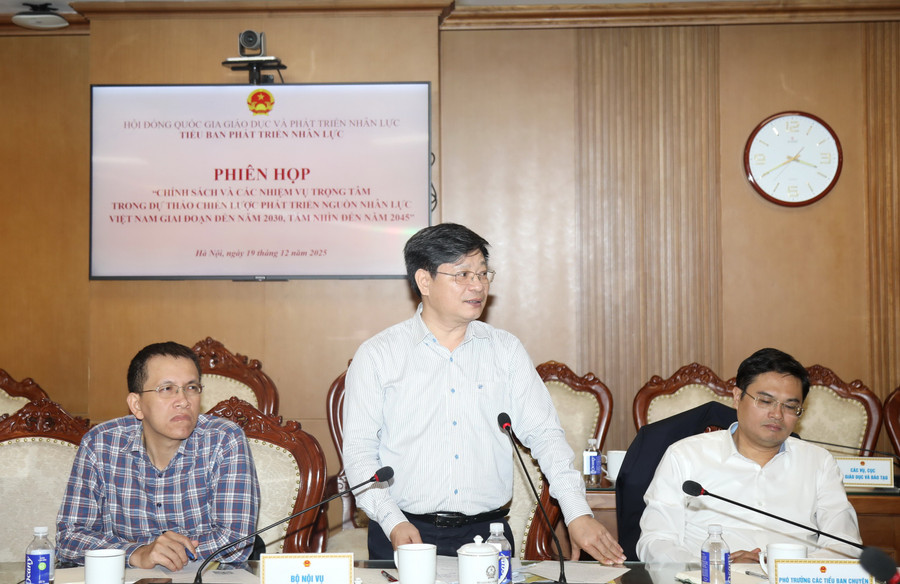
Mr. Pham Manh Thuy, from the Institute of Economic and Financial Strategy and Policy, Ministry of Finance, stated: In social development, it is necessary to care for the health of the people and the development of the entire society, from the vulnerable to those who have made contributions. Human resource development requires a holistic approach, involving coordination among many ministries, sectors, and units.
Human resource development should not only focus on quantity but also place special emphasis on quality, with a focus on developing the skills, professional ethics, and adaptability of workers. Prioritizing high-quality human resources is essential to promoting the application of science and technology, restructuring the economy, and transforming the growth model.
It is necessary to closely link education and training with mechanisms for recruiting, utilizing, and rewarding talent, attracting experts from both within and outside the country; promoting the shift in labor structure towards modernization and strengthening international cooperation. Human resources are an integral part of socio-economic development, linked to socio-economic development and the need for labor force training.
Mr. Bui Ton Hien, Deputy Director of the Institute of State and Labor Organization Science, Ministry of Interior, stated that: The contents of the draft Human Resource Development Strategy to 2030, with a vision to 2050, fully reflect the necessary and important legal aspects in the overall development.
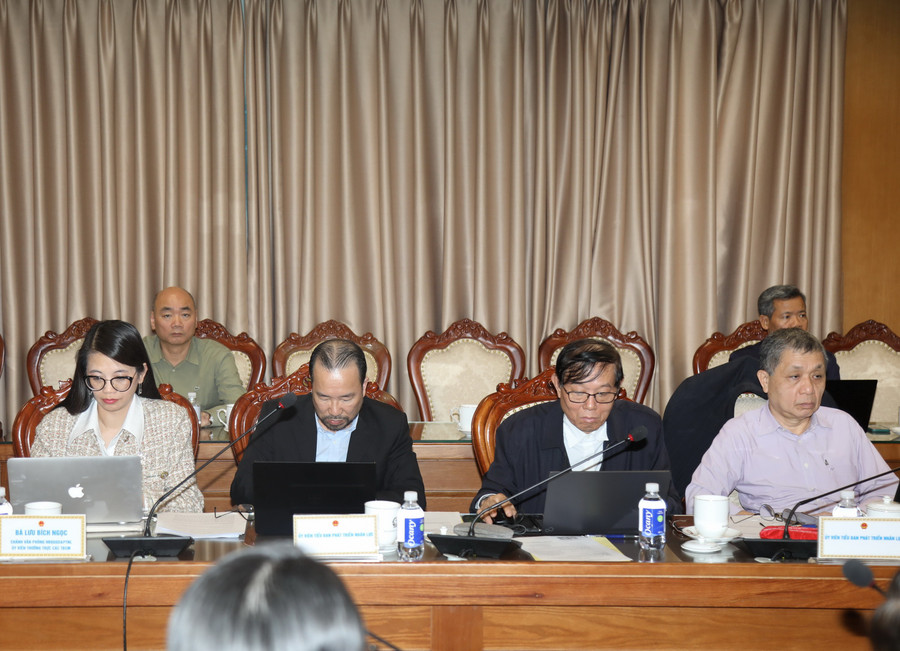
The national human resource development strategy needs to be linked to the orientation of science and technology development, strongly adapting to the context of digital transformation, the Fourth Industrial Revolution, and the transition to a knowledge-based economy, green economy, and circular economy. It should gradually remove bottlenecks in human resources, prioritizing the training of human resources for cutting-edge science and technology sectors, basic sciences, and core technologies.
Human resource development strategies must be linked to the overall human development strategy, population and social security policies, employee benefits, and healthcare for the elderly and children. Emphasis should be placed on moral education, character development, creative abilities, life skills, work skills, foreign languages, information technology, digital technology, and an international integration mindset.
Concluding the meeting, Deputy Minister Nguyen Van Phuc stated that the Human Resource Development Strategy to 2030, with a vision to 2045, aims to develop a comprehensive, high-quality Vietnamese workforce capable of adapting and competing strongly in the region and globally, possessing superior skills and labor productivity, especially in high-tech and strategic technology fields, and capable of proficiently using and mastering artificial intelligence technology.
The Ministry of Education and Training and the National Council for Education and Human Resource Development will incorporate the feedback from the meeting to further refine the proposal and submit it to the Prime Minister for promulgation as soon as possible.
Source: https://giaoducthoidai.vn/phat-trien-nguon-nhan-luc-thich-ung-voi-su-phat-trien-cua-tri-tue-nhan-tao-post761214.html


![[Photo] Prime Minister Pham Minh Chinh attends the Conference on the Implementation of Tasks for 2026 of the Industry and Trade Sector](/_next/image?url=https%3A%2F%2Fvphoto.vietnam.vn%2Fthumb%2F1200x675%2Fvietnam%2Fresource%2FIMAGE%2F2025%2F12%2F19%2F1766159500458_ndo_br_shared31-jpg.webp&w=3840&q=75)


















































































Comment (0)