

Developing a team of ethnic minority cadres, civil servants, and public employees – collectively referred to as ethnic minority cadres – is an important part of the Party and State's personnel work, closely linked to ethnic affairs and building national unity.
This is a task of both long-term strategic importance and urgency in improving the effectiveness and efficiency of state management, ensuring political and social stability, and promoting sustainable development in ethnic minority and mountainous regions.
"Personnel are the foundation of the work."
The story in Cho Ra commune, Thai Nguyen province, is a testament to the assertion that wherever there is a team of competent, reputable, and dedicated officials, the socio -economic situation will clearly improve.

Formed by merging three administrative units: Địa Linh, Thượng Giáo, and Chợ Rã town of the former Ba Bể district, Bắc Kạn province, the commune now has 12 out of 31 villages classified as particularly disadvantaged, concentrated in the former Địa Linh and Thượng Giáo communes. The "bottleneck" to Chợ Rã's development after the merger is its weak infrastructure, limited livelihoods, and the fact that some residents still rely heavily on government policies.
Notably, the solution to the problem didn't start with capital or projects, but with people. The Thai Nguyen Provincial Party Committee transferred and appointed Mr. Duong Ngoc Thuyet (born in 1978), Secretary of the Ba Be District Party Committee, as Secretary of the Party Committee; and transferred and appointed Mr. Trieu Anh Chu (born in 1986), Head of the Propaganda and Mass Mobilization Department of the Ba Be District Party Committee, as Chairman of the People's Committee of Cho Ra commune for the 2021-2026 term.
As of May 31, 2023, the whole country had 260,209 out of 2,147,892 ethnic minority cadres, accounting for 12% of the total staff; of which 9,390 were at the central level and 250,819 at the local level. Of the total 260,209 ethnic minority cadres, 130,074 were under 40 years old (50%), and 151,788 were female cadres (58%).
( Excerpt from Report No. 3286/BC-BDTTG dated December 31, 2025, of the Ministry of Ethnic Minorities and Religions on the preliminary review of the situation and results of implementing the Ethnic Affairs Strategy for the period 2021-2030, with a vision to 2050)
These are two officials of the Tay ethnic group, who have received thorough training, are well-suited to the practical requirements of Cho Ra, and have held important positions.
Before becoming Secretary of the Ba Be District Party Committee, Mr. Thuyet was the Director of the Department of Transport of Bac Kan province (formerly); and Mr. Chu, before becoming Head of the Propaganda and Mass Mobilization Department of the Ba Be District Party Committee, was the Chief of the Ba Be District Party Committee Office.
A person with in-depth knowledge of transportation infrastructure and a strong ability in propaganda and mobilization – this combination quickly created tangible progress at the grassroots level. The focal point was a series of projects such as the Phja Khao road, the Coc Lang - Na Lung road, the Na Kha dam and canal, and the maintenance system for internal village roads in Na Sam and Pac Phai… which were invested in and put into use.

Thanks to the collaborative efforts of Mr. Duong Ngoc Thuyet and Mr. Trieu Anh Chu, along with the endeavors of the Party Committee, the government, and the people of all ethnic groups, Cho Ra commune has made a breakthrough in socio-economic development. By the end of 2025, the commune's economic growth rate is estimated at 8.1%, per capita income is expected to reach approximately 43.6 million VND/year, and the poverty rate will decrease by 7.72%, exceeding the set plan.
Behind those figures lies one clear truth: When the right, competent, and effective officials are in place, even the most challenging areas will transform. This result has been recognized by the people, who continue to place their trust in them for the new term.
In the recent election, Duong Ngoc Thuyet, Secretary of the Party Committee of Cho Ra commune, was elected as a representative to the Thai Nguyen Provincial People's Council. At the first session of the Cho Ra Commune People's Council on March 26, 2026, Mr. Trieu Anh Chu was re-elected as Chairman of the Commune People's Committee for the 2026-2031 term.
For sustainability, we must start from the "roots".
In reality, for policies to be implemented effectively, the decisive factor remains the people – officials who dare to think, dare to act, dare to take responsibility, and are committed to the grassroots. However, to build such a team, we cannot rely on "existing resources," but must proactively create a pool of talent from an early stage and from afar.
In the story of Cho Ra commune, Mr. Trieu Anh Chu is a typical example of the growth of ethnic minority cadres through practical experience. Graduating with honors from university with a major in agriculture and forestry, and selected to participate in the pilot project to strengthen the role of 600 young intellectuals as Vice Chairmen of communes in 64 poor districts according to Decision No. 170/QD-TTg dated January 26, 2011, Mr. Chu has grown through each position he has held.
After nearly 5 years (2012-2017) as Vice Chairman of Dong Phuc commune, Ba Be district (formerly), Mr. Chu was transferred and appointed as Standing Deputy Secretary - Chairman of the Party Committee's Inspection Committee of Quang Khe commune, Ba Be district (formerly), and then as Deputy Secretary of the Party Committee - Chairman of the People's Committee of this commune.

Since 2018, Mr. Trieu Anh Chu has been entrusted with leadership responsibilities at the departmental level in Ba Be district (District Party Committee Office, Culture and Information Department, and the District Party Committee's Propaganda and Mass Mobilization Department).
The career path of Chairman of the People's Committee of Cho Ra Commune, Trieu Anh Chu, demonstrates one thing: officials don't appear naturally, and certainly can't be "created" in a short time. They are the result of a purposeful and strategic process of training, development, utilization, and testing.
Not only in Cho Ra, but many other mountainous localities also affirm that wherever there is a team of competent, reputable, and dedicated officials, the socio-economic situation improves significantly, and the lives of the people are gradually enhanced.
Prepare early, lay the groundwork in advance.
Individuals like Mr. Trieu Anh Chu need to be systematically identified, nurtured, and replicated. The focus should be on building a pool of ethnic minority cadres starting from students with potential; creating conditions for them to receive systematic training, develop in a good environment, and return to serve their localities.
This should be accompanied by a rational recruitment, utilization, and rotation mechanism to allow young officials to gain practical experience and grow from the grassroots level; at the same time, there should be strong enough policies to ensure they feel secure and committed to working in challenging areas in the long term.
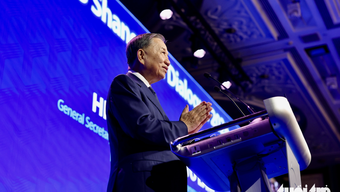
At the meeting with outstanding and exemplary ethnic minority students and youth in 2025 on the afternoon of December 26, 2025, then General Secretary To Lam emphasized that, with the attention and decisive involvement of the entire political system, along with the efforts of ethnic minority students and youth, a new generation of young ethnic minority intellectuals is gradually forming, asserting its role in the political system, in state management, science and technology, and in socio-economic development.

The project to train, nurture, and develop a pool of ethnic minority cadres from outstanding students, initially focusing on selecting and awarding scholarships for overseas training to a number of commended students, is being developed with the goal of continuing to care for, nurture, and further promote the role of the younger generation of ethnic minorities, building a high-quality workforce in the new era of development.
This strategic policy is a fundamental step in forming a generation of ethnic minority cadres who are prepared early and from afar, ensuring continuity and sustainable development for disadvantaged areas.
Experience from Cho Ra and many other localities shows that investing in infrastructure can create change, but investing in people creates the future. When the workforce is well-prepared, continuously trained, and strategically oriented, disadvantaged areas will not only escape poverty but will also rise to sustainable development on their own.
The project "Developing the workforce of ethnic minority cadres, civil servants, and public employees in state agencies and public service units in the period 2026-2030, with orientation to 2035" (the Project) was approved by Decision No. 470/QD-TT dated March 24, 2026. According to the roadmap, the target is to reach 80% by 2026-2030 and 100% by 2030-2035.
- Ensure that the structure of ethnic minority cadres corresponds to the proportion of ethnic minorities in the total population of the province; and is consistent with the structure of ethnic minority groups in the locality.
- Ensure a reasonable structure of ethnic minority cadres holding leadership and management positions at all levels. Specifically, the Ministry of Ethnic Minorities and Religion should have at least 20% to 25% of the total number of leadership and management positions.
- At the local level, a minimum of 10% at the provincial level must be ethnic minority officials, and a minimum of 20% at the commune level must be ethnic minority officials. For public service units at the local level with 30% or more ethnic minority officials, there must be ethnic minority management staff.
- Ensure that the proportion of female cadres from ethnic minority groups is at least 20% of the total minimum percentage of cadres from ethnic minority groups.
Regarding the quality of ethnic minority cadres, the goal is to achieve 80% by 2026-2030 and 100% by 2030-2035 of ethnic minority cadres receiving training and professional development in specialized skills, political theory; knowledge and skills in state management, science and technology, innovation and digital transformation, digital skills and modern management methods, meeting the requirements of national digital transformation; and training in information technology, foreign languages or ethnic minority languages to meet the requirements of their job positions as prescribed.
Source: https://vietnamnet.vn/phat-trien-tu-som-tu-xa-doi-ngu-can-bo-nguoi-dan-toc-thieu-so-2501830.html



![[Photo] General Secretary and President To Lam and the President of the Philippines hold talks.](https://vphoto.vietnam.vn/thumb/1200x675/vietnam/resource/IMAGE/2026/06/01/1780286997787_anh-man-hinh-2026-06-01-luc-11-09-43.png)








































































Comment (0)