

On June 26, 2025, the Party Congress of the Institute of Applied Technology for the 2025-2030 term was solemnly held with the motto "Unity - Democracy - Innovation - Development". Comrade Hoang Minh, Member of the Standing Committee The Party Committee and the Deputy Minister of Science and Technology attended and directed the Congress.
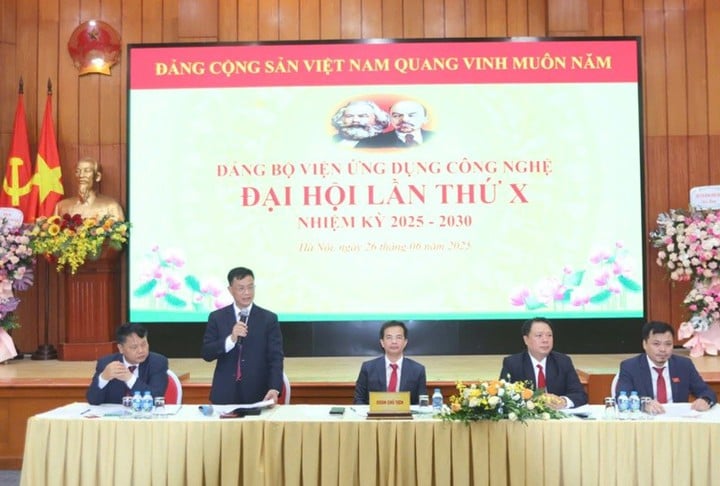
Presidium of the Congress.
To comprehensively fulfill the objectives set forth in the Resolution of the 9th Party Congress
Presenting the political report at the Congress, Comrade Giang Manh Khoi, Deputy Secretary of the Institute's Party Committee, stated that during the 2020-2025 term, the Institute's Party Committee successfully led and directed the comprehensive implementation of all goals and targets set forth in the Resolution of the Congress. Many important targets were exceeded, notably the target for admitting new Party members, which exceeded the resolution by 20%. Party building work has seen many positive changes; the organizational structure has been streamlined for efficient and effective operation; and the level of financial autonomy has been gradually improved. The Institute's scientific and technological potential continues to be consolidated and developed. Research and technology transfer activities have achieved many practical results. Many scientific and technological products have been applied in practice, making positive contributions to economic development, national defense and security, and improving social life. The activities of mass organizations have been maintained in an orderly and effective manner. The core role of Party members in mass mobilization work has been enhanced; internal unity has been strengthened, creating momentum to promote the spirit of emulation, innovation, and creativity throughout the Institute.
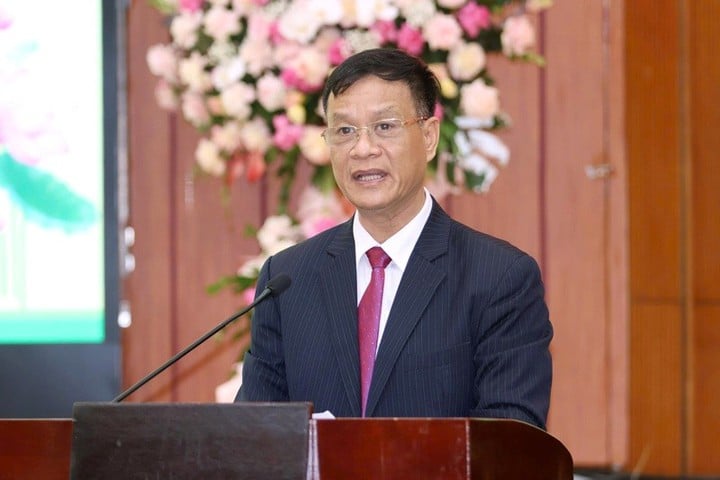
Comrade Giang Manh Khoi, Deputy Secretary of the Party Committee of the Institute of Applied Technology, presented the Political Report at the Congress .
The political report also highlighted several limitations and shortcomings, such as: some scientific research results have not been effectively commercialized and are not deeply linked to market needs; the transition to an autonomous mechanism still faces many difficulties and obstacles; the implementation progress among units within the Institute is uneven; some subordinate Party branches are still hesitant and passive in implementing new policies, and have not yet demonstrated initiative and creativity in organizing and carrying out tasks.
Innovate the model, achieve breakthrough development.
The Congress identified the main goals, directions, and key tasks of the Institute for the 2025-2030 term, which are: building a clean and strong Party Committee within the Institute; enhancing the leadership capacity and fighting strength of Party committees and branches at all levels; leading the effective implementation of science and technology tasks; using the growth of enterprises as the output criterion for technology development; focusing on developing scientific and technological potential and innovation to meet the requirements of the new situation. The Institute will strengthen scientific publications, technology transfer, international cooperation, and commercialization of research products. Effectively implement the financial autonomy mechanism; enhance the management capacity and brand value of the Institute through the application of comprehensive digital transformation.
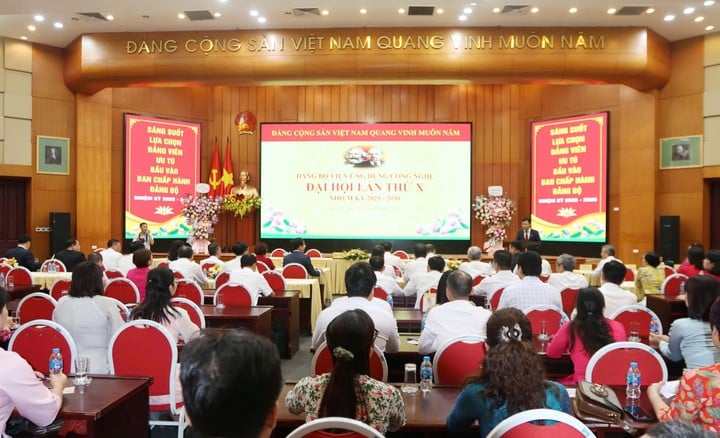
Overview of the Congress.
In terms of direction, the Institute will continue to enhance the leadership capacity and fighting strength of the Party organization; promote the role of the political nucleus in fulfilling the unit's political tasks; and build a clean, strong, and comprehensive Party committee. Party building will be closely linked to improving the quality of applied research, science and technology services, technology transfer, international integration, and reforming the organizational model towards autonomy, modernity, and efficiency.
Regarding professional work targets, 100% of science and technology development tasks involve commissioning or testing by enterprises; of which, at least 60% of tasks have products used in enterprises and at least 30% have products with commercialization potential; register at least 5 utility solutions or inventions each year and gradually increase each year; establish and maintain at least 10 collaborations with enterprises or partners/year. Ensure that the percentage of research staff with postgraduate qualifications reaches ≥ 60%, of which the percentage of staff with doctoral degrees reaches at least ≥ 20% by 2030; develop at least 01 science and technology enterprise directly under the Institute; ensure that the percentage of revenue from sources outside the state budget accounts for ≥ 60% of the total revenue of the entire Institute; the percentage of financial autonomy increases gradually each year.
The Institute has set forth key tasks and breakthroughs: Gradually and effectively implement the autonomy mechanism as prescribed, ensuring a balance between development requirements and the unit's internal capacity; develop a highly qualified scientific staff and build strong research groups to meet the requirements of the new situation; promote international cooperation and technology transfer with domestic and foreign organizations to enhance research, application, and innovation capabilities; strengthen the application of digital technology and implement digital transformation in management, operation, and scientific research, contributing to improving the Institute's operational efficiency.
Specifically, this involves reforming the research institute's governance model to link research with the market; strongly applying digital technology and artificial intelligence in research and management; developing interdisciplinary research groups; and building 3-5 key science and technology products with high commercialization potential.
Becoming a shining example of technology.
In his address at the Congress, Deputy Minister Hoang Minh highly appreciated the orientations and targets set forth in the political report. The Deputy Minister emphasized that if implemented seriously, the Institute will experience positive changes, meeting the requirements in the new context.
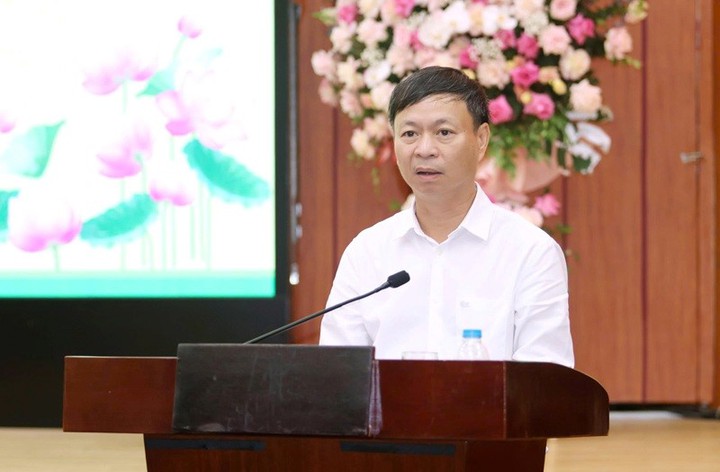
Deputy Minister of Science and Technology Hoang Minh delivered a keynote address at the Congress.
According to the Deputy Minister, the entire country is undergoing a restructuring of its organizational structure with many major changes. The Institute needs to clearly define its role and operational direction to suit this new stage of development. When mentioning the Institute of Applied Technology, it is necessary to mention its specific products, its leading role in applying policies and institutions, and its leadership in modern technologies with high applicability. The Institute was once a cradle for training high-quality science and technology personnel, and also the birthplace of many entrepreneurs and large enterprises such as FPT and CMC... With such a glorious past, the Institute needs to inherit and build upon it.
In the current phase, the Institute needs to closely follow practical realities, starting from the demands of life to research and deploy technology. The demands of rapid socio-economic development require science and technology to play a key role.
Deputy Minister Hoang Minh noted that the application of science and technology is not only a professional task but also an economic and market issue. Therefore, the Institute must both research and apply technology, and provide consulting and support for business models, technology transfer, and product commercialization. The Institute needs to change its mindset, solve major problems from practical experience, and look at market realities.
Sharing about one of the major challenges currently facing research and product output, the Institute needs strong intermediary organizations to connect units inside and outside the Institute, effectively disseminating technology.
The Deputy Minister expects that by 2027, the Institute of Applied Technology will become a leading unit in terms of scientific and technological potential in key areas. The Institute needs to maintain its cohesive and integrated organizational model; and continue to be a proud highlight of Vietnam's science and technology sector.
In his concluding remarks at the Congress, Hoang Ngoc Nhan, Secretary of the Party Committee of the Institute of Applied Technology, affirmed that in the coming time, the Institute will focus on promoting the development of its scientific and technological potential and actively participate in solving major national problems in this field.
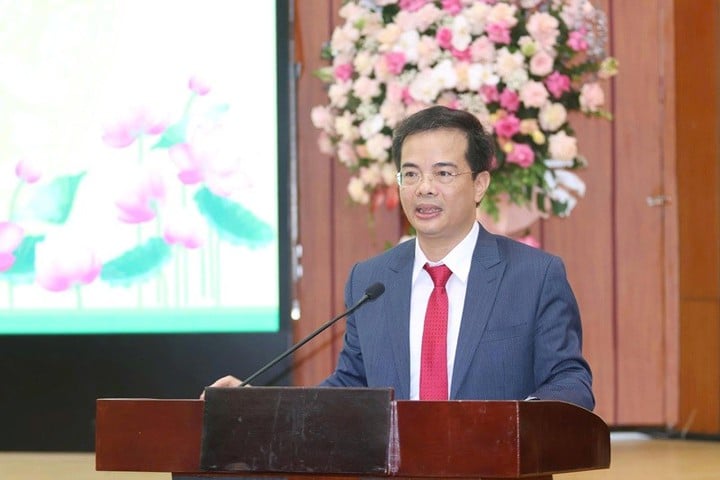
Comrade Hoang Ngoc Nhan, Secretary of the Party Committee and Director of the Institute of Applied Technology, delivered a speech at the Congress.
In addition, the Institute will continue to collaborate with businesses in ordering and implementing research and application tasks, and transferring results into practical applications. The Institute also aims to master one to two cutting-edge technology fields, playing a leading role and contributing to promoting sustainable socio-economic development in the new context.
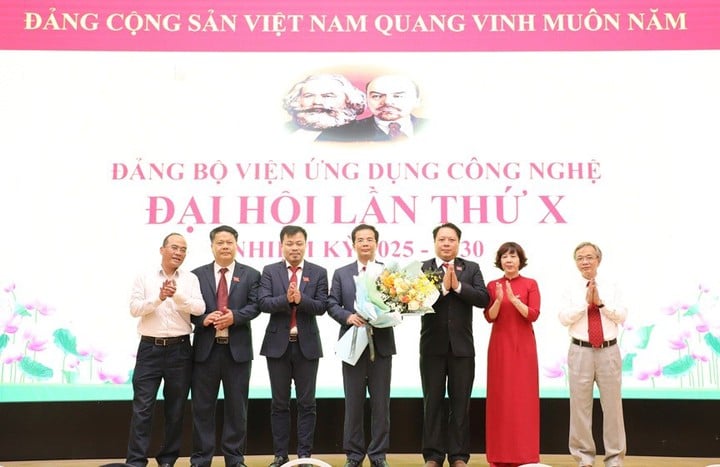
The Executive Committee of the Party Committee of the Vietnam Institute of Applied Technology for the term 2025-2030 has been introduced.
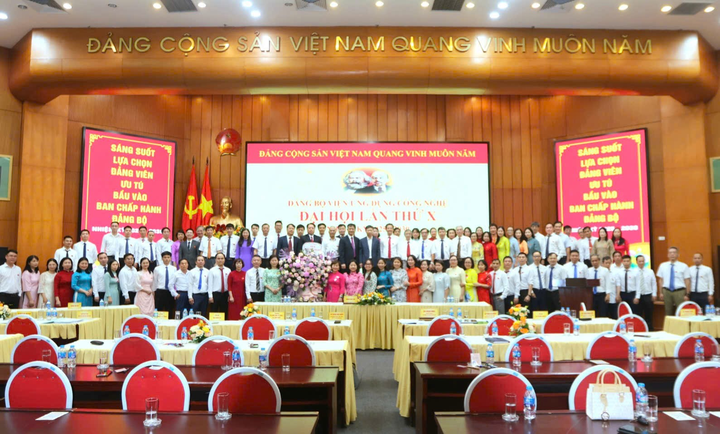
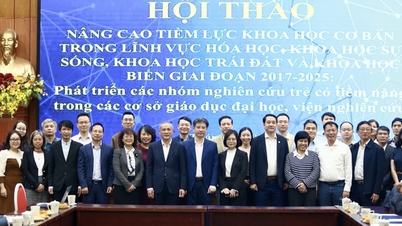
Deputy Minister of Science and Technology Hoang Minh poses for a photo with delegates attending the Congress.
Source: https://mst.gov.vn/phat-trien-vien-ung-dung-cong-nghe-tro-thanh-to-chuc-khoa-hoc-va-cong-nghe-hien-dai-dan-dat-doi-moi-sang-tao-trong-giai-doan-moi-197250626225840457.htm


![[Photo] Prime Minister Pham Minh Chinh presides over a meeting on private sector economic development.](/_next/image?url=https%3A%2F%2Fvphoto.vietnam.vn%2Fthumb%2F1200x675%2Fvietnam%2Fresource%2FIMAGE%2F2025%2F12%2F20%2F1766237501876_thiet-ke-chua-co-ten-40-png.webp&w=3840&q=75)























































Comment (0)