Fascinating but not easy to tell.
Recently, the film "Trang An Firewall" has attracted much attention as it draws inspiration from the Mr. Pips case – a high-tech investment fraud scheme that once rocked society. Beyond simply telling the story of solving the case, the film also reflects the "dark sides" of the digital space, where greed, gullibility, and technology are exploited to create large-scale scams. Bringing a case close to contemporary life to the screen demonstrates the producers' effort to engage viewers with social warnings through film.

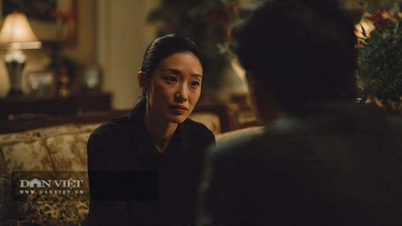
Scene from the movie Dedication
PHOTO: PUBLIC SECURITY CINEMA
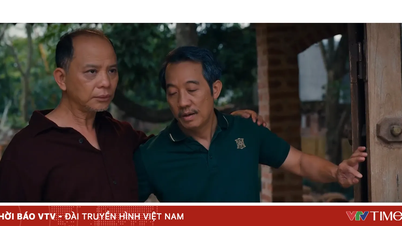
Meanwhile, " Dedication," a political-espionage drama currently airing on VTV3, chooses a different subject matter: the life and operational journey of People's Armed Forces Hero Nguyen Thanh - an intelligence officer codenamed P1. The film portrays a real person who lived on the brink of life and death, operated behind enemy lines, and accepted personal sacrifice for his ideals.
Upcoming is the CM12 Project , based on the CM12 memoir - "Behind the Counter-Intelligence Plan" by Major General and writer Nguyen Khac Duc. This is a real case from the early 1980s, targeting spies, commandos, exiled reactionary organizations, especially the United Front of Patriotic Forces for the Liberation of Vietnam led by Le Quoc Tuy and Mai Van Hanh.

Scene from the movie Dedication
PHOTO: PUBLIC SECURITY CINEMA
According to filmmakers, drawing content from real-life "prototypes" is both fascinating and stressful. The most difficult part isn't recounting an event or a person, but rather balancing authenticity with the appeal of a television production. Too much factual reliance on documentation can make a film dry, while excessive fictionalization risks negative reactions for distorting the truth or misrepresenting the real-life character.
According to director Tran Ka My of the film "Dedication ," characters in the intelligence field are often associated with sensitive information that is not always readily available or publicly disclosed. Therefore, filmmakers must be selective, even accepting the need to tell "part of the truth" or "half the truth," while still maintaining the essence of the subject. The challenge is how to present this "grey area" to the audience from the most accurate perspective.

Scene from the movie Dedication
PHOTO: PUBLIC SECURITY CINEMA
"Making films about 'real people and real events' has both difficulties and advantages. It's easy because you already have the events and characters… that's the foundation to develop; but it's difficult because your ability to use fiction and creativity is limited, and that's the 'forbidden zone.' Of course, filmmakers can still use fiction and creativity, but within limits, they can't go too far or deviate too much from the truth," said Tran Duy Linh, director and screenwriter of the film "The CM12 Plan ."
According to filmmakers, another pressure comes from the research and verification of documents, the reconstruction of settings, costumes, the language of the era, and even the psychology of the characters. With films based on real events like "The CM12 Plan" or "Dedication ," even a small inaccuracy can provoke a reaction from the audience, especially those involved or who witnessed the events. That's why directors, screenwriters, and producers often work with historical consultants, authorities, or relatives of the real-life figures to ensure accuracy.
DRAMA-THE-SCALE OF A REAL EVENT
The key to making "true stories" appealing to audiences is telling the story with emotion, not just information. Today's audience not only wants to know what happened, but also wants to understand how the people involved lived, chose, and sacrificed. When history is told through the breath of fate, seemingly dry criminal cases or security files can become captivating works of art.

On the set of the CM12 Project
PHOTO: PROVIDED BY THE FILM CREW
According to director Tran Duy Linh: "To attract viewers, the film must first be dramatic and engaging. That's why I researched and chose to develop the project in the direction of 'docu-drama,' which means 'dramatizing real events,' recounting real events in the most engaging way possible, while still ensuring the authenticity of those events. To achieve this, when writing the script, I had to follow storytelling techniques and methods, build a tight storyline structure, choose compelling climaxes… and then arrange the events and details according to this structure."
Director Tran Ka My believes that a balance is needed between authenticity and cinematic quality. Finding that balance is not easy, and every creative decision must be carefully considered. "Adding creative elements" to biographical films is not about "inventing things for dramatic effect," but rather about reorganizing the truth using cinematic language.
"I always adhere to one principle: details can be changed, but the essence remains. For example, multiple events can be combined into one, or several characters can be created collectively, but the psychological journey, moral choices, and spirit of the main character must remain true. To make the character both close to the real-life archetype and relatable to the audience, the character must be brought closer to real life. An intelligence officer in a film is not just a 'missionary,' but also a human being with their own relationships and internal struggles. When the audience sees that 'human' side, they will believe in and empathize with the character, instead of just seeing them as a symbol," the director of the film " Dedication " added.
Source: https://thanhnien.vn/phim-truyen-hinh-khai-thac-nguoi-that-viec-that-185260517222340277.htm



![[Image] Hanoi's urban life under the challenge of a "scorching hot" environment](https://vphoto.vietnam.vn/thumb/1200x675/vietnam/resource/IMAGE/2026/05/25/1779706979265_nang-nong-t5-2026-minh-duy-7-4636-jpg.webp)

![[Image] Close-up view of the interchange connecting the two expressways and Long Thanh Airport.](https://vphoto.vietnam.vn/thumb/1200x675/vietnam/resource/IMAGE/2026/05/25/1779703378210_ndo_br_z7863716673926-224453a31600126cce10622af6290afd-4549-jpg.webp)



















































































Comment (0)