

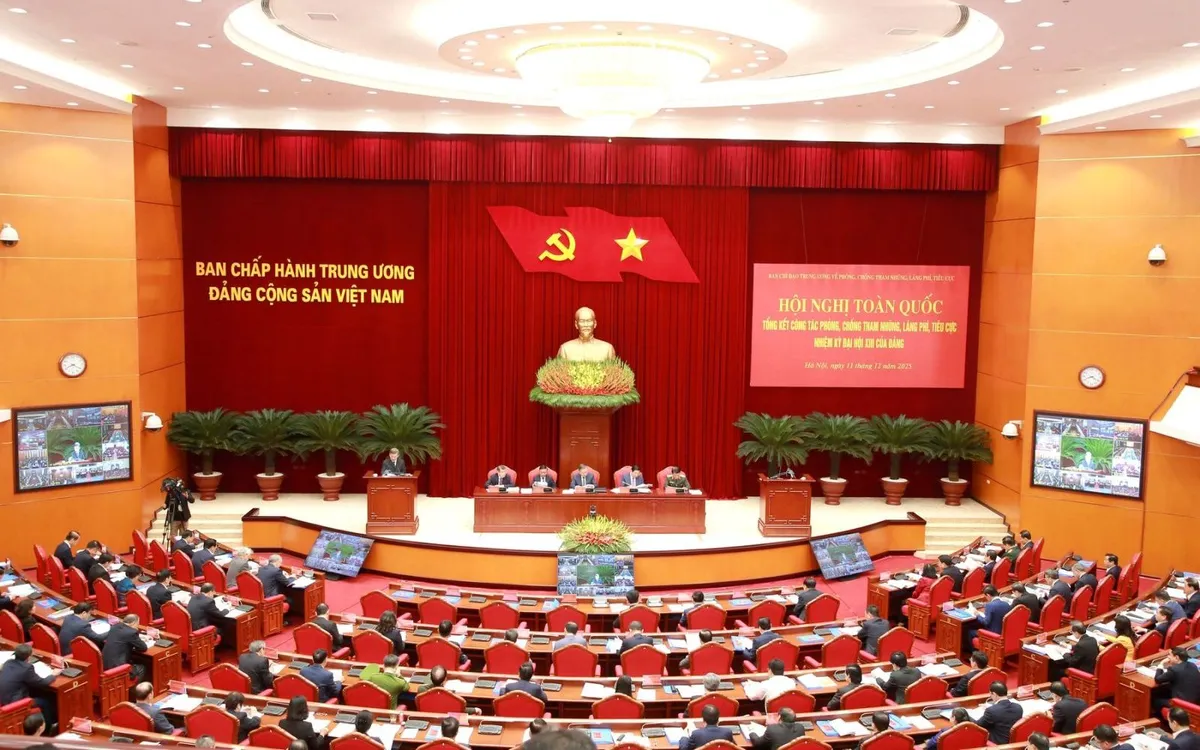
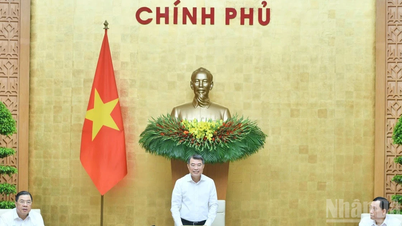
National Conference summarizing the work on preventing and combating corruption, waste, and negative practices in December 2025.
Corruption not only causes the loss of public assets but, more dangerously, erodes the people's trust in the Party and the government apparatus. For a ruling party, this is the greatest loss. Therefore, from Ho Chi Minh's ideology to the Party's current views and policies, preventing and combating corruption has always been identified as a vital task to maintain the integrity of the political system, protect the Party's leadership role, and strengthen the foundation of social trust.
In a period when the country is entering a new phase of development with increasingly high demands for governance effectiveness and discipline, combating corruption is no longer just about dealing with wrongdoings after the consequences occur. More importantly, it is a process of controlling power to prevent corruption from within, preventing power from being abused for personal or group interests.
Controlling power is at the core of preventing and combating corruption.
From a very early age, President Ho Chi Minh foresaw the dangers of corruption, waste, and bureaucracy to the survival of the revolutionary government. He likened these negative manifestations to "worms" silently gnawing away at a tree trunk from within. This simple image contains profound wisdom: an organization can withstand external pressure, but it will be extremely dangerous if decay begins to appear within its ranks without being detected and prevented in time.
The Party's understanding of anti-corruption work has also been gradually supplemented and perfected along with the country's development. From the concept of "fighting embezzlement" in the early years of the revolution to the thinking of "preventing and combating corruption" in the đổi mới (renovation) period, this is an important development in both theory and practice.
This shift shows that the fight against corruption cannot stop at handling individual cases. If we only focus on "eradicating corruption" without improving the environment, corruption will still have the conditions to thrive. Therefore, the requirement is not only to punish corrupt officials but also to build mechanisms for prevention, control of power, and elimination of conditions that can give rise to corruption.
In reality, corruption is always linked to the abuse of power. Power is supposed to be a tool to serve the people, but without effective control mechanisms, it can easily be exploited to serve personal or group interests. President Ho Chi Minh once emphasized that the power of officials is entrusted to them by the people, not seized by themselves. When officials prioritize personal interests over the common good, the risk of abuse of power becomes almost unavoidable.
That is also why the Party has repeatedly affirmed the principle: all power must be strictly controlled by mechanisms; responsibility matches authority; the higher the power, the greater the responsibility. This is not only a requirement in administrative management but also a fundamental solution to prevent corruption from its root.
Do not allow power to be manipulated by vested interests.
Numerous major cases in recent times have shown that a common thread among serious violations stems from lax inspection and supervision or gaps in the control of power.
There are cases where the process is carried out fully and correctly, but the final result is still the selection of the wrong personnel. This reality raises a profound lesson about personnel management and the control of power within the political system. If the "input" is not strictly controlled, if personnel evaluations lack objectivity, or if corrupt individuals are allowed into important positions, the consequences will not only affect one individual but can impact the entire system.
More worryingly, corruption today is no longer an isolated act of self-interest, but has emerged as complex links of interests between businesses and people in positions of power, aiming to manipulate policies and influence the management process.
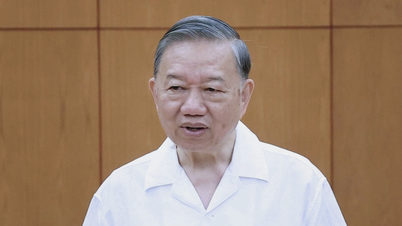
General Secretary and President To Lam once warned of a situation where "the government doesn't dare to make decisions," and even saw the influence of interest groups and criminals on policy implementation. This is not only a risk of corruption but also a warning of the abuse of power if effective control mechanisms are lacking.
When power is manipulated by vested interests, the consequences are not only the loss of state assets but also the distortion of the development environment, the obstruction of policy-making, and the direct damage to public trust.
Therefore, controlling power must become a consistent requirement in building the Party and the political system. There are no areas outside of oversight and no exceptions in controlling power.
Maintain the people's trust through concrete actions.
Ultimately, the greatest goal of the fight against corruption is not just about how many cases are prosecuted or how many officials are disciplined. More importantly, it is about building a clean system, where the people see that power is controlled, wrongdoings are handled fairly, and the interests of the people are always placed at the center.
Social trust is not built on slogans or formal declarations, but is nurtured by substantive actions in controlling power, selecting officials, and strictly dealing with all negative manifestations.
When the fight against corruption is carried out resolutely, comprehensively, and consistently, the people will see more clearly the spirit of matching words with actions; they will see more clearly the responsibility of cadres and Party members to the Party, the State, and the people.
The fight against corruption certainly still faces many difficulties and challenges ahead. But if power continues to be "confined" within the "cage" of mechanisms, if all manifestations of abuse of power are dealt with strictly, and if the people's trust continues to be strengthened by concrete results, this will not only be a condition for purifying the system, but also a foundation for maintaining the Party's leadership role and ensuring the sustainable development of the country in the new era.
Source: https://vtv.vn/phong-chong-tham-nhung-bat-dau-tu-kiem-soat-quyen-luc-100260519205349356.htm


![[Photo] General Secretary and President To Lam presides over a meeting with the Central Organizing Committee.](https://vphoto.vietnam.vn/thumb/1200x675/vietnam/resource/IMAGE/2026/06/03/1780482764658_a1-bnd-4741-3342-jpg.webp)

![[Photo] Secretary of the National Assembly Party Committee, Chairman of the National Assembly presides over the meeting of the Standing Committee and Executive Committee of the National Assembly Party Committee.](https://vphoto.vietnam.vn/thumb/1200x675/vietnam/resource/IMAGE/2026/06/03/1780480353201_ndo_br_bnd-2585-jpg.webp)
![[Photo] First session of the 14th Congress of the Vietnam Trade Union](https://vphoto.vietnam.vn/thumb/1200x675/vietnam/resource/IMAGE/2026/06/03/1780465947883_ndo_br_img-3852-jpg.webp)






























![[Video] Sunset at Lap An Lagoon – Where the sun sets over the fishing nets](https://vphoto.vietnam.vn/thumb/1200x675/vietnam/resource/IMAGE/2026/05/31/1780192137701_beach-landscape-sea-water-nature-grass-745871-pxhere-com.jpeg)




























Comment (0)