

Chinese scientists have developed silicon-based solar cells that are only 50 micrometers thick yet still offer good energy conversion efficiency.
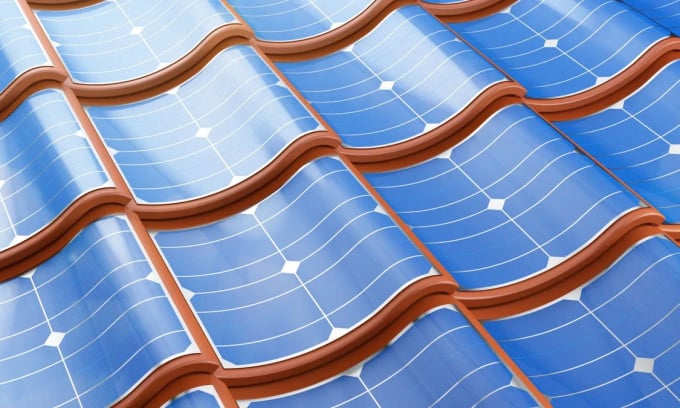
Simulation of a flexible solar cell. Photo: laremenko/iStock
A research team led by experts at Jiangsu University of Science and Technology (JUST) has developed silicon-based solar cells thinner than an A4 sheet of paper, Interesting Engineering reported on February 13. Researchers from Curtin University in Australia and the Chinese company LONGi Green Energy Technology also contributed to the new study.
Silicon-based solar cells are becoming increasingly popular. However, this technology is typically used only in limited settings such as ground-based solar farms with flat, rigid panels. Other locations, such as outer space, require curved surfaces and necessitate more expensive alternative technologies.
Solar cells made from crystalline silicon have a "sandwich" structure, where the semiconductor disk or middle layer contributes most of the panel's thickness. In a new study, the team created silicon panels that are only 50 micrometers thick, thinner than an A4 sheet of paper. Although not foldable like paper, silicon panels can be rolled up, making them very useful for installation on satellites or for other space applications.
Making silicon batteries thinner has another benefit: it allows for manufacturing using less material, thereby reducing weight and deployment costs.
However, thin-film solar cells also have the disadvantage of reduced power conversion efficiency (PCE). This is also the main reason why thin-film silicon cells have not yet become widespread. In previous efforts, scientists have created flexible silicon cells with a thickness of less than 150 micrometers that have a maximum PCE of 24.7%.
The PCE of thinner solar panels will need to be maintained around this level for the panels to operate efficiently. In the new study, the team successfully raised the PCE to above 26% for all the panels they created with thicknesses ranging from 50 to 130 micrometers.
Because silicon solar cells can be bent at will, the research team believes they could be used in a variety of devices such as drones, balloons, and even wearable smart devices. Currently, they are focusing on developing flexible, highly portable solar panels that can be rolled up like a roll of film.
Thu Thao (According to Interesting Engineering )
Source link

![[Image] Close-up view of the interchange connecting the two expressways and Long Thanh Airport.](https://vphoto.vietnam.vn/thumb/1200x675/vietnam/resource/IMAGE/2026/05/25/1779703378210_ndo_br_z7863716673926-224453a31600126cce10622af6290afd-4549-jpg.webp)

![[Image] Hanoi's urban life under the challenge of a "scorching hot" environment](https://vphoto.vietnam.vn/thumb/1200x675/vietnam/resource/IMAGE/2026/05/25/1779706979265_nang-nong-t5-2026-minh-duy-7-4636-jpg.webp)


















































































Comment (0)