

 |
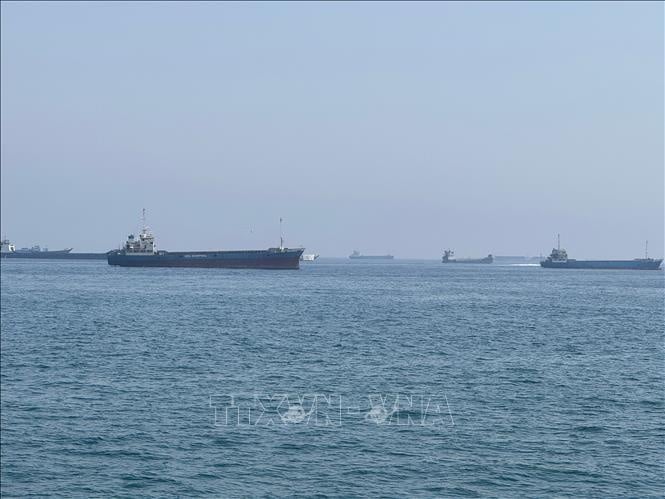
Commercial ships wait to pass through the Strait of Hormuz, near the town of Khasab in northern Oman, on May 29, 2026. Photo: THX/VNA . |
One official revealed that over the past three weeks, the U.S. Central Command has guided approximately 70 commercial vessels through the Strait of Hormuz, both into and out of the Persian Gulf. U.S. officials also stated that most of these ships had switched off their transponders to avoid detection while transiting the route.
Officials declined to disclose the specific types of ships and routes used, but one source said that at least one route avoided the Iranian coast. Ships sailing near Iran without its approval almost certainly risk attack by Iranian drones or missiles. Maritime analysts suggest that the U.S.-led voyages likely used routes closer to Oman.
Prior to the US and Israeli attacks on Iran in late February, more than 100 commercial ships passed through the Strait of Hormuz daily. Therefore, the US-coordinated voyages (an average of about three per day for three weeks) did not indicate a significant increase in shipping activity. Furthermore, because the ships participating in these voyages under US guidance switched off their transponders, maritime analysts could not independently verify the actual numbers.
However, the fact that ships continue to regularly pass through under American guidance suggests that some shipowners are willing to take the risk of entering and exiting the Persian Gulf, where many ships have been stranded for weeks, causing financial losses and forcing crews to work in difficult conditions.
The route coordinated by the US is also an alternative for shipowners who do not want to seek permission from Iran or pay fees to pass through the Strait of Hormuz. The conflict with Iran has drastically reduced the world's energy supply.
Last week, US officials said Iran and the US were close to reaching an agreement to reopen the Strait of Hormuz. However, on May 31, US officials revealed that President Trump had tightened the conditions of the agreement.
In early May, Trump announced a large-scale military operation called Project Freedom to assist ships transiting the Strait of Hormuz, but quickly ended it, partly due to opposition from Saudi Arabia. Since then, the U.S. Central Command has encouraged ships to transit the Strait of Hormuz but has not deployed naval escorts.
U.S. Central Command spokesman Captain Tim Hawkins said in a statement on May 30: “Even without U.S. escort, we continue to communicate and coordinate with commercial vessels seeking to pass through the Strait of Hormuz freely and safely – a vital international shipping lane for the regional and global economy .”
Ships using the route proposed by the U.S. still face the risk of attack from Iran. Iran claims it controls the waterway. U.S. officials believe the level of risk from Iran is exaggerated and have assisted ships willing to participate in finding safe passage across the Strait of Hormuz. While the shipping industry is aware of this assistance, U.S. officials admit they do not publicly disclose it to avoid Iranian targeting of U.S.-guided vessels.
A container ship was attacked in early May while transiting the Strait of Hormuz during the deployment of Project Freedom. The ship's owner, the French shipping group CMA CGM, said it coordinated with the US military, but the US Central Command asserted that the ship had not followed certain guidelines.
Noam Raydan, a senior research fellow at the Washington Institute for Near East Policy, noted that the figure of 70 ships coordinated by the U.S. was higher than anticipated. Because the ships had their transponders switched off, Raydan suggested it would take time to confirm how many ships were actually coordinating with the U.S.
During the implementation of Project Freedom, two ships flying the U.S. flag transited the Strait of Hormuz.
In mid-April, the US began blockading ships that had visited Iranian ports. According to the US Central Command, the blockade in the Gulf of Oman has so far forced 116 ships to change course. This operation has largely reduced Iran's oil exports.
However, Iran still exerts considerable influence over the Strait of Hormuz. Many ships continue to use the route along the Iranian coast, indicating that shipowners and governments are still coordinating with Iran to facilitate the voyage.
According to maritime data company Kpler, of the 895 transits through the Strait of Hormuz between March 1 and May 19, more than half used Iranian routes. Approximately 40% followed unidentified routes or switched off their signals.
Source: https://znews.vn/quan-doi-my-bi-mat-dan-tau-qua-eo-bien-hormuz-post1655951.html























![[Photo] Reception to welcome General Secretary and President To Lam and his wife on their State visit to the Philippines](https://vphoto.vietnam.vn/thumb/1200x675/vietnam/resource/IMAGE/2026/06/01/1780295488620_vna-potal-chieu-dai-chao-mung-tong-bi-thu-chu-tich-nuoc-to-lam-va-phu-nhan-tham-cap-nha-nuoc-toi-philippines-8798060-7855-jpg.webp)










































































Comment (0)