

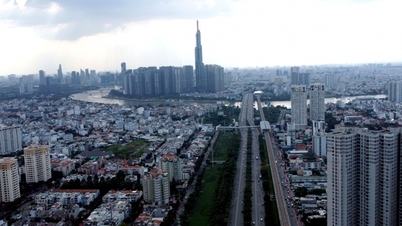
From now until 2030, Hanoi aims for two goals: building a "green city" and becoming a "green metropolis". This necessitates a thorough understanding of the management of green space systems within the entire administrative boundaries of the city.
Planning objectives have not been achieved.
The Resolution of the 17th Congress of the Hanoi Party Committee (2020-2025 term) sets the overall goal: by 2025, to develop the capital city rapidly and sustainably towards a green city, a smart city, and a modern city; by 2030, to become a green, smart, and modern city; and by 2045, to be a comprehensively and sustainably developed city. Thus, the Resolution has determined that "green city" is only the starting point for Hanoi to move towards becoming a "green city" and a "comprehensively and sustainably developed city".
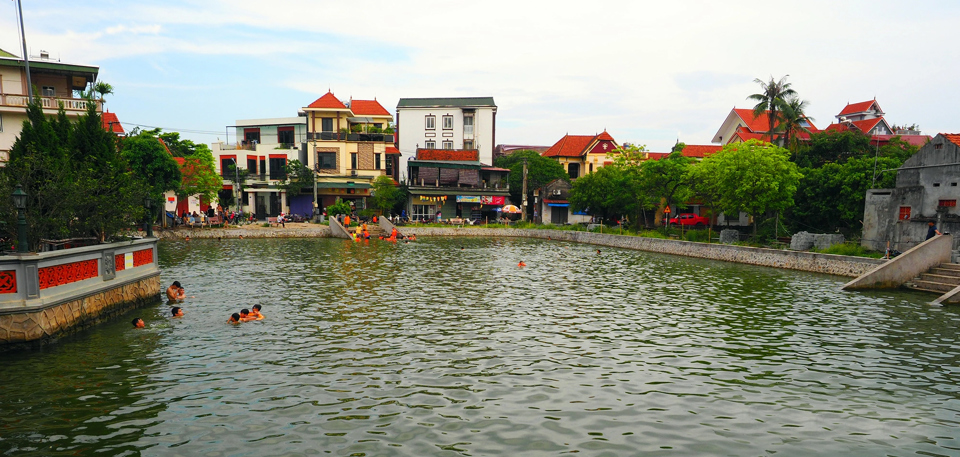
Recently, in Conclusion No. 80-KL/TW dated May 24, 2024, of the Politburo on two major planning schemes for Hanoi – the Hanoi Capital City Planning for the period 2021-2030, with a vision to 2050; and the Adjusted General Planning of Hanoi Capital City to 2045, with a vision to 2065 – there was a strong emphasis on "green" elements, including: green spaces; green transportation; green parks; building green district models; green corridors; green wedges; green carpets to increase green land area; greening in the historical inner city area; urban development according to a green, smart, modern, and distinctive model; and reconstruction of the inner city area towards a green, civilized, and modern direction.
In fact, defining the system of green spaces, parks, gardens, and lakes according to the plan is an important component criterion for the city to achieve the goal of building a "green city" (along with green buildings, green transportation, green and clean industry, green environmental quality, preservation of cultural and historical values, natural landscapes, and environmentally friendly communities).
Since 2014, Hanoi has had Decision No. 1495/QD-UBND approving the planning of the system of green spaces, parks, gardens, and lakes in Hanoi until 2030, with a vision to 2050. However, even though two-thirds of the plan has passed, its implementation has not met expectations, with only about one-third of the planned objectives completed.
Specifically, in urban areas, the number of parks completed and under construction according to the plan has only reached 9 out of 25 parks (approximately 36%); the total land area of completed parks and gardens is only 400 hectares out of 947 hectares (approximately 42%).
In satellite urban areas, eco-towns, and towns located far from the central district, there is almost no investment or development of additional park land to urban scale; only a few have small-scale flower gardens or playgrounds for children.
In the districts, the area of land allocated for parks and gardens is still very modest, especially in the eastern and southern districts of the city such as Thanh Tri, Thanh Oai, and Thuong Tin… where there is almost no investment in building park systems in areas within the urban development zones of the central city, and the nature and function of land use are mainly agricultural land.
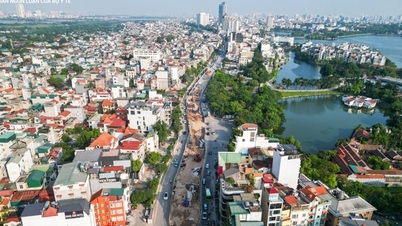
In addition, Hanoi has a large number of lakes and ponds, covering a significant area compared to other cities nationwide. Currently, across 12 districts, there are approximately 111 lakes and ponds with a total area of about 1,146 hectares (the lake area accounts for about 8.62% of the total urban land area).
In the suburban areas, the low-lying terrain results in numerous lakes and ponds. The main river network includes the Red River, Duong River, Nhue River, To Lich River, Kim Nguu River, Lu River, Set River, etc. Although there are many rivers, none of them have yet served as scenic corridors, public spaces, or riverside parks for the people of Hanoi.
Regarding the management of the green space system in Hanoi, only the management of green spaces in the inner city and urban areas has been addressed. As for rural areas, green spaces such as green corridors, green belts, and green wedges are unique to each locality and account for up to 70% of the city's total natural area. However, planning for these areas remains abstract, qualitative, and lacks clear objectives regarding management, nature, and function. Furthermore, management is often handled by multiple specialized agencies, including the Department of Construction, the Department of Agriculture and Rural Development, and district-level People's Committees, among others.
A city-wide approach to green space management.
From now until 2030, Hanoi aims for two goals: building a "green city" and becoming a "green metropolis" (along with new trends such as green growth, sustainable smart cities, etc.). Therefore, it is essential to establish requirements and have a full understanding of green space management within the entire administrative boundaries of the city.
Hanoi is a large urban area composed of two zones: the inner city and the suburbs. Currently, urban space is expanding rapidly, shrinking the area of rural green corridors. Green corridors are fragmented and lack synchronized infrastructure connectivity. Therefore, to complete a synchronized green corridor structure and ensure sustainability, a shift in approach to the city-wide green corridor (green city) is needed, aiming for a more comprehensive and holistic approach compared to the approach to urban green corridors (green city).
In particular, the Ministry of Construction needs to promptly develop and issue standards and criteria for "green cities," and to soon add provisions on development planning for rural areas (suburbs, outskirts of cities) within the administrative boundaries of Ho Chi Minh City.
For Hanoi, it is necessary to develop and promulgate specific mechanisms and policies for managing the development of green corridors, green belts, and green wedges based on the characteristics of urban and rural ecosystems and landscapes.
In this context, the management objective is to ensure comprehensiveness and consistency, reaffirming the value of green spaces: green corridors, green belts, and green wedges according to General Planning 1259. Ensuring the stability of the green space structure and avoiding a significant reduction in the scale of green space area is a prerequisite for Hanoi to develop into a "cultured, civilized, and modern" city by 2065.
Develop and promulgate standards and criteria for "green urban areas" and "green cities" as a basis for local authorities to implement, including the early addition of regulations on managing rural green corridors within the city.
Develop and promulgate specific programs, plans, mechanisms, and policies for managing the development of green corridors, green belts, and green wedges based on ecological and landscape characteristics immediately after the revised master plan for Hanoi until 2045, with a vision to 2065, is approved by the competent authority.
In particular, the city needs to immediately review, revise, and supplement the Planning of the system of green spaces, parks, gardens, and lakes in Hanoi until 2030, with a vision to 2050, to cover the entire administrative area of the city.
The management of green infrastructure is an interdisciplinary management activity involving the coordination of many closely related entities participating in the development, preservation, and conservation of green infrastructure values. In this process, the local community plays a crucial role; they are both owners (investors) and users, and are both subjects and objects of management. They are vital in the creation, preservation, and utilization of green infrastructure. Therefore, it is necessary to leverage and promote the role of the community in policies, mechanisms, and activities for the management and development of green infrastructure in urban and rural areas.
Source: https://kinhtedothi.vn/quan-ly-khong-gian-xanh-de-thanh-pho-ha-noi-xanh.html
![[Photo] First session of the 14th Congress of the Vietnam Trade Union](https://vphoto.vietnam.vn/thumb/1200x675/vietnam/resource/IMAGE/2026/06/03/1780465947883_ndo_br_img-3852-jpg.webp)
![[Photo] Secretary of the National Assembly Party Committee, Chairman of the National Assembly presides over the meeting of the Standing Committee and Executive Committee of the National Assembly Party Committee.](https://vphoto.vietnam.vn/thumb/1200x675/vietnam/resource/IMAGE/2026/06/03/1780480353201_ndo_br_bnd-2585-jpg.webp)

![[Photo] General Secretary and President To Lam presides over a meeting with the Central Organizing Committee.](https://vphoto.vietnam.vn/thumb/1200x675/vietnam/resource/IMAGE/2026/06/03/1780482764658_a1-bnd-4741-3342-jpg.webp)










































![[Video] Sunset at Lap An Lagoon – Where the sun sets over the fishing nets](https://vphoto.vietnam.vn/thumb/1200x675/vietnam/resource/IMAGE/2026/05/31/1780192137701_beach-landscape-sea-water-nature-grass-745871-pxhere-com.jpeg)
































Comment (0)