

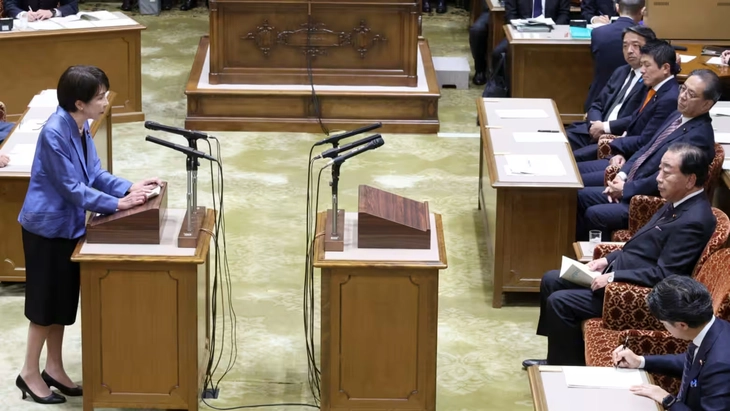
A meeting of the Japanese Parliament - Photo: NIKKEI ASIA
According to the plan, by the end of March 2026, Japanese government ministries and agencies will apply an artificial intelligence (AI) tool to perform tasks such as preparing answers to questions in Parliament, thereby reducing the heavy workload currently borne by administrative officials.
The AI generation platform called Gennai, developed by Japan's Digital Agency, will be distributed to all government employees, according to Nikkei Asia .
Prime Minister Takaichi Sanae announced the Gennai deployment plan at a meeting on December 19, with an estimated cost of 1 trillion yen. According to Japan News , the cabinet will approve the plan as early as next Tuesday, December 23.
The use of this tool will be expanded to all ministries and agencies, after several units, including the Digital Agency, began applying AI generation in May.
The Japanese government will also consider the possibility of deploying AI in local governments.
According to Japan's interim personnel committee, Japanese central government employees work an average of 376 overtime hours per year, more than double the average of 181 hours for employees outside the central system.
One major reason is believed to be the time required to prepare draft responses to questions from members of Congress.
AI generation is expected to significantly shorten the time spent on this task, including preparing responses to any follow-up questions that may arise.
Traditionally, Japanese civil servants must prepare multiple draft answers to each question, with each version adjusted to address different follow-up inquiries. This preparation often extends late into the night.
Agencies will use Gennai as a platform to develop specialized machine-learning "AI agents" that learn from parliamentary minutes, written questions from MPs, and past responses from government officials. Because it is developed internally by the state, this AI system is allowed access to some highly confidential data.
To date, AI has only been used in the initial research phase when preparing responses, and has never been used to directly create drafts. In the future, AI will suggest response content for staff to review, edit, and finalize the draft.
Additionally, Japan also plans to develop AI to support the licensing and approval process. A pilot project will use AI to review applications from businesses seeking certification for workplaces that are friendly to women and parents with young children.
Source: https://tuoitre.vn/quoc-hoi-nhat-ban-cho-dung-ai-soan-tra-loi-chat-van-20251219160045232.htm


![[Photo] Prime Minister Pham Minh Chinh attends the Conference on the Implementation of Tasks for 2026 of the Industry and Trade Sector](/_next/image?url=https%3A%2F%2Fvphoto.vietnam.vn%2Fthumb%2F1200x675%2Fvietnam%2Fresource%2FIMAGE%2F2025%2F12%2F19%2F1766159500458_ndo_br_shared31-jpg.webp&w=3840&q=75)


































































































Comment (0)