

Many new requirements regarding land allocation.
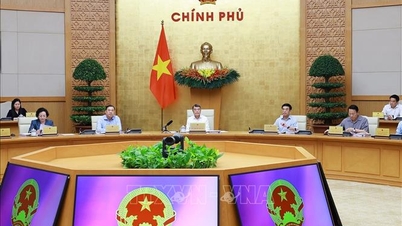
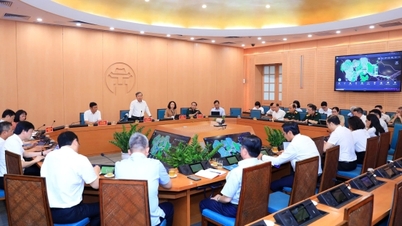
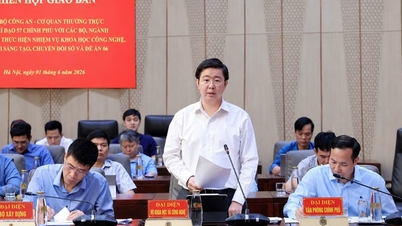
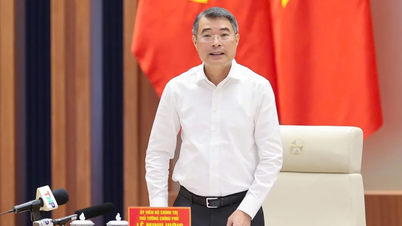
On the morning of May 22nd, Deputy Prime Minister Ho Quoc Dung chaired a meeting on adjusting the National Land Use Planning for the period 2021-2030, with a vision to 2050; and to review the implementation of Resolution 18-NQ/TW of the 13th Central Committee of the Communist Party of Vietnam on land and amend the Land Law.
Also attending were Minister of Agriculture and Environment Trinh Viet Hung and leaders from many relevant ministries and sectors.
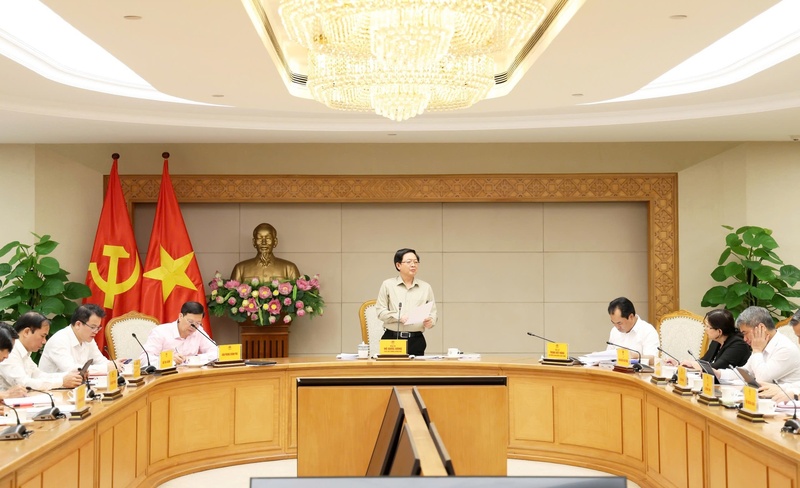
Deputy Prime Minister Ho Quoc Dung chaired a meeting on adjusting the National Land Use Planning for the period 2021-2030, with a vision to 2050 - Photo: VGP/Gia Huy
At the meeting, the Ministry of Agriculture and Environment stated that, after nearly five years of implementing the National Land Use Planning according to Resolution No. 39/2021/QH15 of the National Assembly, many socio -economic development goals have changed significantly, especially the requirement for double-digit economic growth in the coming period, leading to increased land use demand in many sectors. Along with this, the adjustment of provincial planning and national sectoral plans approved after the National Land Use Planning by localities has also given rise to many new requirements for land allocation.
This revised planning scheme is based on a synthesis of land use needs from 34 provinces and cities, national sectoral land-use plans, regional plans, and socio-economic development orientations in line with the spirit of the 14th National Congress of the Party.
At the meeting, many opinions focused on reviewing agricultural land indicators, especially rice paddy land, protective forest land, special-use forest land, and national defense and security land. Ministries and sectors argued that the adjustment of planning must both meet new development requirements and avoid the situation of "suspended" planning and waste of land resources.
Concluding the meeting, Deputy Prime Minister Ho Quoc Dung emphasized the Central Committee's guiding principles regarding land use planning, stressing that it must create breakthroughs for rapid and sustainable development, while maintaining independence, self-reliance, food security, water security, environmental security, and social stability. Planning must have a long-term vision, not only serving immediate needs but also laying the foundation for subsequent stages of national development.
The Deputy Prime Minister requested that the adjustment of the planning be based on a comprehensive, accurate, and substantive assessment of the current land use situation as well as future development needs. Accordingly, the planning agencies need to fully consider factors related to seed technology, farming methods, food consumption trends, the impact of climate change, urbanization rate, natural disasters, diseases, and global fluctuations.
The goal is to simultaneously ensure food security, protect the ecological environment and forest land area, while creating room for the development of industry, urban areas, infrastructure, and services in the new phase.
No division of development space
The Deputy Prime Minister particularly emphasized the need to ensure consistency, uniformity, and interconnectedness between the National Land Use Plan and the national master plan, sectoral plans, regional plans, provincial plans, and socio-economic development strategies. The plan must be comprehensive and long-term, encompassing the spatial development of industry, urban areas, agriculture, infrastructure, culture, education, national defense, security, and environmental protection.
" Avoid arbitrary adjustments to planning, fragmentation of development space, haphazard development, or development lacking a strategic vision, " Deputy Prime Minister Ho Quoc Dung emphasized, stating that this is a consistent requirement throughout the process of perfecting the national land planning.
Regarding the implementation mechanism, the Deputy Prime Minister requested the establishment of a mechanism for inspection, supervision, and prevention of violations in land management and use; and also requested the Ministry of Agriculture and Environment to closely adhere to the central government's guiding principles in the process of finalizing the revised planning documents.
The Deputy Prime Minister also requested the drafting agency to clearly explain the results of implementing the land use targets approved by the National Assembly in the 2021-2025 period; clarifying which targets were achieved, which were not, and the specific reasons. At the same time, the Ministry of Agriculture and Environment needs to report fully on the plan for adjusting the increase or decrease of 6 land use targets in the 2026-2030 period.
Responding to the directives, Minister of Agriculture and Environment Trinh Viet Hung stated that the drafting agency will review and fully complete the revised National Land Use Planning dossier, ensuring its quality, feasibility, and suitability to the country's development requirements.
Source: https://congthuong.vn/quy-hoach-dat-dai-phai-tao-nen-tang-phat-trien-ben-vung-457762.html



















![[Photo] Reception to welcome General Secretary and President To Lam and his wife on their State visit to the Philippines](https://vphoto.vietnam.vn/thumb/1200x675/vietnam/resource/IMAGE/2026/06/01/1780295488620_vna-potal-chieu-dai-chao-mung-tong-bi-thu-chu-tich-nuoc-to-lam-va-phu-nhan-tham-cap-nha-nuoc-toi-philippines-8798060-7855-jpg.webp)


















































Comment (0)