

Although not part of the original plan of either side, this decision officially made Dien Bien Phu the decisive strategic battle between Vietnam and the French colonialists, paving the way for the glorious Dien Bien Phu victory that shook the world.
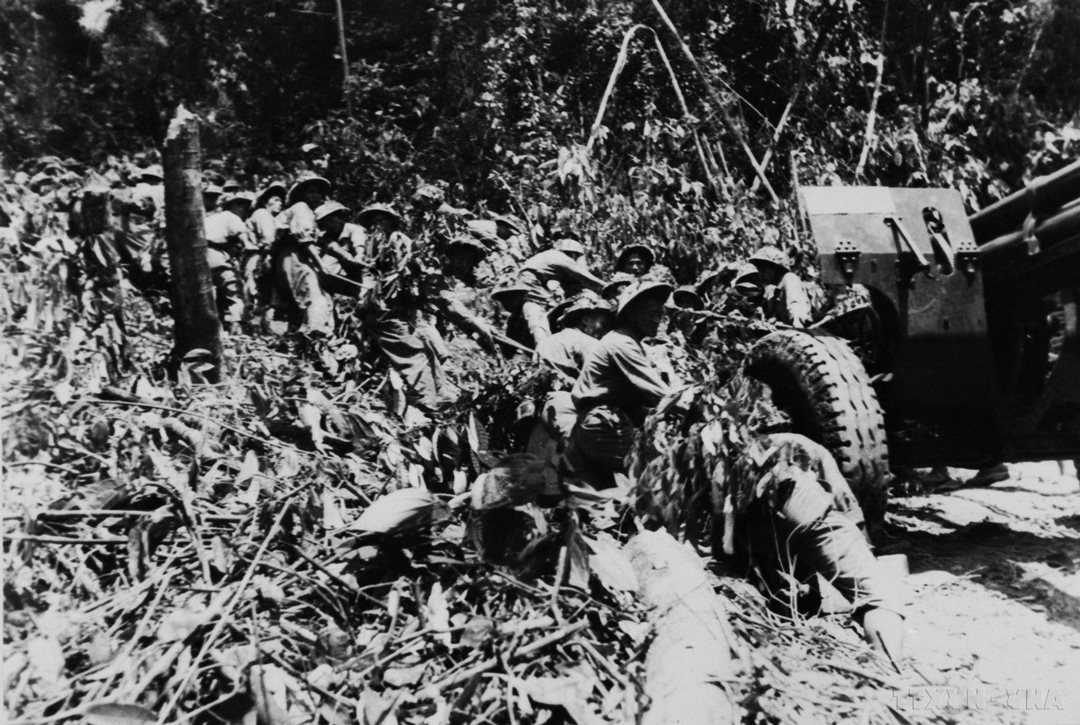
Soldiers haul artillery into position during the Dien Bien Phu Campaign. (Archival photo)
High level of determination
During the resistance war against French colonialism, the Party made many important decisions, creating major turning points for the resistance, such as launching the Border Campaign and the Peace Campaign… However, the decision to attack Dien Bien Phu was the most important, demonstrating the highest determination of the Party and President Ho Chi Minh throughout the entire resistance war.
For the French and American empires, Dien Bien Phu was a strategically important location for controlling North Vietnam, Upper Laos, and Southwestern China.
Initially, the French, specifically General Nava, considered Dien Bien Phu merely an ordinary stronghold to hinder our military operations. However, from the end of 1953, upon discovering that our forces were moving significantly towards the Northwest, the French focused on reinforcing Dien Bien Phu, transforming it into the strongest fortified complex in Indochina.
On December 6, 1953, under the chairmanship of President Ho Chi Minh, the Politburo met to discuss and hear the General Military Commission's report on the strategic plan for the spring of 1954, focusing on the Dien Bien Phu Front. After hearing the General Military Commission's report, the Politburo deliberated and carefully considered the matter before unanimously deciding to launch the Dien Bien Phu Campaign, codenamed "Tran Dinh". A Front Party Committee was established, comprising comrades: Hoang Van Thai - Chief of Staff, Le Liem - Head of Political Affairs, Dang Kim Giang - Head of Supply, and General Vo Nguyen Giap was appointed Commander and Secretary of the Front Party Committee.
It is clear that the decision to attack Dien Bien Phu was a historic one. When deciding to attack Dien Bien Phu, the Central Committee of the Party and the Politburo not only recognized the enemy's strengths and our difficulties and obstacles, but also thoroughly analyzed all aspects to find the enemy's weaknesses that we could exploit, and recognized the immense capabilities of our army and people to overcome them; at the same time, they pointed out our decisive advantages.
In his book "Memoirs of Dien Bien Phu - A Historical Rendezvous," General Vo Nguyen Giap analyzed: We have seen two major weaknesses of the "Dien Bien Phu hedgehog."
First, there is the rigidity and passivity of the enemy's chosen fortified complex defense system. While a fortified complex is a tightly knit structure of many strongholds, in reality, they remain isolated. Although the enemy forces there are numerous, when one stronghold is attacked, the primary response force is still the stronghold's own forces, supplemented by long-range fire support and the intervention of a smaller, less formidable reserve force that we can control. This weakness allows us to concentrate our strength to destroy individual strongholds at the opportune moment.
Secondly, there was the isolation of the "Dien Bien Phu hedgehog" itself. In reality, Dien Bien Phu was situated in isolation amidst a vast, completely liberated mountainous region, far from enemy rear bases, especially major air bases. All reinforcements and supplies relied on air transport. If air transport were restricted or cut off, it would quickly lose its combat effectiveness.
General Vo Nguyen Giap also analyzed: On our side, our forces are elite main units with high fighting spirit, advanced technical equipment, enthusiasm, and determination to annihilate the enemy. Our troops have certain experience in fighting the enemy in fortified positions, have received initial training to attack enemy strongholds, and are capable of overcoming difficulties and solving necessary problems in destroying enemy strongholds...
Based on the above calculations, the Central Military Commission affirmed that: "The Battle of Dien Bien Phu will be the largest siege battle ever... Preparations are difficult and require intense concentration of forces to be completed on time, but if we resolutely overcome the difficulties and complete the campaign, this victory will be a very great victory."
The yearning for national liberation
When the Party decided to launch the Dien Bien Phu Campaign, it received wholehearted support from our people and progressive people around the world, especially the oppressed peoples.
According to a report by the Central Front Supply Council on July 10, 1954, during the Dien Bien Phu Campaign, "the people of the Northwest, Viet Bac, Inter-Region III, and Inter-Region IV contributed more than 260,000 civilian laborers (approximately 13 million man-days), 20,991 bicycles, and thousands of other rudimentary and semi-rudimentary means of transport. In terms of material support, the people contributed to the campaign (mobilized at the source) 25,056 tons of food, 907 tons of meat, and thousands of tons of other foodstuffs...". This was an immense contribution and effort by the Vietnamese people. Evaluating this feat, French General Gra remarked: "The entire Vietnamese nation found a solution to the logistical problem, and this solution thwarted all the calculations and plans of the French General Staff."
The Vietnamese people's resistance struggle also received immense attention and support from progressive people around the world.
During the Dien Bien Phu Campaign, the Chinese military advisory team actively participated with Vietnamese generals in surveying, planning, and preparing the battlefield, supporting changes in the operational plans proposed by the Vietnamese side. In terms of material aid, during the campaign, China provided Vietnam with 1,700 tons of rice, equivalent to 6.8% of the total rice mobilized for the campaign; and 3,600 105mm artillery shells, accounting for 18% of the total artillery shells used.
The Soviet Union also paid due attention to and provided significant support to Vietnam. Sharing the burden of the Dien Bien Phu Campaign were national liberation movements taking place in many parts of Asia, Africa, and Latin America; in addition, there were anti-war movements in many capitalist countries, especially the anti-war movement of progressive people in France.
The overwhelming support of the Vietnamese people and progressive people around the world is proof that the decision of the Party and President Ho Chi Minh to attack Dien Bien Phu was in line with the demands of history and the aspirations of peace-loving people worldwide.
After the Politburo decided to destroy the Dien Bien Phu fortified complex, the entire Party, people, and army quickly entered the preparation and execution phase of the campaign. On March 13, 1954, our troops opened fire on the Him Lam and Doc Lap fortified complexes, marking the beginning of the historic Dien Bien Phu Campaign. After 56 days and nights of heroic fighting, at 5:30 PM on May 7, 1954, the "Determined to Fight, Determined to Win" flag of our army flew atop the enemy's command bunker, signifying the complete victory of the Dien Bien Phu Campaign.
The victory at Dien Bien Phu in 1954 marked the end of nine years of arduous, yet heroic resistance by our army and people. This victory marked a glorious milestone in the history of the nation and the era, becoming a symbol of heroism and the strength of the times. It forced the French colonialists to sign the Geneva Accords, ending the war and restoring peace in Indochina, ending centuries of French colonial rule, and opening a new chapter for the revolutions in Vietnam, Laos, and Cambodia. The victory inspired the entire Party, the entire people, and the entire army to resolutely carry out the national democratic revolution in the South, unify the country, and lead the entire nation towards socialism.
The victory at Dien Bien Phu left the Vietnamese revolution with many valuable lessons: steadfastly pursuing the goals of national independence and socialism; maintaining and strengthening the Party's leadership; promptly seizing opportunities, decisively and astutely directing strategies to concentrate the nation's strength to achieve victory. These lessons retain their full value and continue to be creatively applied by the Party in the current cause of building and defending the socialist Vietnamese Fatherland.
Colonel, Doctor Nguyen Van Truong
Source

















































Comment (0)