

Thousands of megawatts of solar power contribute to "lighting up" the economy.
The Ministry of Industry and Trade has just issued a plan to implement Government Directive No. 10 on strengthening electricity saving and developing rooftop solar power. Accordingly, the Ministry will coordinate with other ministries and agencies to finalize the mechanism to support households in installing rooftop solar power and battery storage systems (BESS).
The annual target is for approximately 10% of government agencies and 10% of households nationwide to install and use self-generating and self-consuming rooftop solar power systems; or for the total rooftop solar power capacity to reach 20% of the installed capacity according to the 2026-2030 development plan of each locality.
According to the General Statistics Office, by the beginning of 2026, Vietnam will have approximately 28.6 million households. Therefore, about 2.8 million rooftops could potentially have solar power installed if the aforementioned target is met.
The model promoted by the Ministry of Industry and Trade is "self-production, self-consumption," combined with the BESS storage system, so the capacity is designed to suit the actual needs of each household. On average, each household needs a system with a capacity of 3-5 kWp, depending on the area and scale of electricity use. With an average of about 4 kWp/household, if 2.8 million households implement it in the first year, the total installed capacity could reach approximately 11,440 MW.
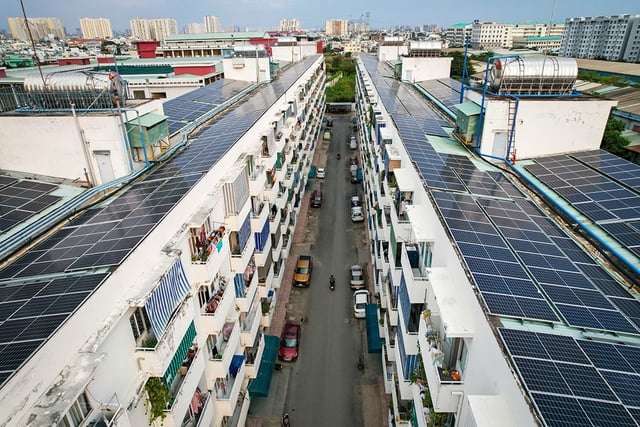
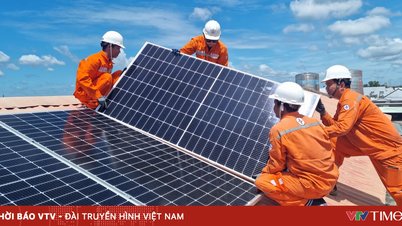
The Ministry of Industry and Trade aims to have 10% of government offices and 10% of households using rooftop solar power this year.
PHOTO: NHAT THINH
Energy experts estimate that if the set targets are met, the amount of solar power added to the grid each year will be substantial, potentially reaching thousands of megawatts. This will help the national power system directly reduce peak load capacity by 3-10% during peak hot months.
For example, Ho Chi Minh City is estimated to have about 3 million houses, according to Mr. Bui Trung Kien, Deputy General Director of the Ho Chi Minh City Power Corporation. If we subtract the number of apartment buildings that cannot have rooftop solar power installed, there are still about 2.5 million rooftops. "If we develop about 10% each year, equivalent to 250,000 rooftops installing solar power, with an average capacity of 3-5 kWp/system, Ho Chi Minh City could add about 1,000 MW of power during sunny days," Mr. Kien calculated, emphasizing that if each locality were to add several hundred to a thousand MW of renewable energy annually, the amount of electricity added to the system would be enormous.
However, according to Mr. Kien, this is "an extremely difficult target" without strong support mechanisms and decisive coordination from many agencies and organizations. Because in the period up to 2020, despite a very favorable FIT price mechanism, only over 100,000 rooftop solar systems were developed nationwide. Updated data from the beginning of the year shows that Ho Chi Minh City has only recorded over 2,400 customers investing in rooftop solar power. "The potential for development is still very large, but to achieve the goal requires strong involvement from localities along with financial support policies for people to install rooftop solar power with storage systems," Mr. Kien said.
A World Bank (WB) survey indicates that Ho Chi Minh City and Da Nang are two cities with great potential for developing rooftop solar power. Rapid urbanization is causing a sharp increase in electricity demand in major cities, while rooftop solar power can be economically efficient, increase the reliability of the power supply, and support new sectors such as electric vehicles and smart home systems. The WB estimates that nearly 30% of the rooftop area in these two cities is suitable for installing efficient rooftop solar power systems, contributing to reducing pressure on electricity supply in the future.
Increase the electricity sales rate to 50%, simplify procedures.
To achieve the aforementioned goal, energy experts believe that clear, practical, and sufficiently attractive support mechanisms are needed.
Dr. Nguyen Duy Khiem, a lecturer at Quy Nhon University (Gia Lai province), shared that through advising on numerous rooftop solar power projects in the Central region, he has observed positive market growth. "After Decree 58 on the development of rooftop solar power connected to the national grid came into effect, the installation movement has developed quite strongly. In particular, from the beginning of 2026 to the present, the number of newly installed systems has increased by about 30% compared to the same period last year. This is also one of the reasons why installation costs and the price of equipment and materials have increased again," Dr. Khiem stated.
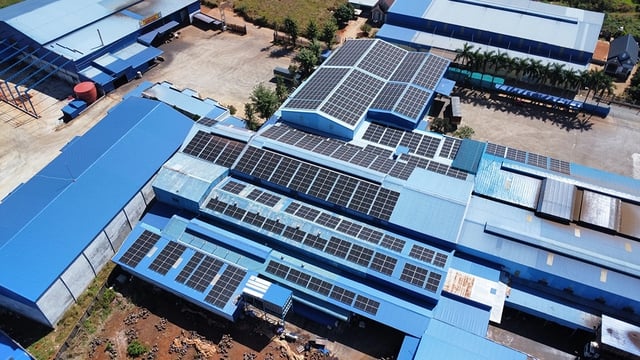
There is an urgent need for mechanisms to encourage the development of rooftop solar power with battery storage.
PHOTO: H.Hy
According to Dr. Khiem, in addition to the electricity needs for daily life and production, the increasing popularity of electric vehicles is also contributing to the demand for rooftop solar power installation. The sharp fluctuations in gasoline prices due to military conflicts in the Middle East are further prompting many people to seek more energy-efficient and proactive solutions.
"In the context of increasing electricity demand and rising electricity prices, the decision to invest in rooftop solar power is becoming increasingly popular, especially in Central Vietnam – where there is good solar radiation intensity, high economic efficiency, and a quick return on investment. However, the system is only truly effective when combined with battery storage for use during periods without sunlight. The problem is that the investment cost is still quite high, becoming a barrier for many households," Dr. Khiem commented.
Currently, Dr. Khiem is advising two businesses on investing in electric vehicle charging station systems combined with rooftop solar power installations. The expert further analyzed that the government's policy is to encourage the development of self-sufficient rooftop solar power. However, to encourage people to invest in systems with battery storage, a mechanism allowing the sale of surplus electricity to the grid at a higher rate needs to be issued soon. Specifically, currently, the percentage of electricity allowed to be connected to the grid is only about 20% of the capacity. A draft proposal to raise it to 50% has been under consideration for a long time but has not yet been issued. Meanwhile, the investment cost for battery storage increases the value of the solar power system by approximately 50-80%. Therefore, many households and businesses only invest at a level sufficient for their needs, even though they want to expand capacity to sell electricity to the grid. This is a bottleneck that needs to be addressed if the rooftop solar power model is to develop strongly. Simply increasing grid-connected capacity by 50% would completely change the landscape of the rooftop solar power movement. Secondly, the current low purchase price for self-produced and self-consumed surplus rooftop solar power creates a barrier for households wanting to invest. Furthermore, several other barriers need to be removed as quickly as possible to promote rooftop solar power in households and small businesses. For example, in some cases, licensing authorities require procedures not stipulated in regulations; solar power cannot be connected to the grid because the local power company lacks meters for measurement...
Mr. Nguyen Quoc Dung, Head of Business Department of Vietnam Electricity Group (EVN), cited that EVN has approximately 31 million electricity customers. If just half of these customers installed rooftop solar power systems with battery storage, the national power grid would be under significantly less pressure. Therefore, a specific policy is needed to support the installation of rooftop solar power with BESS (Battery Energy Storage System) through subsidies to reduce investment costs. This is one of the methods that many countries have successfully applied. For example, Australia once had a policy to triple the budget for a support program to promote the storage of rooftop solar power after the household meter. This program was designed to reduce the initial investment costs for home BESS systems and accelerate the installation of storage after the meter. Earlier this year, the Australian government tripled the program's budget to approximately US$5.12 billion.
"Providing financial support to households installing rooftop solar power is a humane policy of the Government, encouraging development, but it must ensure stability. To ensure stability, there must be a Balanced Energy Efficiency (BESS), and priority should be given to developing rooftop solar power with a BESS. To achieve this, people need resources from the Government, specifically a percentage of the installation cost as a subsidy. The more detailed, clear, and realistic the support figures are, the more people will be interested and willing to invest," shared energy expert Dao Nhat Dinh.
The need for an "easy to apply, easy to implement" mechanism is urgent.
According to experts, the urgent solution is to promptly issue a separate legal framework and pricing mechanism tailored to the specific operational characteristics of rooftop solar power systems with BESS (Balanced Energy Efficiency System).
According to expert Dao Nhat Dinh, the revised Power Development Plan 8 has considered additional investment in BESS (Building Energy Supply System) as a component of the national power source plan, aiming to reach 10,000 - 16,300 MW by 2030. However, in reality, BESS in rooftop solar power systems accounts for an extremely modest proportion. As of early 2025, the total installed BESS capacity in Vietnam will still be below 100 MW, while the development demand will reach over 16 GW in less than a decade.
"The mechanism to support the development of BESS needs to be issued soon in order to effectively bring rooftop solar power into the economy. We aim for double-digit growth, with a major focus on increasing renewable energy. The early issuance of a clear, easy-to-implement, and easily applicable mechanism for accelerating rooftop solar power is crucial. It's not about how much per kWh to buy, but about a clear, immediately applicable, and effective policy. We shouldn't have to keep seeking opinions and waiting every time the issue is raised... otherwise, it will be very difficult to bring renewable energy into life in a meaningful and expected way," Mr. Dao Nhat Dinh emphasized.
Dr. Ngo Duc Lam, former Deputy Director of the Institute of Energy (Ministry of Industry and Trade), commented: "In recent years, our policies for developing renewable energy in general and rooftop solar power in particular have been quite good. However, rooftop solar power has the unique characteristic of depending on the intensity of sunlight, so it has an advantage in the South and Central regions compared to the North."
"For rooftop solar power, the current challenges are production capacity, consumption, and storage. In some developed countries with good economic conditions, they invest in centralized storage systems for a region or area. This requires significant investment costs, but conversely, it attracts community participation. In the long term, this is a solution that needs to be considered. Meanwhile, Vietnam's current policy is to encourage self-production and consumption, along with battery storage. Therefore, the investment cost increases by at least 50%, which is why many people have not yet dared to develop this," analyzed Dr. Ngo Duc Lam.
Therefore, the State can use financial mechanisms and interest rates to support people in covering part of the investment cost for solar panel systems. Besides, with the future development trend of this sector, controlling the quality of products, input equipment, and prices is very important. "Furthermore, the Government needs to continue improving policies on pricing and connection infrastructure to encourage better participation from people in connecting rooftop solar power to the grid," Dr. Ngo Duc Lam noted.
Mr. Nguyen Quoc Dung suggested that Vietnam could apply a mechanism to provide financial support for the cost of installing rooftop solar power systems with battery storage more effectively. In fact, the electricity sector has historically implemented policies to support people significantly, yielding clear results. For example, since 2005, EVN has launched campaigns to encourage and support the replacement of incandescent light bulbs with compact fluorescent lamps (CFLs) to save over 80% of electricity, reduce the load on the grid, and protect the environment. Similarly, regarding solar energy, from 2011 to 2013, EVN implemented a program to support customers installing solar water heaters with a subsidy of 1 million VND per unit, achieving unexpected success.
If Vietnam can achieve this, it will not only avoid electricity shortages but also have access to clean electricity, in line with modern global trends.
Number of households expected to install rooftop solar power
According to the General Statistics Office, by early 2026, Vietnam will have approximately 28.6 million households (out of a population of 101 million). With a target of 10% per year, in 2026, approximately 2.86 million households nationwide will install or switch to rooftop solar power. The revised Power Development Plan 8 aims for 50% of households to use rooftop solar power by 2030, equivalent to approximately 14 million households.
According to the Ministry of Industry and Trade's Action Plan to implement Prime Minister's Directive No. 10 dated March 30 on strengthening electricity saving and developing rooftop solar power, the Ministry of Industry and Trade, in coordination with the Ministry of Finance, the State Bank of Vietnam, and relevant agencies, will promptly research and finalize a draft Decision for the Prime Minister's consideration, stipulating policies to support households installing rooftop solar power and electricity storage systems, in accordance with their technical capabilities, economic conditions, and state budget capacity in each period.
This includes appropriate budgetary solutions, credit support for the installation of rooftop solar power and storage systems in office buildings and households; and support for green credit and preferential credit for households and businesses installing rooftop solar power.
Source: https://thanhnien.vn/quyet-liet-thap-sang-hang-trieu-mai-nha-185260517220353473.htm



![[Image] Close-up view of the interchange connecting the two expressways and Long Thanh Airport.](https://vphoto.vietnam.vn/thumb/1200x675/vietnam/resource/IMAGE/2026/05/25/1779703378210_ndo_br_z7863716673926-224453a31600126cce10622af6290afd-4549-jpg.webp)
















































































Comment (0)