

Netizens are competing to post stunning "transformations" thanks to an app that allows users to change their appearance, from clothing and hairstyles to details like lipstick color, all with just one click, using artificial intelligence (AI).
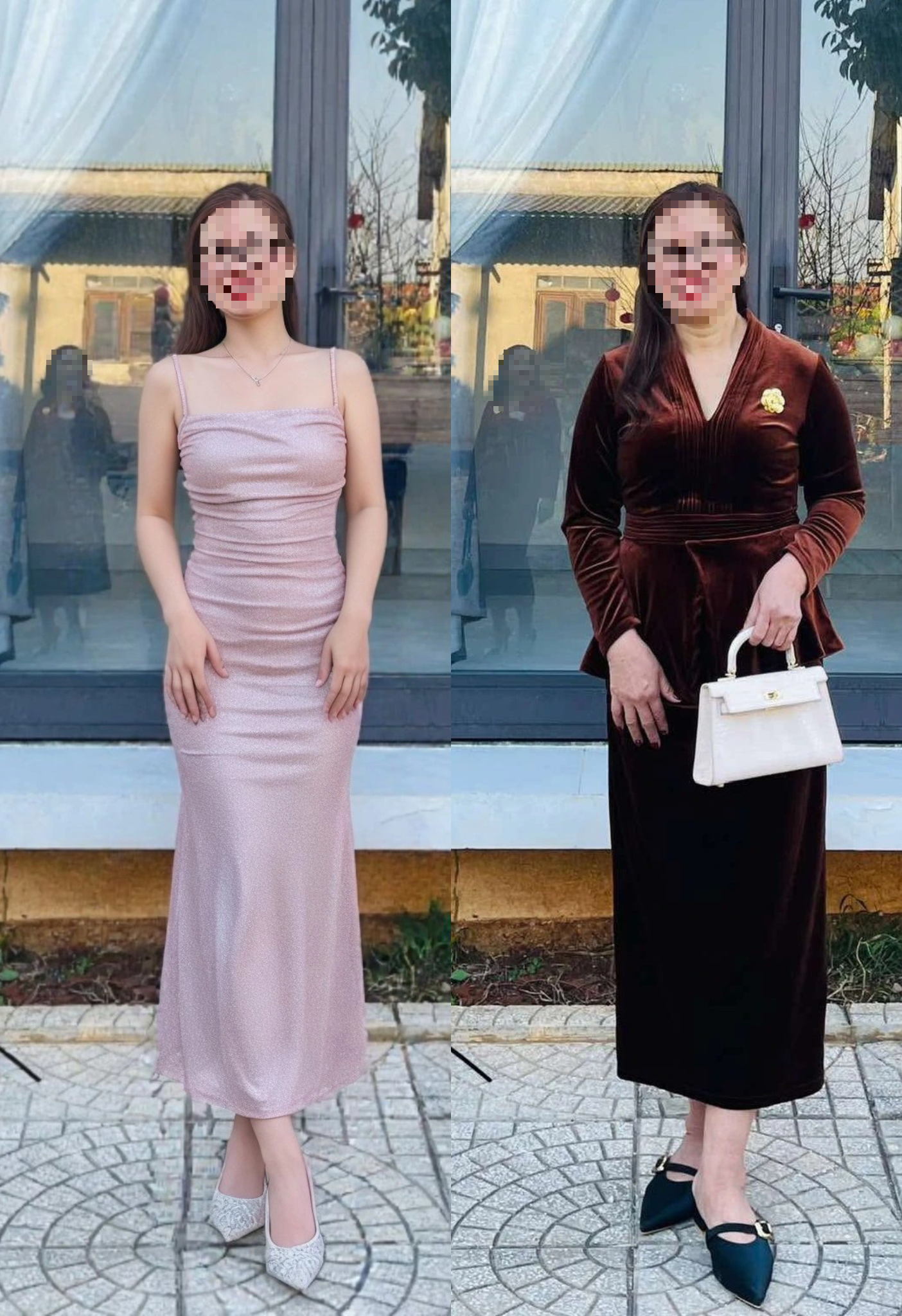
After just three attempts to select photos, change outfits, and adjust styles, BeautyCam produces very different images. The before-edited photo (right) and the edited photo (right) are shown.
Netizens commented: "From now on, no need to buy dresses and clothes anymore!"
Many young people, after using "BeautyCam - Multifunctional Camera," share a common feeling of amazement. This is because the application practically has every function, from taking photos (portraits, film-style photos, professional photos with DSLR mode), to editing photos and videos .
From the afternoon of February 18th, netizens enthusiastically shared stunning, yet incredibly surreal, edited photos. What captivated young people was that the app's photo and video editing commands were fully automated with AI. Manual editing was still possible, down to the smallest detail, from facial features, wrinkle removal, blemish concealment, cheekbones, lips, and even lipstick color…
One particularly popular feature among young people in Vietnam is the AI wardrobe. All you have to do is select a pre-existing image, choose a dress, top, or accessory, and let the AI process it. The result is instant: a picture with the same face but completely transformed clothing.
Since then, many young people have joked that from now on they don't need to invest too much money in buying dresses, clothes, and shoes.
Users remain skeptical about security and privacy.
The simultaneous use of the AI wardrobe feature by too many people caused BeautyCam to repeatedly report being overloaded on the evening of February 18th.
According to information on the App Store, "BeautyCam - a multi-functional camera app" is from Xiamen Meitu Technology Co., Ltd. Meitu Inc. is a Chinese technology company, founded in 2008, whose main business is manufacturing smartphones and camera apps.
Speaking to Tuoi Tre Online , Thuy Trinh (26 years old, residing in Ho Chi Minh City) said that besides photo-taking and editing features like background blurring and makeup application, BeautyCam's AI feature is what truly attracted her.
With its AI capabilities, BeautyCam can help users take professional-looking photos no matter where they are. Features like expression correction, removal of unwanted objects, image enlargement, and AI-powered transformation effects are also very popular with young people.
However, Thuy Trinh and many other users are also skeptical about BeautyCam's ability to protect user privacy and information.
Sharing the same concern, Ngoc Duc (27 years old, residing in District 1) believes that the ability to freely change a person's appearance and clothing with a single click will allow those with malicious intentions to easily "manipulate" the software to impersonate someone.
On the App Store, BeautyCam is categorized as a 12+ app. This means the app "occasionally contains mild profanity, frequent and graphic animated violence, fantasy violence, or real-life violence. There are sometimes mildly adult or suggestive themes, as well as simulated gambling. This content may not be suitable for children under 12 years old."
Be cautious when installing and granting access permissions to applications.
In a quick exchange with Tuoi Tre Online, Lieutenant Colonel, Doctor, and expert in criminal psychology Dao Trung Hieu stated that when installing applications, many people carelessly grant these applications permission to access almost all the available features on their phones.

Lieutenant Colonel, Doctor of Science, Criminal Psychology Expert Dao Trung Hieu - Photo: Provided by the interviewee
In this case, granting access to the photo library inadvertently allows the app to collect and analyze all images, including sensitive ones. Some apps may silently activate the camera without explicit consent, creating a risk of surveillance.
The risk of being eavesdropped on is real if an application has uncontrolled access to your microphone. Some applications even collect information about your location, contacts, messages, and call history, facilitating privacy violations.
Constantly updating personal photos on social media can lead to many risks for people. These include identity theft, allowing hackers to use photos to create fake accounts or deepfakes. Photos may also contain metadata (EXIF), revealing location, time, device used, etc., making them useful for malicious actors to track.
AI, exploited to create fake content, can now edit and manipulate images very skillfully, creating fictitious photos or videos for the purpose of deception and defamation.
Psychological attacks and online scams occur because malicious actors can exploit images to lure, extort, or attack through social engineering techniques (scams based on human psychology).
Therefore, criminal psychology expert Dao Trung Hieu suggests that users need to be more proactive in protecting themselves.
By checking app access permissions, verifying app origins, using tools to remove EXIF information before uploading photos online, limiting real-time photo sharing, using highly trusted apps, and checking and removing permissions after you're done using the app.
"Photo editing apps can offer an enjoyable experience, but they are also a double-edged sword if not used carefully. In this era of rapidly developing AI, protecting personal data is more important than ever. Users need to be vigilant before granting permissions, avoiding letting personal images become tools for malicious actors to exploit," said Mr. Dao Hieu Trung.
Source: https://tuoitre.vn/ran-ran-toan-coi-mang-mac-chung-1-chiec-vay-can-trong-nguy-co-rinh-rap-20250219141003207.htm
![[Photo] Prime Minister Pham Minh Chinh attends the Conference on the Implementation of Tasks for 2026 of the Industry and Trade Sector](/_next/image?url=https%3A%2F%2Fvphoto.vietnam.vn%2Fthumb%2F1200x675%2Fvietnam%2Fresource%2FIMAGE%2F2025%2F12%2F19%2F1766159500458_ndo_br_shared31-jpg.webp&w=3840&q=75)































































































Comment (0)