

 |
| Farmers in Gia Kiem commune, Dong Nai province, tend to their Tet (Lunar New Year) flowers. Photo: D.Quynh |
Gardeners carefully tend to the plants to ensure the stems, branches, and flower buds are healthy and bloom evenly.
Phuc Nhac flower village still maintains its planting area.
After the three communes of Gia Tan 3, Quang Trung, and Gia Kiem (formerly Thong Nhat district) merged to form Gia Kiem commune (Dong Nai province), Phuc Nhac flower village (including Tet flower growing areas in the hamlets of Gia Yen, Tan Yen, Phuc Nhac 1, and Phuc Nhac 2) still maintains its original flower growing area.
Farmer Pham Van Tinh (residing in Tan Yen hamlet, Gia Kiem commune) said: "Entering the ninth lunar month, when the harvest of coriander, celery, mint, and fish mint has just finished, farmers here begin clearing the land to plant flowers (flower seedlings have already been sown in the garden). Depending on their experience in flower care, available land, capital, and flower sales connections, farmers plant different types of flowers and ornamental plants for Tet (Lunar New Year). However, every spring, the fields and gardens in Gia Kiem commune are filled with colorful flowers such as cockscomb, chrysanthemums, marigolds, and ornamental chili peppers..."
Phuc Nhac flower village has been famous for its chrysanthemums, marigolds, cockscomb, and pansies for many years. At times, the area dedicated to flower cultivation here reached tens of hectares, and all the produce was sold out in the days leading up to Tet (Lunar New Year). This year, despite unfavorable weather conditions, labor shortages, and a challenging flower market, farmers in Gia Kiem commune have maintained the same flower cultivation area as in previous years.
Without waiting for full daylight, Mrs. Tran Thi Tham (residing in Tan Yen hamlet) was already at her family's chrysanthemum and marigold flower field. Mrs. Tham shared: “Last year, I planted 2,000 pots (with a radius of 10-20cm) of flowers for Tet. Although the flowers bloomed beautifully and had uniform buds, I only managed to sell 2/3 of them. The rest had to be sold at a loss, so after deducting expenses, I only made a profit of nearly 20 million VND.”
Ms. Tham hopes that the Tet flower season of the Year of the Horse 2026 will see a more favorable situation in terms of flower sales.
Every spring, the Chơro ethnic people in the Trung Sơn resettlement area (Xuân Lộc commune) place their hopes in the Tet flower season. The more vibrant and valuable the flowers are, and the more they are sold, the more successful and prosperous the Chơro people in the hamlet will be.
Mr. Nguyen Xuan Manh, Head of Trung Son Hamlet, Xuan Loc Commune, Dong Nai Province
Green flowers are emerging in the high fields.
Similar to Phuc Nhac flower village, the flower-growing areas in Trung Son hamlet (Xuan Loc commune) and Bung Can hamlet (Xuan Dinh commune) are also ablaze with the vibrant red, green, yellow, and purple hues of many flower species such as gladiolus, lilies, marigolds, chrysanthemums, daisies, and cockscomb, as in previous years. Currently, as the fields and gardens here begin to dry up, the flower buds are starting to sprout in a green color.
 |
| Gladiolus (or gladioli), a characteristic flower of the Bung Can hamlet, Xuan Dinh commune, Dong Nai province. Photo: D.Quynh |
Mr. Nguyen Xuan Manh, Head of Trung Son Hamlet (Xuan Loc Commune), shared: Every spring, his Trung Son hamlet is ablaze with colorful flowers. The flowers seem to showcase the prosperity and development of the Kinh and Choro farmers in the fields at the foot of Gia Lao (Chua Chan) mountain.
Every year, in preparation for the Lunar New Year flower season, Mr. and Mrs. Van Thuong (of the Choro ethnic group, residing in Trung Son hamlet) clear land to plant 1.5 acres of marigolds, chrysanthemums, and gladioli. They use all the land they have to grow flowers for Tet. Thanks to this, every spring their family earns over 25 million VND from selling Tet flowers.
Farmer Van Thuong confided: Before introducing Tet flowers, most of the land here was left fallow or used for growing small amounts of corn and beans during the winter-spring season. From 2010 to the present, all the Chơro people in the hamlet have taken advantage of the winter-spring season to grow flowers, both to earn money for Tet and to beautify the village. Farmers in Trung Son hamlet only sow flowers directly in the rice fields, not in pots. The Chơro people are only familiar with traditional varieties that do not require high-level care techniques, such as marigolds, chrysanthemums, cockscomb, and gladioli, and the market is mainly within the commune and province, so on average, each plot only yields a profit of 10-15 million VND.
Trung Son hamlet has 70 households of the Chơro ethnic minority, who live and work concentrated in group 6. Thanks to flower cultivation, along with supportive policies investing in capital, farming techniques, electricity, roads, housing, and employment, especially since the ethnic minority people in this resettlement area have now adapted to the production and business mindset of the Kinh people, their lives are gradually changing with each passing spring.
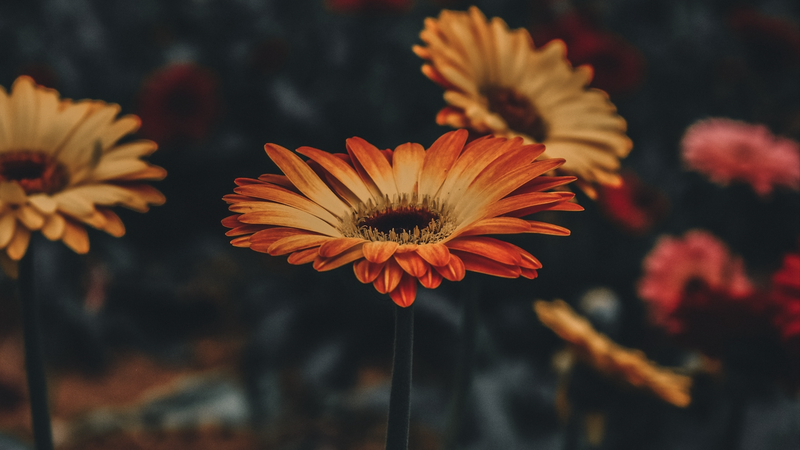
Along with Phuc Nhac and Trung Son flower villages, Bung Can flower village (Xuan Dinh commune) was once famous for its vibrant fields of marigolds, dahlias, lilies, chrysanthemums, and gerberas... every Tet holiday and spring season. Now, the area of flower cultivation in the hamlet has shrunk, to only a few hectares, mainly consisting of dahlias and lilies.
Farmer Nguyen Van Chien (residing in Bung Can hamlet) shared: "The land in Bung Can hamlet is very good, so the flowers there have large stems and strong buds, making them very popular in the domestic market. Previously, Bung Can hamlet had dozens of hectares dedicated to flower cultivation, and farmers grew all kinds of flowers to sell during Tet (Lunar New Year). Now, the land available for flower cultivation is limited, and farmers only reserve a small area in their gardens to grow dahlias and lilies for Tet and the spring festivities."
Phuc Nhac flower village (Gia Kiem commune) is famous for its pansies and petunias grown in hanging pots. However, these two species are more difficult to cultivate than others, and the profits are not high, so farmers in Phuc Nhac flower village now commonly grow only chrysanthemums, marigolds, cockscomb, and ornamental chili peppers.
Farmer TRAN VAN THIN, Phuc Nhac 1 hamlet, Gia Kiem commune, Dong Nai province.
Diem Quynh
Source: https://baodongnai.com.vn/xa-hoi/202512/ron-rang-cung-hoa-tet-fde1bde/


![[Photo] People's Public Security forces deployed to protect the 14th National Congress of the Party](/_next/image?url=https%3A%2F%2Fvphoto.vietnam.vn%2Fthumb%2F1200x675%2Fvietnam%2Fresource%2FIMAGE%2F2026%2F01%2F10%2F1768034712186_ra-quan-bvdhd-bca-39-8977-jpg.webp&w=3840&q=75)






![[Photo gallery] Gardeners in Dong Nai are busily pruning branches and separating flower buds for Tet (Lunar New Year).](https://vphoto.vietnam.vn/thumb/402x226/vietnam/resource/IMAGE/2026/01/10/1768023908545_b0_20260110124143.jpeg)










![[Infographics] Resolution No. 79-NQ/TW of the Politburo on the development of the state-owned economy](https://vphoto.vietnam.vn/thumb/402x226/vietnam/resource/IMAGE/2026/01/10/1768038914679_chp_3-11-23.jpeg)
























Comment (0)