

 |
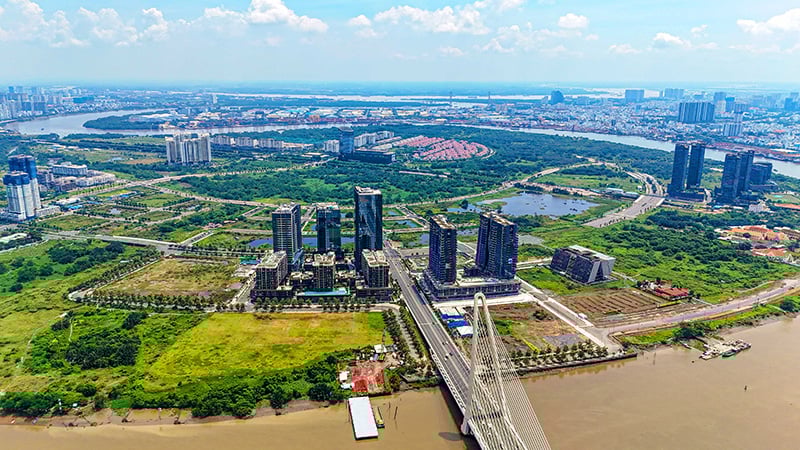
| The effort to restructure the entire economic space of the Southeast region is expected to create new development opportunities for the megacity of Ho Chi Minh City. |
Combining strengths to drive economic growth.
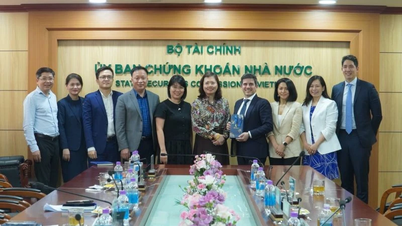
In the early days of 2026, the leaders of Bac Ninh province held a special meeting with Mr. Li ShaoHui, Vice President of Regional Business and Head of the Chairman's Office of JA Solar Group (China).
In fact, this is a very regular activity of the leaders of Bac Ninh province - receiving investors. But it is special because this time, Mr. Li ShaoHui brought good news: JA Solar plans to revive its photovoltaic cell technology project in Quang Chau Industrial Park to continue serving the Southeast Asian market in a new phase of development.
JA Solar began investing in Bac Ninh in 2016 and to date has three projects in the province, with a total investment of $967 million, specializing in the production of silicon ingots, silicon wafers, and photovoltaic cells. However, since October 2024, the photovoltaic cell factory has had to temporarily cease operations due to market conditions. Now, JA Solar is developing a new production and business strategy, with plans to bring the photovoltaic cell factory back into operation.
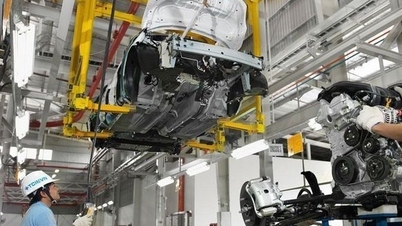
This is certainly good news for Bac Ninh, a manufacturing hub for many foreign investors, especially in the high-tech, electronics, and semiconductor sectors in recent times. Before merging with Bac Giang to form a new Bac Ninh with an area of 4,718.6 km2, Bac Ninh was already a magnet for foreign investment in the North, attracting major names such as Samsung, Canon, Amkor, and Goertek. The merger with Bac Giang, a rising star, has given Bac Ninh even more strength. The consolidation of these two localities, as leaders of the Foreign Investment Agency ( Ministry of Finance ) have repeatedly affirmed, is a "strategic step" to form a closed-loop electronics production chain, from component processing to assembly and export of finished products.
Meanwhile, Ms. Nguyen Thi Huong, Director of the Statistics Department (Ministry of Finance), said that after the merger, Bac Ninh has become a large-scale, diversified production center, enhancing its international competitiveness. "The consolidation has also expanded the development space, optimized resources, and created new growth poles, promoting sustainable regional linkages," Ms. Huong stated.
When resources are invested, production capacity increases, creating momentum for economic growth. That is one of the reasons why, in 2025, Bac Ninh's GRDP growth is expected to reach 10.3%, ranking 5th nationwide and contributing 5.3% to the overall GDP growth.
Not only Bac Ninh, but Phu Tho has also gained new development opportunities after merging with Vinh Phuc and Hoa Binh. It is also one of the localities achieving double-digit growth in 2025 (10.52%), ranking 4th nationwide.
“After the merger, Phu Tho entered a new phase of development on a larger scale, with clearer potential and advantages. The province inherited the resources, culture, history, and development potential of the three former localities, connecting them into a continuous value chain, creating opportunities for breakthroughs,” said Mr. Tran Duy Dong, Chairman of the People's Committee of Phu Tho province.
According to Mr. Dong, industrial production continues to play a key role as one of the driving forces for Phu Tho's economy, with the industrial production index projected to grow by 26.4% in 2025, the highest in the country. This is partly due to the $1.51 billion in foreign investment and VND 260,000 billion in domestic investment that the province has attracted in 2025.
As Mr. Dong said, the combined strength of the three localities of Phu Tho, Vinh Phuc, and Hoa Binh has enabled the new Phu Tho after the merger to accelerate and make breakthroughs.
Similar to Bac Ninh and Phu Tho, many localities across the country, after mergers, have combined their strengths to achieve remarkable results in socio-economic development. For example, Ninh Binh – after merging with Nam Dinh and Ha Nam – achieved a growth rate of 10.65% in 2025, attracting $1.65 billion in foreign investment; Hai Phong – after merging with Hai Duong – achieved a growth rate of 11.81%, attracting $2.33 billion in foreign investment… Ho Chi Minh City is also similar; after merging with Binh Duong and Ba Ria - Vung Tau, it has become a megacity, with a GRDP growth rate of 8.03% (excluding crude oil); attracting nearly $7.1 billion in foreign investment…
Besides these localities, which are experiencing both high economic growth and active investment attraction, several other localities are also emerging as new growth poles and investment magnets. Among the top 10 localities attracting the most foreign investment nationwide in 2025, there are some notable names, such as Tay Ninh (merged with Long An), attracting $2.92 billion; Hung Yen (merged with Thai Binh), $1.776 billion; and Gia Lai (merged with Binh Dinh), $1.5 billion…
"The recent emergence of large-scale projects in some localities such as Tay Ninh and Hung Yen shows that the local merger process is initially effective, enhancing competitiveness and promoting the implementation of policies for equitable investment allocation," the head of the Foreign Investment Agency stated.
Creating new spaces for development, ready for breakthroughs.
Many localities have experienced a breakthrough in their economies following the administrative reorganization revolution. However, expectations for the future are even higher, with the target of double-digit growth in the 2026-2030 period clearly defined. Consequently, the responsibilities and pressures on these localities are also greater.
"We aim for a GRDP growth rate of 11% in 2026," said Mr. Tran Duy Dong.
To continue attracting investment and achieving double-digit growth in the coming period, Phu Tho is adjusting its Provincial Planning for the period 2021-2030, with a vision to 2050, aiming to make the locality one of the growth poles of the Northern Midlands and Mountains, while restructuring its development space after merging with Hoa Binh and Vinh Phuc.
 Instead of letting the administrative reorganization story be merely a "mechanical merger," many localities have strived to shape and expand new development spaces.
"The overarching principle is that mergers are not mechanical; instead, they are about consolidating and complementing the strengths of each locality, and redistributing industries and sectors in a way that avoids intra-regional competition," said Mr. Tran Duy Dong.
Instead of letting the story of administrative unit reorganization and the implementation of a two-tiered local government model be merely a "mechanical merger," many localities have strived to shape and expand new development spaces.
Ho Chi Minh City, for example, is a leading economic hub striving towards a multi-polar urban spatial model, encompassing three regions: Ho Chi Minh City, Binh Duong, and Ba Ria - Vung Tau. The goal is to maximize the advantages of each region within a unified ecosystem, thereby creating a megacity – a regional and global center for finance, manufacturing, logistics, and innovation.
Far from being a mere mechanical merger or simply linking three localities, the effort to restructure the entire economic space of the Southeast region is expected to create new development spaces and new growth drivers for the megacity of Ho Chi Minh City.
In his presentation at the 14th National Congress of the Communist Party of Vietnam, Chairman of the Ho Chi Minh City People's Committee Nguyen Van Duoc stated that Ho Chi Minh City's development aspirations by 2030 must be placed within a larger picture, inseparable from the nation's overall aspiration: By 2045, the 100th anniversary of the founding of the country, Vietnam will become a developed, high-income nation with a firm position in the international arena.
“Within that overall strategy, the Central Government has placed very special expectations on Ho Chi Minh City: not only rapid growth but also growth in a different way; not only leading the way but also paving the way; and not only achieving success for itself but creating a ripple effect for the overall development of the whole country,” said Chairman of the People's Committee of Ho Chi Minh City, Nguyen Van Duoc, adding that Ho Chi Minh City is expected to become a testing ground for mechanisms and policies, a hub for science and technology and innovation, and a model for urban development management in the new era.
“This is not only an honor and recognition, but also a commitment to strategic national development, requiring unified understanding, strong political determination, breakthrough thinking, solidarity, and steadfast, consistent action,” said Mr. Nguyen Van Duoc, emphasizing the city's key growth drivers: institutions, innovation, infrastructure… and, equally important, the need for a rational organization of regional economic space and appropriate allocation of value chains…
"Ho Chi Minh City cannot and should not develop in isolation," emphasized Chairman of the People's Committee of Ho Chi Minh City, Nguyen Van Duoc.
This is certainly not a story unique to Ho Chi Minh City. Hanoi is also developing its Master Plan for the Capital City with a 100-year vision, closely linked with localities such as Thai Nguyen, Bac Ninh, Hung Yen, Ninh Binh, and other regions across the country. In that Master Plan, Hanoi will play the role of a center, a main driving force, coordinating and leading the spread of development: road, rail, waterway, and air transport; a financial, banking, trade, and logistics service center of regional and international stature…
The same applies to other localities across the country. The story isn't just about boosting industrial production and attracting investment this year or next year to achieve 9-10% GRDP growth, but about creating new development spaces that will enable localities to not only grow, but also accelerate and break through.
"After the merger, Bac Ninh province entered a new phase of development with a larger space, greater potential, more resources, and higher governance requirements," shared Nguyen Hong Thai, Secretary of the Bac Ninh Provincial Party Committee.
On June 30, 2025, when localities simultaneously announced resolutions and decisions from the Central and local governments on the merger of provincial and commune-level administrative units, General Secretary To Lam spoke about this historic step with strategic significance as we decided to "reorganize the country," because from here, a new development space will be created based on a long-term vision, aiming for synchronous, sustainable, and scientific development...
Reorganizing administrative units is, in fact, a way to restructure development space, strengthen regional linkages, and improve the efficiency of resource utilization in accordance with the national master plan. This is the path to accelerating the Vietnamese economy in general, as well as that of the 34 localities in particular.
Source: https://baodautu.vn/rong-mo-khong-gian-phat-trien-moi-d512495.html
![[Photo] Capturing each moment at the "People We Meet" photography exhibition.](https://vphoto.vietnam.vn/thumb/1200x675/vietnam/resource/IMAGE/2026/04/15/1776245695648_1-8944-jpg.webp)
![[Photo] General Secretary and President To Lam and his wife, along with General Secretary and President Xi Jinping and his wife, attending a tea party.](https://vphoto.vietnam.vn/thumb/1200x675/vietnam/resource/IMAGE/2026/04/15/1776245678527_vna-potal-tong-bi-thu-chu-tich-nuoc-to-lam-va-phu-nhan-cung-tong-bi-thu-chu-tich-nuoc-tap-can-binh-va-phu-nhan-du-tiec-tra-8702812-9829-jpg.webp)
![[Photo] National Assembly Chairman Tran Thanh Man concludes official visit to Italy, departs for IPU-152](https://vphoto.vietnam.vn/thumb/1200x675/vietnam/resource/IMAGE/2026/04/15/1776253436109_vna-potal-chu-tich-quoc-hoi-ket-thuc-tham-chinh-thuc-italy-len-duong-du-ipu-152-tai-tho-nhi-ky-8702876-7969-jpg.webp)
![[Photo] General Secretary and President To Lam and General Secretary and President Xi Jinping meet with youth from both countries.](https://vphoto.vietnam.vn/thumb/1200x675/vietnam/resource/IMAGE/2026/04/15/1776245687540_vna-potal-tong-bi-thu-chu-tich-nuoc-to-lam-va-tong-bi-thu-chu-tich-nuoc-tap-can-binh-gap-go-thanh-nien-hai-nuoc-8702371-jpg.webp)
![[Image] Overview of the Tam Trinh-Giai Phong connecting road section after land clearance is completed.](https://vphoto.vietnam.vn/thumb/1200x675/vietnam/resource/IMAGE/2026/04/15/1776245679644_ndo_br_dji-0195-jpg.webp)
![[Image] Current status of the land area of over 5.5 hectares that Ho Chi Minh City is considering reclaiming.](https://vphoto.vietnam.vn/thumb/1200x675/vietnam/resource/IMAGE/2026/04/15/1776245690095_1-3102-8409-jpg.webp)



























































Comment (0)