

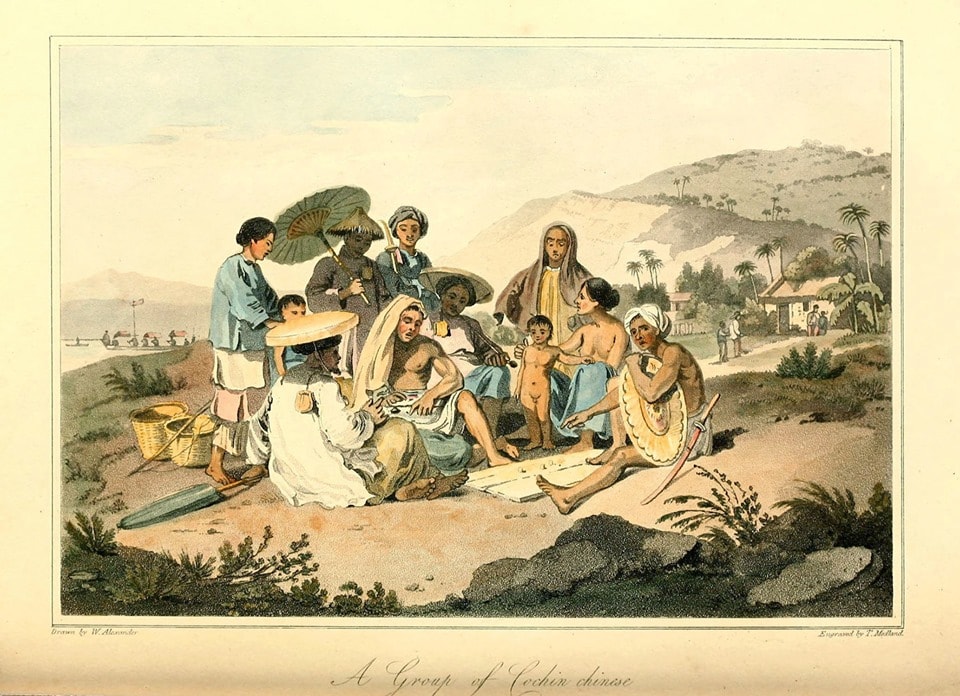
Silk permeated every aspect of life...
During the southward migration of the Vietnamese people, Quang Nam province soon became a melting pot of people and culture. This was evident not only in social life but also deeply ingrained in clothing, which directly reflected the lifestyle and aesthetics of its people. In the *O Chau Can Luc* (Records of the Ancient O Chau), revised by Dr. Sung Nham Hau Duong Van An in the first half of the 16th century, this image is depicted through concise yet evocative lines: "Women wear Cham clothes / Boys carry Chinese fans / The clothes of the rich and the poor / Are all decorated with dragons and phoenixes / The clothes of the tall and the short / Are all red and pink."
In just a few brief lines, Duong Van An clearly shows the intermingling of cultures: Cham influence in women's clothing, Chinese elements in men's accessories, and the prevalent dragon and phoenix motifs found across various social classes. Notably, red and pink are prominent colors that seem to dominate the attire of the local people.
In the early 17th century, the missionary Cristoforo Borri, who lived in Dang Trong from 1618 to 1622, left detailed records in *Dang Trong* in 1621. What impressed him most was the popularity of silk: "...silk was so common in Dang Trong that everyone wore silk."
Not only was it common, but its use also surprised him when he witnessed "men and women carrying stones, earth, lime... without any care to keep their clothes beautiful and precious, or to prevent them from tearing or getting dirty. Because this place has tall mulberry trees, planted in vast fields, people pick the leaves to feed silkworms... This silk, although not as delicate and smooth, is more durable and stronger than Chinese silk."
Towards the end of the 18th century, John Barrow, in *A Journey to Southern Vietnam* (1792-1793), noted another aspect: the simplification of everyday clothing. He observed: "The clothing of the people of Southern Vietnam… was greatly reduced… often leaving their calves bare and always going barefoot." This shows a flexible adaptation to the climate and living conditions.
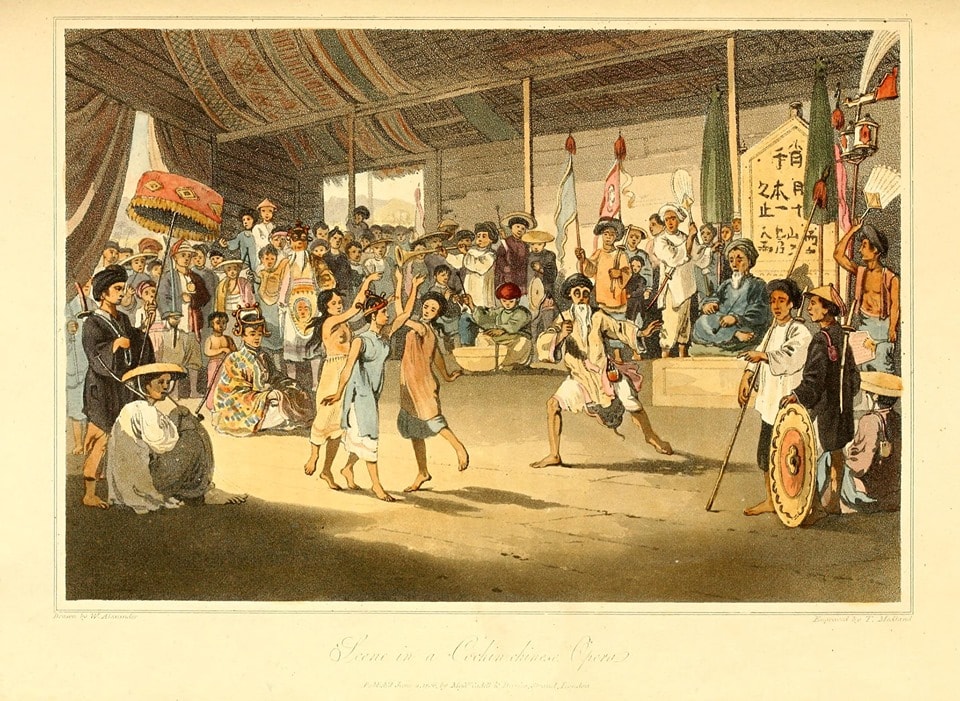
When clothing changes color
If the material forms the foundation, then the style and color scheme are the soul of the garment. Through Borri, one can clearly see the layered structure and the ability to subtly showcase colors.
He described them: “They wore five or six plain silk skirts, one on top of the other, all in different colors. The first one stretched down to the ground, dragging so solemnly, skillfully, and majestically that the toes were invisible. Then came the second, shorter than the first by about four or five finger widths, then the third, shorter than the second, and so on, with the rest in a ratio of one shorter than the other, so that all the colors were displayed in the variations of each piece. That is what women wore from the waist down.” The gradually shortening layers of skirts created a natural color-shifting effect; as they moved, the colors appeared and disappeared, giving a soft, vibrant appearance.
The upper part of the garment further accentuates the elaborate style as they "wear robes draped diagonally like a chessboard in various colors, covered entirely with a very smooth and thin veil that allows one to see through all the vibrant colors, like a joyful and graceful spring, yet also dignified and simple."
Not only clothing, but also hair and accessories contribute to shaping beauty: “They wear their hair down, cascading over their shoulders; some have hair so long it touches the ground, the longer the hair, the more beautiful it is considered. They wear a large, wide-brimmed hat that covers their entire face, allowing them to see only three or four steps ahead. This hat is also woven with silk and gold thread, depending on the social standing of each person,” Borri describes.
Men's attire was also far from simple. Borri noted: "The men didn't wear sashes, but instead draped themselves in a whole bundle, and then added five or six long, loose robes. All were made of silk in various colors, with wide, long sleeves like those of monks. From the waist down, the colors were arranged very skillfully and beautifully. So when they went out into the street, they displayed a harmonious array of colors."
Meanwhile, the intellectual class tended to be more restrained: “Writers and doctors dressed more formally, though their clothes were not flashy, usually black robes, with turbans on their heads. Both men and women preferred to carry fans, much like in Europe (they carried them only as a formality). Europeans wore black when mourning, while they wore white.”
By the 18th century, scholar Le Quy Don, in his book "Phu Bien Tap Luc," further confirmed the development of the weaving craft in this area: "...The people of Thang Hoa and Dien Ban knew how to weave cloth and silk... with beautiful colors no less than Guangdong silk."
He also commented on the somewhat extravagant dressing trend: "Even the common people wear silk brocade robes... they feel ashamed to wear plain cloth clothes."
From historical documents, it can be seen that the traditional clothing of the people of Quang Nam province was a culmination of economic conditions, developed crafts, and profound cultural exchange. It was not just an outer garment, but also an expression of a dynamic society where beauty was created from richness, flexibility, and constant change.
Source: https://baodanang.vn/sac-lua-xu-quang-qua-tu-lieu-xua-3334320.html
![[Photo] General Secretary and President To Lam and his wife begin their official visit to Thailand.](https://vphoto.vietnam.vn/thumb/1200x675/vietnam/resource/IMAGE/2026/05/27/1779881249412_anh-man-hinh-2026-05-27-luc-18-10-51.png)
![[Photo] The courage of new recruits of Brigade 144 on the training ground.](https://vphoto.vietnam.vn/thumb/1200x675/vietnam/resource/IMAGE/2026/05/27/1779881651341_anh-man-hinh-2026-05-27-luc-18-32-52.png)












![[Video] Weather forecast for tonight and tomorrow, May 28, 2026: Northern Vietnam to see a drop in temperature, Central Vietnam to continue experiencing intense heat.](https://vphoto.vietnam.vn/thumb/402x226/vietnam/resource/IMAGE/2026/05/27/1779887047052_thumb-toi-2705-png.webp)




































![[Photo] The courage of new recruits of Brigade 144 on the training ground.](https://vphoto.vietnam.vn/thumb/402x226/vietnam/resource/IMAGE/2026/05/27/1779881651341_anh-man-hinh-2026-05-27-luc-18-32-52.png)




















Comment (0)