

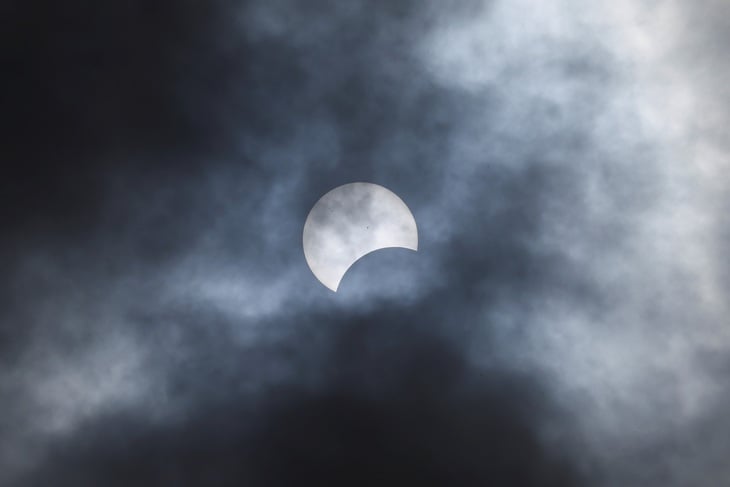
A solar eclipse observed at Niagara Falls, New York City (USA) in 2024 - Photo: REUTERS
On September 15th, the Hanoi Astronomical Society (HAS) announced that a partial solar eclipse will occur on September 21st (international time, September 22nd in Vietnam).
Only about 16.6 million people in the narrow strip east of Australia, New Zealand, sparsely populated islands in the South Pacific, and parts of Antarctica—equivalent to about 0.2% of the world's population—were able to see at least a portion of this solar eclipse.
October brings a supermoon, meteor showers, and comets.
According to HAS, the first supermoon of 2025 (Harvest Moon) will appear in October.
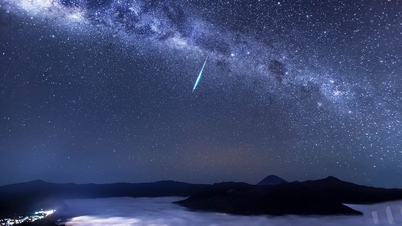
In addition, there will be two meteor showers: the Draconids (October 8th and 9th) and the Orionids (October 22nd and 23rd).
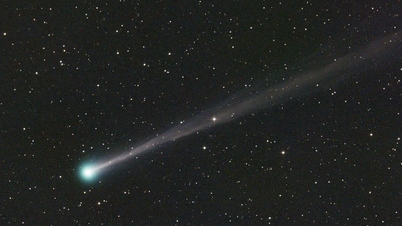
Additionally, a comet will appear at the end of October.
The maximum eclipse occurred at coordinates (60°54' south, 153°30' east) with a maximum obscuration of 79.52%.
According to Vietnam time, the specific times of the solar eclipse are as follows:
- 00:29:43 on September 22nd: The solar eclipse begins (the first location to see a partial solar eclipse starts).
- 2 hours 41 minutes 59 seconds: Maximum solar eclipse.
- 4:53:45: The solar eclipse ends (the last location where the eclipse was visible).
Unfortunately, Vietnam and many other countries will not be able to observe this phenomenon at any stage.
According to HAS, the next solar eclipse visible in Vietnam will occur on August 2, 2027.
Meanwhile, another lunar eclipse will visit us early next year, specifically a total lunar eclipse on March 3, 2026.
What is a solar eclipse?
A solar eclipse occurs when the Moon moves between the Sun and the Earth, blocking sunlight and casting a shadow of the Moon on the Earth's surface. People often jokingly refer to this phenomenon as "the moon eating the sun."
There are four types of solar eclipses, and they are determined by the areas of the Moon's shadow on the Earth's surface.
- Total solar eclipse : Occurs when the Moon completely obscures the Sun, forming areas of shadow and penumbra on the Earth's surface. A total solar eclipse can only occur when the Moon is near its perigee (closest point in its orbit).
You can observe a total solar eclipse if you are standing in the path of the Moon's umbra. Those not in the umbra but in the penumbra will observe a partial solar eclipse.
- Partial solar eclipse : Occurs when the Moon does not completely obscure the Sun's disk, forming only a penumbra (a region of shadow) on the Earth's surface.
- Annular solar eclipse : Occurs when the opposite side of the shadow appears on Earth. The Moon's disk will obscure the center of the Sun's disk, revealing the outer edge of the Sun in the shape of a ring. An annular solar eclipse can only occur when the Moon is at its apogee (farthest point from its orbit).
- Hybrid solar eclipses : These are very rare. They occur when an annular solar eclipse transforms into a total solar eclipse.
Source: https://tuoitre.vn/sap-nhat-thuc-viet-nam-co-xem-duoc-mat-trang-an-mat-troi-20250915152218153.htm
![[Photo] General Secretary and President To Lam presides over a meeting with the Central Organizing Committee.](https://vphoto.vietnam.vn/thumb/1200x675/vietnam/resource/IMAGE/2026/06/03/1780482764658_a1-bnd-4741-3342-jpg.webp)
![[Photo] First session of the 14th Congress of the Vietnam Trade Union](https://vphoto.vietnam.vn/thumb/1200x675/vietnam/resource/IMAGE/2026/06/03/1780465947883_ndo_br_img-3852-jpg.webp)


![[Photo] Secretary of the National Assembly Party Committee, Chairman of the National Assembly presides over the meeting of the Standing Committee and Executive Committee of the National Assembly Party Committee.](https://vphoto.vietnam.vn/thumb/1200x675/vietnam/resource/IMAGE/2026/06/03/1780480353201_ndo_br_bnd-2585-jpg.webp)


















































![[Video] Sunset at Lap An Lagoon – Where the sun sets over the fishing nets](https://vphoto.vietnam.vn/thumb/1200x675/vietnam/resource/IMAGE/2026/05/31/1780192137701_beach-landscape-sea-water-nature-grass-745871-pxhere-com.jpeg)









































Comment (0)