

In 1976, Tuyen Quang and Ha Giang provinces merged to form Ha Tuyen province, and in 1991 they were separated again, re-establishing two new provinces: Tuyen Quang and Ha Giang. Since then, the administrative boundaries of Tuyen Quang province have remained unchanged.
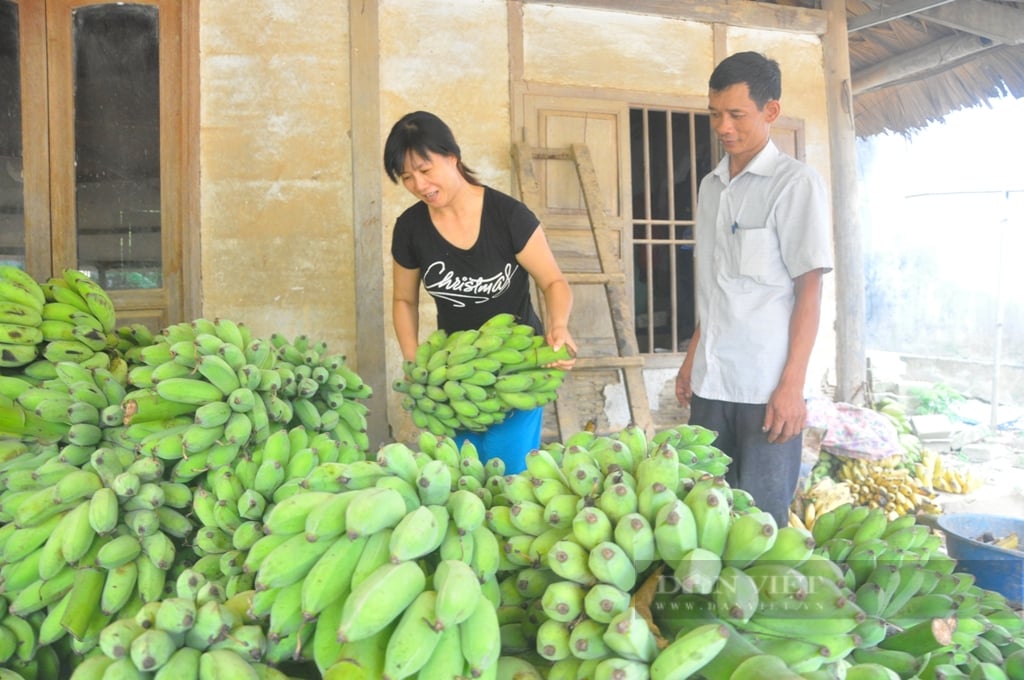
Locals harvest bananas to sell to traders in Kim Binh commune, Chiem Hoa district ( Tuyen Quang province). Photo: TQ
It has merged and separated twice.
During the Tran Dynasty, the place name Tuyen Quang first appeared in ancient texts under the name: Tuyen Quang Province. In 1397 (the 10th year of Quang Thai's reign), Ho Quy Ly renamed Tuyen Quang Province to Tuyen Quang Town. Then, in 1466 (the 7th year of Quang Thuan's reign), King Le Thanh Tong divided the country into 12 administrative divisions, including Tuyen Quang.
In the tenth lunar month of the year of Tan Mao (November 1831), Emperor Minh Menh carried out reforms to the national administrative system, dividing the territory from Quang Tri northward into 18 provinces, including Tuyen Quang province. Thus, in 1831, for the first time in history, Tuyen Quang province appeared in the administrative system of the Vietnamese feudal state.
In 2011, at a scientific conference to determine the founding date of Tuyen Quang province, organized by the Propaganda Department of the Tuyen Quang Provincial Party Committee in coordination with the Vietnam Institute of Historical Studies, November 4, 1831, was identified as the founding date of Tuyen Quang province. The 17th Provincial People's Council of Tuyen Quang, term 2011-2016, issued a resolution recognizing the founding date of Tuyen Quang province as November 4, 1831.
When Tuyen Quang province was divided, it comprised one prefecture, one district, and five sub-districts: Yen Binh prefecture, Ham Yen district, and the sub-districts of Vi Xuyen, Dai Man, Luc Yen, Bao Lac, and Thu Vat. The entire territory of Tuyen Quang province at that time included the districts of Yen Son, Chiem Hoa, Ham Yen, Na Hang, Lam Binh, and Tuyen Quang city; the districts of Yen Bai province; the districts of Bao Lac and Bao Lam in Cao Bang province; and the entire present-day Ha Giang province.
Throughout history, the administrative divisions of Tuyen Quang province have undergone many changes: Doan Hung prefecture separated from Son Tay province to join Tuyen Quang province; Luc Yen district separated from Tuyen Quang province to join Lao Cai province; Vinh Tuy and Vi Xuyen districts separated from Tuyen Quang to form Ha Giang province; Yen Binh district separated from Tuyen Quang to join Yen Bai province; Bao Lac and Bao Lam districts separated from Tuyen Quang to join Cao Bang province.
In 1976, Tuyen Quang and Ha Giang provinces merged to form Ha Tuyen province, and in 1991 they were separated again, re-establishing two new provinces: Tuyen Quang and Ha Giang. Since then, the administrative boundaries of Tuyen Quang province have remained unchanged.

Cage fish farming is bringing high income to people in Na Hang (Tuyen Quang). Photo: TQ
The province's highest growth rate in the last 10 years.
On April 14, 2023, Tuyen Quang province held a ceremony to announce the Tuyen Quang Provincial Planning for the period 2021-2030 with a vision to 2050, in accordance with Decision No. 325/QD-TTg dated March 30, 2023, of the Prime Minister.
The plan sets economic targets, aiming for an average economic growth rate (GRDP) of over 9.5% during the period 2021-2030.
Economic structure: Industry and construction account for 42.8%, services 40.8%, agriculture, forestry and fisheries 13.2%, product taxes less subsidies 3.2%, GRDP per capita is over 130 million VND/person/year.
By 2050, Tuyen Quang aims to be a developed, high-income province in the Northern Midlands and Mountains region. Industrial zones and clusters will develop green, ecological, and smart industries; services will be diversified and modern; and agricultural production will utilize high technology and adapt to climate change.
According to the plan, this locality focuses on developing three economic pillars: processing, manufacturing and energy industries oriented towards a circular economy and green growth; developing tourism into an important economic sector of the province; and high-tech, organic, and specialty agriculture, as well as sustainable forestry and rural development.
The plan involves forming four growth poles linked to the region's potential strengths, including: industry, services, tourism, and urban development in Tuyen Quang City and the southern part of Yen Son district; industry, urban development, and tourism in Son Duong district; tourism and high-quality, specialty agricultural products in Na Hang and Lam Binh districts; and industry and agriculture/forestry in Ham Yen and Chiem Hoa districts.
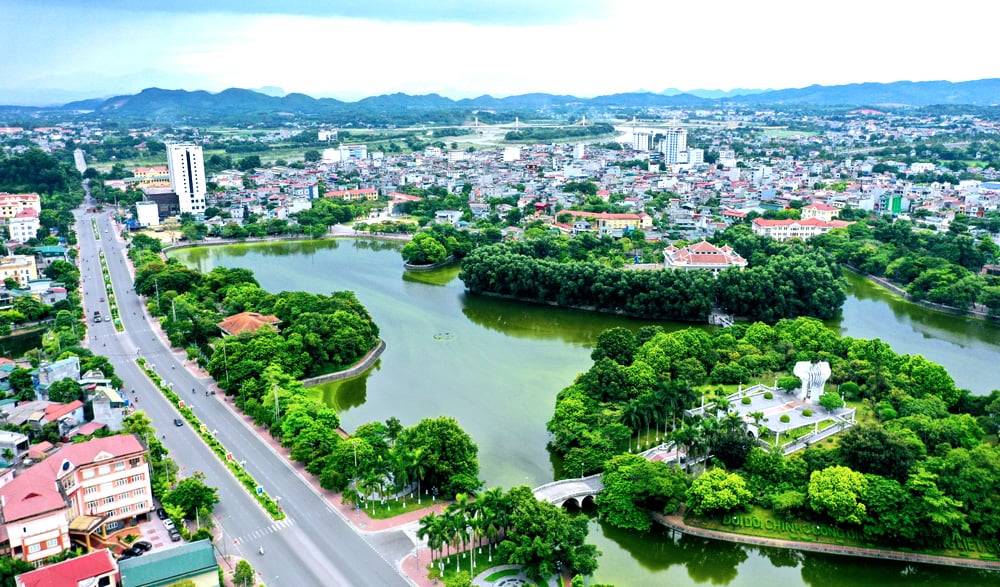
A view of Tuyen Quang city. Image source: baotuyenquang.com.vn
After four years of implementing the Resolution of the 17th Provincial Party Congress, many important results have been achieved in all fields, most notably: the 15 main targets, breakthroughs, and key tasks of the Congress Resolution have basically been met according to the set schedule.
In addition, the quality of education, medical examination and treatment, and healthcare for the people continues to improve; the percentage of people with health insurance reached 95.9%. The poverty rate in the province decreased to 10.2%. In 2024, support was provided to eliminate temporary and dilapidated houses for 2,449 households with a total budget of over 365 billion VND. Cumulatively from 2021 to the present, support has been provided to eliminate temporary and dilapidated houses for over 7,000 households with a total budget of nearly 1,000 billion VND. National defense was strengthened, and security, order, and social safety were maintained.
Regarding the new rural development program, to date, 85 out of 121 communes in the province have completed and met the new rural development standards (70.25% of the total number of communes, exceeding the target set for the 2021-2025 period). Currently, the average GRDP per capita is 61.53 million VND/year.
Tuyen Quang is aiming for a GRDP growth rate of 9.01% in 2025, and striving to achieve double-digit growth (10.05%) during the 2026-2030 period.
At the same time, Tuyen Quang also strives to increase the average income of ethnic minorities by more than double by the end of 2025 compared to 2020. The poverty rate among ethnic minorities will decrease by an average of 4% or more per year; and 50% of ethnic minority workers of working age will receive vocational training suitable to the needs, conditions, and specific characteristics of ethnic minority and mountainous areas.
Complete the asphalt and concrete paving of 100% of roads from the district center to the commune centers; 100% of households have access to the national power grid; over 80% of village cultural centers meet standards; 100% of ethnic minorities participate in health insurance; 80% of villages with a large ethnic minority population have established clubs for preserving their ethnic languages and costumes, as well as clubs for folk culture and arts.
Source: https://danviet.vn/sau-2-lan-sap-nhap-tach-ra-tinh-tuyen-quang-thay-doi-ten-nhu-the-nao-thu-nhap-cua-nguoi-dan-dat-bao-nhieu-20250318213930686.htm

![[Photo] Prime Minister Pham Minh Chinh presides over a meeting on private sector economic development.](/_next/image?url=https%3A%2F%2Fvphoto.vietnam.vn%2Fthumb%2F1200x675%2Fvietnam%2Fresource%2FIMAGE%2F2025%2F12%2F20%2F1766237501876_thiet-ke-chua-co-ten-40-png.webp&w=3840&q=75)




















































































Comment (0)