

Responding to questions from many National Assembly deputies regarding solutions to improve the health of the insurance market, Minister of Finance Ho Duc Phoc stated that all insurance companies will be inspected, violations will be promptly rectified, and policyholders' rights will be addressed.
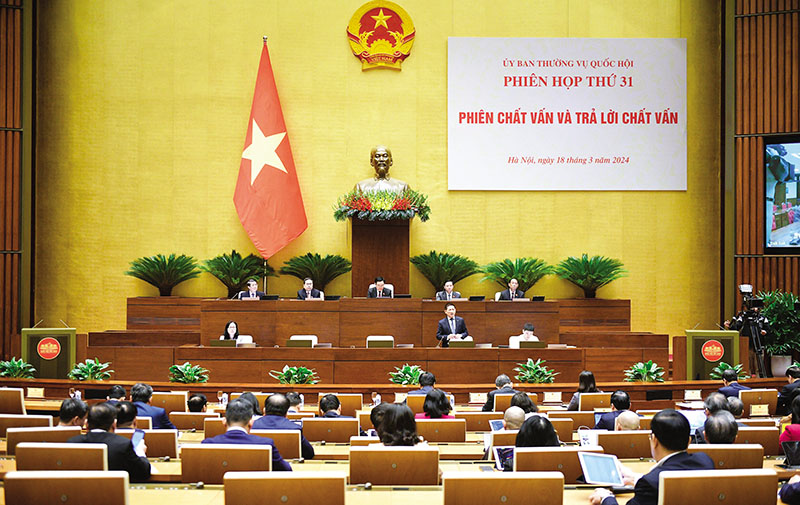 |
| Questioning session with Minister of Finance Ho Duc Phoc |
I can't say for sure whether cross-selling of insurance is still happening.
All 43 delegates who registered to ask questions and 4 who registered to debate were given the opportunity to express their opinions. The questioning session with Minister of Finance Ho Duc Phoc earlier this week raised quite a few pressing issues, from the management of gold and foreign currency, valuation, to betting business, and restoring order to the insurance market…
However, since the moderator did not invite anyone to "share the burden," Minister Ho Duc Phoc alone could not clarify all the delegates' concerns, including the management and supervision of insurance business activities and services in the life insurance sector - an issue that many delegates questioned from the beginning to the end of the session.
The results of the first inspection of four insurance companies selling insurance through banks, announced by the Ministry of Finance in July 2023, showed that the total revenue from insurance sales through commercial banks up to December 31, 2021, was approximately 5,000 billion VND. However, some companies had up to 70% of their customers canceling their insurance policies after the first premium payment (usually for one or two years). The majority of customers who purchased insurance through banks immediately decided to cancel upon signing the contract, accepting the complete loss of the premiums already paid.
Citing the above information, National Assembly Economic Committee member and delegate Pham Van Thinh (Bac Giang) asked: “How does the Minister assess and handle the responsibilities of the relevant organizations based on the results of this inspection? Are there any signs of legal violations causing significant consequences and losses to the large number of customers who have abruptly canceled their contracts?”
"What measures does the Ministry of Finance have in place to ensure that insurance companies do not commit similar violations in the future, especially in light of the addition of Clause 5, Article 15 of the Law on Credit Institutions, which was passed by the National Assembly at its fifth extraordinary session, prohibiting the sale of non-compulsory insurance products linked to the provision of banking products and services in any form?" Mr. Thinh further inquired.
In response to questions, Minister Ho Duc Phoc stated that he "couldn't confirm" whether the situation mentioned by the delegates still exists. However, he added that in the past, some commercial banks, when advising people on loans, would also guide them to purchase insurance. If borrowers purchased insurance, the benefits for the bank and the advisor would be significant.
"Therefore, when businesses borrow money and pay the first insurance premium, they cancel it abruptly. If they continue paying in subsequent years, it will prolong the process and cause even greater losses. It's better to lose the initial amount and add it to the borrowing costs than to prolong it in subsequent years," Mr. Phớc explained.
 Life insurance revenue has fallen sharply.
- Minister of Finance Ho Duc Phoc
Vietnam currently has 82 insurance companies and businesses, including 19 life insurance companies (2 domestic companies, the rest are foreign and foreign joint ventures). The total assets of these companies are approximately VND 913 trillion, and their investments back into the economy are nearly VND 700 trillion. Insurance revenue in 2023 reached VND 227 trillion, a decrease of 8% compared to 2022, of which non-life insurance revenue accounted for VND 71 trillion, and life insurance revenue was approximately VND 155 trillion. Life insurance revenue decreased significantly, by nearly 13% in 2023, while non-life insurance revenue decreased by nearly 3%. The demand for life insurance as a long-term savings and security measure has decreased due to difficult living conditions or because people have found better alternative options.

The head of the finance sector stated that they have coordinated with the banking inspection and supervision agency to investigate and address the issues raised by the delegates. One measure taken is to fully record the consultation process for future inspection and auditing purposes.
Besides the question from delegate Pham Van Thinh, Minister Ho Duc Phoc also received a series of other questions about solutions to rectify shortcomings in the insurance market. Delegate Nguyen Thi Viet Nga (Hai Duong) asked: "Does the Minister believe that a broad and comprehensive inspection of life insurance companies is necessary to better manage this sector?" The Minister's answer was that the Ministry of Finance has inspected 10 insurance companies and will continue to inspect 7 more insurance companies next year.
“We intend to inspect all insurance companies. However, in addition to planned inspections to address recurring loopholes or violations, we will conduct surprise inspections based on complaints and denunciations from insurance policyholders to resolve claims for policyholders and promptly correct violations by insurance companies. This ensures that these companies operate on an equal footing and comply with the law, demonstrating fairness and transparency in the insurance market,” Mr. Phớc said.
Tighten control and prevent gold and foreign currency smuggling.
Combating smuggling and illegal transportation of goods across borders was also among the issues raised in the questioning of the head of the finance sector.
According to delegate Huynh Thi Phuc (Ba Ria - Vung Tau), in recent times, many cases of smuggling, illegal transportation of goods across the border, and tax evasion have become quite complex, involving many items, including gold and foreign currency. These activities are quite sophisticated and widespread, impacting the Vietnamese market, especially during periods when domestic gold prices fluctuate significantly and rise quite high.
A delegate requested that the Minister of Finance provide solutions to effectively control the domestic gold and foreign exchange markets to address the aforementioned situation. Clarifying that gold and foreign exchange fall under the state management purview of the State Bank of Vietnam, not the Ministry of Finance, Mr. Phớc stated that the Ministry of Finance's responsibilities include combating smuggling and trade fraud, and managing border areas to prevent smuggled goods from entering Vietnam when the price of gold and the USD in Vietnam rises.
"We have tightened border controls to manage this gold and foreign currency. Recently, we have intercepted several cases related to the smuggling of foreign currency, such as the transfer of $1.6 billion to South Korea, or are investigating and processing cases involving 3,700 billion VND or 1 million USD in counterfeit currency transferred through the air transport system," the Minister replied.
To bring down the price of gold and the USD, the Minister believes that a series of solutions must be implemented, as the price of gold is related to supply and demand, and to imports and exports. “Is there gold being imported? How should we tighten regulations on buying and selling? Is there any exploitation of the psychology of ineffective investment in production and business, and low interest rates on bank deposits, to divert this money into gold? A series of solutions are needed to address and prevent price increases,” the Minister stated.
Regarding the USD, Mr. Phớc believes that the exchange rate reflects the strength of the currency. However, a depreciation of the Vietnamese Dong could also benefit exports. “But how exports will be impacted and how to prevent the VND from depreciating requires a series of monetary policy solutions. The Governor of the State Bank of Vietnam will provide further answers later,” Mr. Phớc said.
At that time, the Governor of the State Bank of Vietnam, Nguyen Thi Hong, was also present at the Dien Hong Hall - where the questioning session took place, but the presiding Vice Chairman of the National Assembly did not invite Ms. Hong to "share the burden" with Minister Phuoc.
During the questioning session, delegate Trinh Xuan An (Dong Nai) argued that the high price of airfares is not necessarily due to supply-demand imbalances or fuel costs, but rather to inadequate cost calculations by businesses. "Price management has a complete legal framework, yet paradoxically, the more the price of a product increases, the more losses businesses incur," Mr. An stated, and requested the Ministry of Finance to review the pricing process.
Minister Ho Duc Phoc affirmed that the airfare price framework issued by the Ministry of Transport has 15 levels and is being managed within that framework, and "has not exceeded it." Some countries have abolished airfare price caps, allowing businesses to determine prices based on market supply and demand. However, the Law on Prices still stipulates a price ceiling, and businesses "are operating in accordance with regulations, therefore they have not violated the law on pricing."
Source

![[Image] Close-up view of the interchange connecting the two expressways and Long Thanh Airport.](https://vphoto.vietnam.vn/thumb/1200x675/vietnam/resource/IMAGE/2026/05/25/1779703378210_ndo_br_z7863716673926-224453a31600126cce10622af6290afd-4549-jpg.webp)


![[Image] Hanoi's urban life under the challenge of a "scorching hot" environment](https://vphoto.vietnam.vn/thumb/1200x675/vietnam/resource/IMAGE/2026/05/25/1779706979265_nang-nong-t5-2026-minh-duy-7-4636-jpg.webp)


































































































Comment (0)