

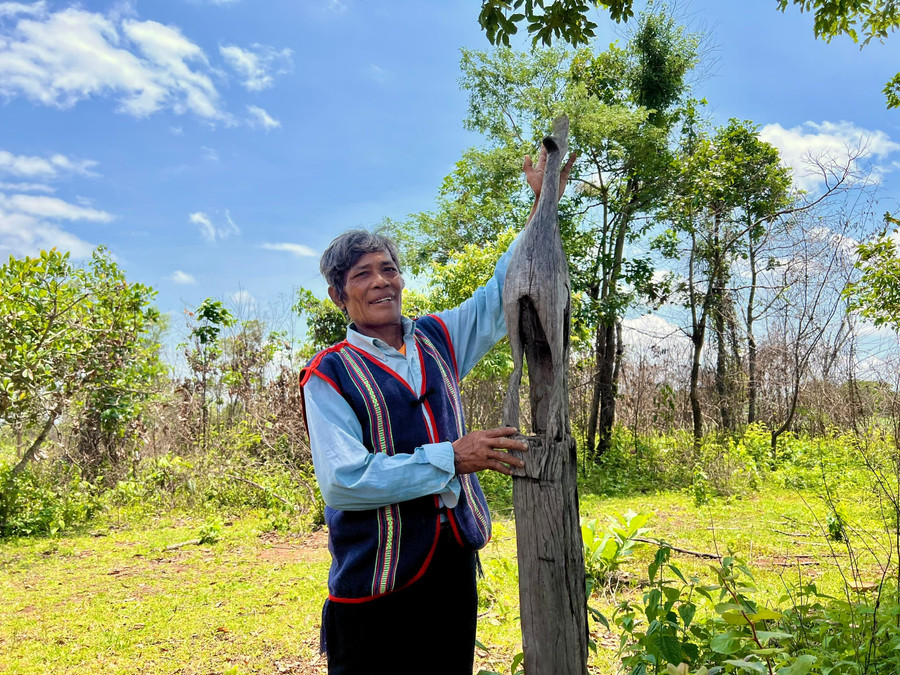
From a young age, Mr. Krang was familiar with the sight of village elders carving large logs into statues used in the horse-laying ceremony. In 1988, while accompanying an elder into the forest to gather wood, he first encountered and began learning the craft. He learned by observing the methods of those who came before him, practicing on his own, and accumulating experience. By 1990, he had completed his first monkey statue.
“When I finished sculpting the first statue and it was erected in the middle of the ceremonial grounds, I was both nervous and happy. Nervous because I didn't know if anyone would criticize it, happy because it was the first time my work had been accepted. That feeling made me want to learn more and create more,” Mr. Krang recalled.
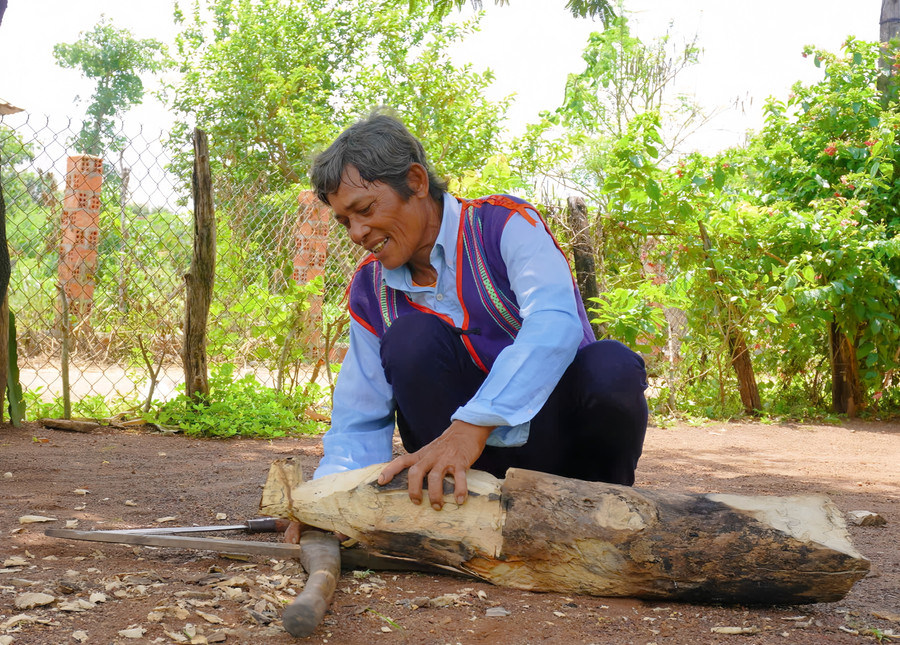
According to Mr. Siu Krang, to create a statue, one must first have good and suitable wood. The wood chosen is usually chay wood or chit wood because it is easy to carve, durable, and resistant to termites. The trunk must be straight, even, and have a diameter of 25-35cm or more to be sufficient to shape a person or animal. "In the past, we could find large trees in the forest. Now the forests are dwindling, and there isn't as much wood as before. Sometimes it takes a whole week to find a tree that's just right," Mr. Krang shared.
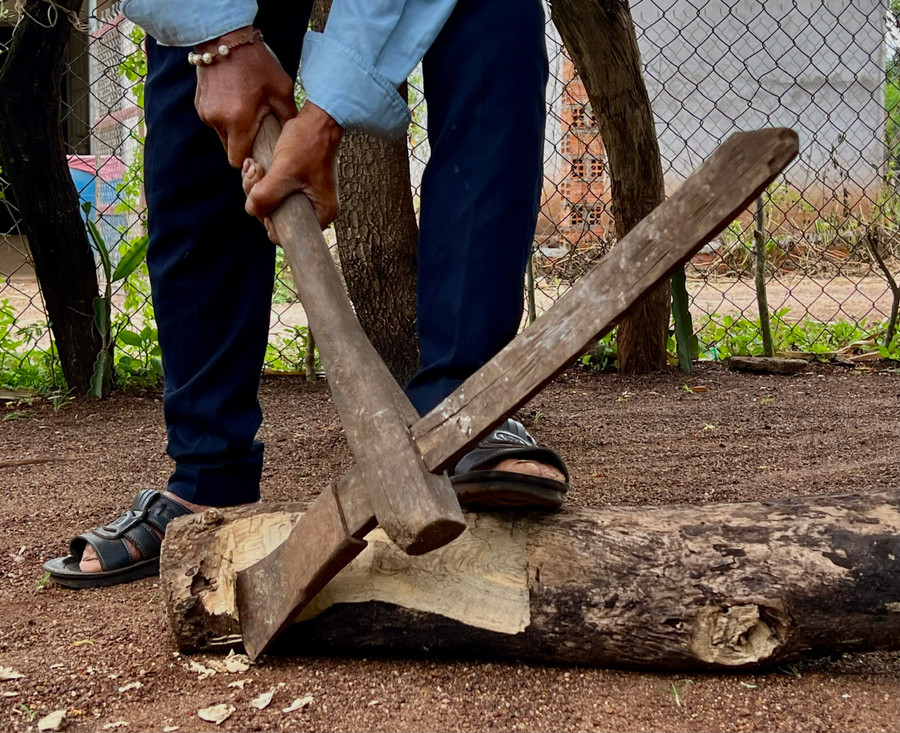
Currently, due to the depletion of natural wood resources, Mr. Siu Krang mainly carves small statues, both to serve the traditional horse-laying ceremony in the village and to teach the carving technique to local youth. Each statue he creates is made by hand using an axe, knife, and a few simple tools.
Mr. Krang said that sculpting human figures is the most complex because it requires precise calculations of body proportions, facial features, and posture according to cultural symbols. Meanwhile, sculpting animal figures such as monkeys, birds, and toads is simpler and easier to complete in a short time. On average, each statue takes about 3 days to complete, consisting of 3 main steps: sketching, carving, and refining details. “Sculpting animals is easier than sculpting people. For example, monkeys and birds… you don’t need any facial features; you can just look at the shape and you’re done,” Mr. Siu Krang said.
Many people call him a "master craftsman," but he doesn't accept the title. He believes that preserving the craft is the greatest joy. For him, continuing to pass on the craft isn't about seeking fame, but about preserving a cultural value that is gradually being forgotten.
According to Mr. Siu Krang, fewer and fewer young people are interested in sculpting or traditional skills. Many young people in the village go to work far away or spend their time on technology and social media. “These kids are obsessed with phones and the internet. Few people are interested in sculpting or playing gongs anymore. If no one preserves them, they will all be lost,” Mr. Siu Krang lamented.
Besides sculpting, Mr. Siu Krang is also skilled in the art of playing gongs and traditional weaving. Between 2017 and 2020, he actively participated in the Cultural and Sports Competition of Ethnic Minorities in Chu Se District, contributing many performances such as gong performances, sculpture demonstrations, and presentations of Jrai weaving techniques.
Speaking with reporters, Mr. Siu Vong, Vice Chairman of the People's Committee of Hbong commune, said: Mr. Siu Krang is one of the very few people who still master the traditional tomb statue carving technique in the locality. The statues he makes are still used in the Jrai people's funeral rituals. Whenever the commune has a cultural event, he participates as a performing artist and guides the community.
“In the future, we will cooperate with people knowledgeable about traditional culture like Mr. Siu Krang to organize classes to teach carving, gong playing, and other crafts to young people in the village. This is not only a way to preserve intangible cultural heritage but also to help the younger generation better understand the value of their ethnic identity,” Mr. Vong added.
Source: https://baogialai.com.vn/siu-krang-gin-giu-nghe-tac-tuong-post330066.html


![[Image] Close-up view of the interchange connecting the two expressways and Long Thanh Airport.](https://vphoto.vietnam.vn/thumb/1200x675/vietnam/resource/IMAGE/2026/05/25/1779703378210_ndo_br_z7863716673926-224453a31600126cce10622af6290afd-4549-jpg.webp)













































































Comment (0)