

 |
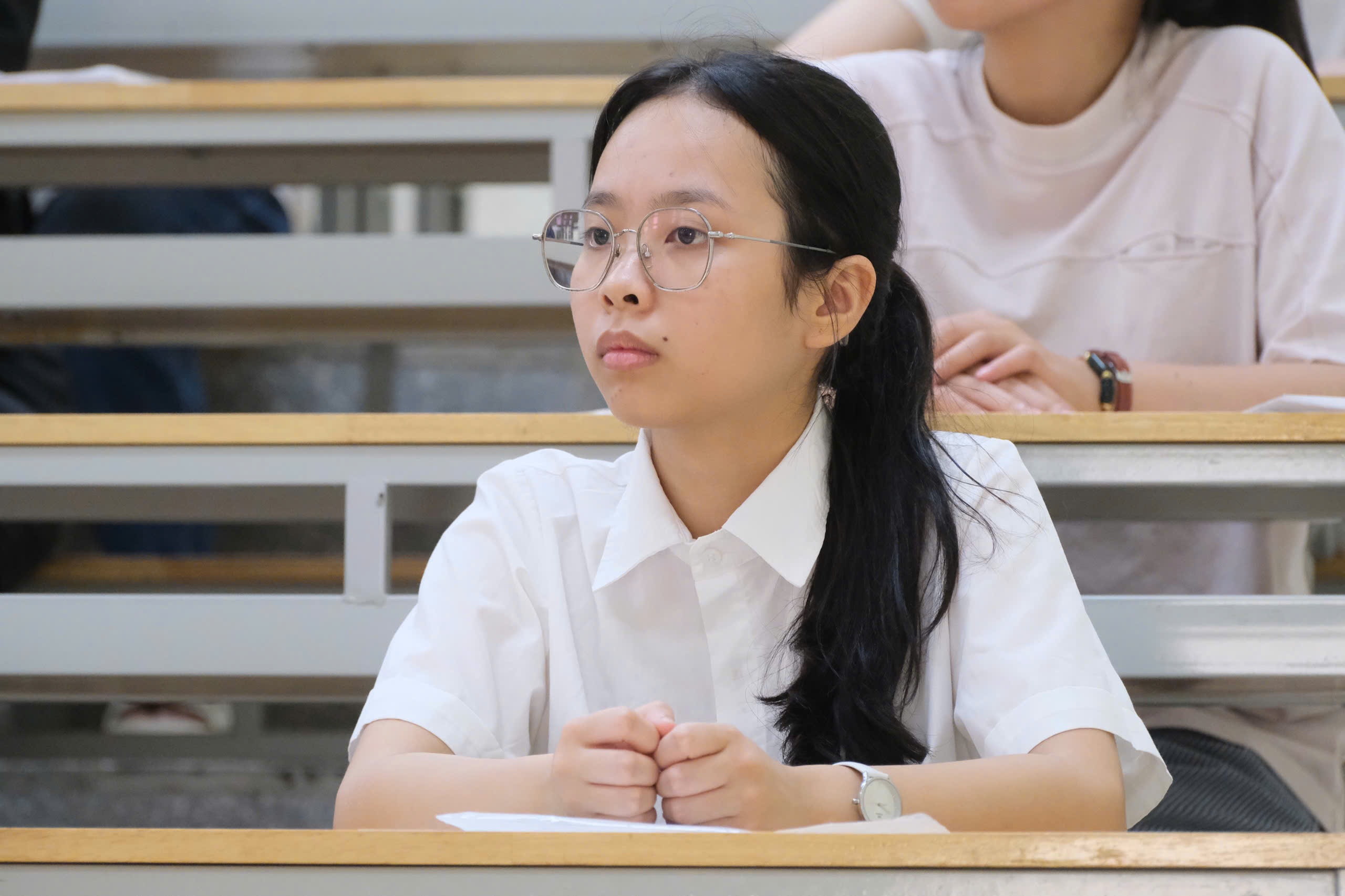
Candidates at the Hanoi University of Education examination area. Photo: Ngoc Bich . |
On the morning of May 23rd, thousands of candidates from various provinces and cities flocked to Hanoi Pedagogical University to take the first round of the 2026 National Competency Assessment Test (SPT).
Candidates who choose to self-study
Nguyen Thi Hong Quyen (a student from Chuong My B High School, Hanoi) said she moved to the city center yesterday and rented accommodation near the exam location for convenience.
"I want to increase my chances of being admitted to teacher training programs," Quyen said, explaining her reason for participating in the exam.
According to regulations, candidates can take 3-7 subjects from the following: Mathematics, Literature, English, Physics, Chemistry, Biology, History, Geography, Informatics, Technology, Economics and Law Education. They use the exam results to apply for admission to various programs at each higher education institution. The exam combines multiple-choice and essay questions.
Quyen said she mainly studied on her own, practiced with sample test papers from her school, and combined it with additional online courses. The results of her practice tests were relatively consistent, with scores not varying too much, so the female student felt somewhat reassured before the exam.
Similarly, Nguyen Ha Linh, a student at Ly Thuong Kiet No. 2 High School ( Bac Ninh ), said she started preparing for the aptitude test around January this year. Instead of attending extra classes, the female student mainly studied on her own by buying specialized books, practicing with sample questions online, and researching the exam structure.
According to Ha Linh, the exam content generally still closely follows the high school curriculum, but the major difference lies in the essay-based exam requirement, which demands that candidates not only find the answer but also fully present their thought process and solution.
"Many questions in other exams only require candidates to state the result, while the SPT exam requires step-by-step explanations, so I had to practice my explanation skills and write more essays," the female student said.
Ha Linh admitted that it took her a long time to get used to the switch from multiple-choice to essay format.
 |
The number of applications for the SPT (Spanish Probability Test) reached a record high with nearly 23,000 candidates, an increase of more than 5,000 compared to last year. Photo: Ngoc Bich . |
Record number of candidates
The aptitude test organized by Hanoi Pedagogical University was first held in 2022 with approximately 2,400 candidates. To date, the exam has attracted nearly 23,000 participants, an increase of over 5,000 compared to last year, reaching a record high.
Dr. Tran Ba Trinh, Head of Training Department, Hanoi Pedagogical University, assessed this as a signal showing the increasing reliability and attractiveness of the exam.
Besides creating more opportunities for university admissions, the exam is also seen by many students as a "measure" of their abilities before the high school graduation exam because the exam structure has a certain degree of similarity, but requires higher levels of thinking and presentation skills.
This year, the SPT exam was held in two phases, on May 23-24 and May 30-31. Phase 1 focused mainly on the northern region, with testing locations in Cao Bang, Quang Ninh, Son La, and Thanh Hoa in addition to Hanoi. Approximately 15,000 candidates participated in this phase.
Phase 2 took place mainly in the central region with examination centers at Quy Nhon University, the University of Education (Da Nang University), Vinh University, and one location in Hanoi.
 |
The basic structure and matrix of the exam remain stable as in the previous year, closely following the 2018 general education curriculum. Photo: Ngoc Bich . |
Organizing the exam in two phases is considered to give candidates more flexibility in choosing their exam time, avoiding scheduling conflicts with other aptitude and thinking skills assessment exams. At the same time, expanding the number of exam locations allows students to choose a location near their residence, reducing travel costs and increasing their access to the exam.
"The school wants to create fairness in access to the exam," Mr. Trinh said. Although the exam is held at partner schools, the invigilation, supervision, and inspection processes are all implemented according to unified standards, with no difference in quality or level of seriousness.
Another new feature of this year's exam is the addition of subjects such as Economic and Legal Education, Informatics, and Technology (Industry and Agriculture). Mr. Trinh said that although the number of candidates registering for these subjects is not large, with some subjects having only a few dozen candidates, the school still decided to implement them in order to guide teaching and learning at the high school level, and at the same time create more options for students in the university admission process.
The basic structure and matrix of the exam remain stable compared to last year, closely following the 2018 general education curriculum. The exam continues to include an essay section to assess candidates' critical thinking skills, application of knowledge, presentation, and argumentation. These are essential skills at the university level, especially for teacher training programs.
According to an announcement from Hanoi University of Education, as of now, 39 universities are using the results of the SPT aptitude test for admissions in 2026. Compared to last year, this number has increased by 13 universities, including many universities in the fields of education, engineering, and medicine.
Source: https://znews.vn/so-thi-sinh-thi-danh-gia-nang-luc-truong-su-pham-dat-ky-luc-post1653565.html



![[Photo] General Secretary and President To Lam presides over a meeting on preparations for the review of one year of operation of the three-tiered government system.](https://vphoto.vietnam.vn/thumb/1200x675/vietnam/resource/IMAGE/2026/06/02/1780391821195_a1-bnd-4595-9717-jpg.webp)






















































































Comment (0)