

In Quang Ninh province, a 65-year-old male patient was admitted to the hospital due to severe abdominal pain. Doctors discovered a large kidney stone, nearly 7 cm long, in his kidney.
On July 31st, Dr. Nguyen Nhu Trung, from the Urology Department of Vietnam-Sweden Uong Bi Hospital, stated that the patient had a kidney stone as large as a ginger root, with complex branching.
After two hours of surgery, the surgical team completely removed the rough, coral-shaped kidney stone, preserving kidney function. "The intervention was very difficult; even a small mistake could have caused the patient to bleed, or even require kidney removal," the doctor said.
Coral-like stones have a distinctive, spiky shape similar to coral. The formation process is often silent and asymptomatic. When coral-like stones become large, patients may experience persistent, dull back pain, painful urination, or blood in the urine. If left untreated, coral-like stones can impair kidney function due to hydronephrosis, infection, and other complications.
For large kidney stones, doctors must intervene with measures such as lithotripsy or surgery to remove them, helping to reduce symptoms and restore normal urine flow. After kidney stone treatment, patients need to maintain a healthy diet, drink more than two liters of water a day, and have regular check-ups to detect recurrent kidney stones or complications and sequelae.
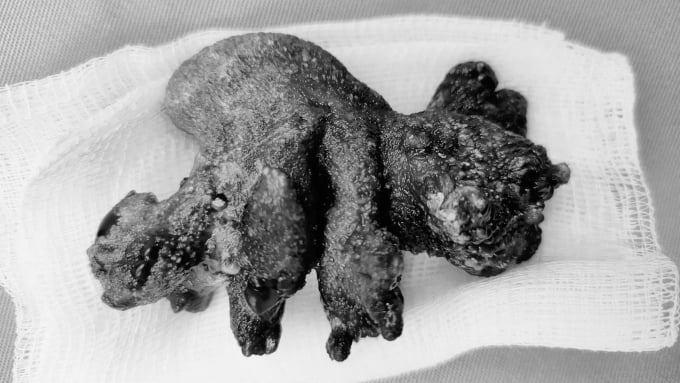
A large kidney stone in the patient. Photo: Provided by the hospital.
Doctors advise that people experiencing lower back pain, blood in the urine, or painful urination should see a doctor and not self-medicate at home. Kidney ultrasound and abdominal X-ray are basic diagnostic methods to detect urinary tract stones.
If detected late, kidney stones can cause damage, impair kidney function, lead to recurrent kidney infections, and even severe infections and death.
Minh An
Source link

































































































Comment (0)