

|
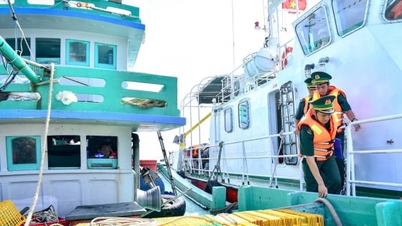
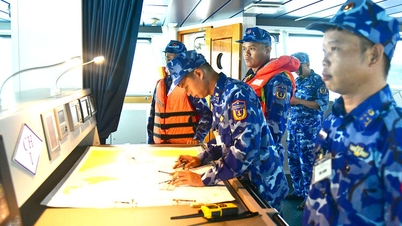
Illustration: On-duty scene |

Right next to the rocky outcrop stood an ancient banyan tree. No one knew how old it was, only that the elders said it had been there since they were born. Its trunk was so large that several people couldn't encircle it, its roots spread out in a tangled mess, and its branches and leaves covered a large area of the river. On the 15th and 1st days of the lunar month, the villagers brought incense and flowers to offer as sacrifices. My grandmother warned me: "The rice tree has a ghost, the banyan tree has a spirit; you children mustn't be disrespectful or mischievous." I listened, feeling scared, but still somewhat skeptical, because my teacher at school said there were no ghosts or spirits, only adults scaring children.
During the rainy season, the river water rose, the rapids roaring loudly. We crawled to the banyan tree, stood upright, took a deep breath, and plunged into the murky water. We competed with each other, jumping and spinning in mid-air, falling with a splash into the water, feeling triumphant as if we had just achieved a great victory. There were four of us in my group of friends. We were in the same class. Among them, Hung always stood out in his own unique way. He was two years older than me, sturdy, with a tanned complexion, and his eyes always seemed more experienced than the others. His father was a well digger, a profession as quiet and profound as their lives. I heard the adults say that in the old days, his family lived far down in the lowlands, where land was scarce, fields were small, and they had many children, so they moved up to the mountains to make a living, carrying with them the hardships of a life of wandering. Hung was a man of few words, but when he started something, he did it thoroughly. Every time we stood on the banyan tree, he was always the first to jump, without hesitation or boasting. His body plunged into the water decisively and swiftly, as if he were accustomed to letting himself be carried along by the current. Looking at Hung, I thought that within him there must be another river, a river of journeys, never turning back, only flowing forward.
Among our group, Quyết was the one most attached to the river. His grandfather was a fisherman, spending his whole life immersed in the water, so from a young age, Quyết was familiar with the smell of the river, the sound of water lapping against the raft's deck, and the quiet moonlit nights drifting across the river's surface. He wasn't boisterous or reckless like Hùng, nor impulsive like me. Quyết was calm and unhurried, always seeming to be listening to something far away. In the water, Quyết seemed to belong to another world . Every time he surfaced, he would exhale sharply, wipe the water from his face, and then burst into laughter, saying that there were so many fish down there. He spoke with the excitement of someone who had just emerged from a familiar territory. That rocky outcrop, with its deep swirling current and scattered rocks, was where the fish chose to take refuge. The slender-bodied, dark-backed barbels darted quickly between the rocks. The long-bearded, slippery-bodied spindly fish hid in dark crevices, waiting for the current to change before gliding away. Sometimes we'd spot large, sullen fish, lying motionless at the bottom like submerged logs. But the most numerous were the red-eyed carp. They swarmed in schools, their bright red eyes flashing in the murky water, appearing and disappearing with the swirling currents. Quyết said that if you dived down for a while, you'd see the riverbed moving, not because of the water, but because of the fish. Listening to him, I imagined the riverbed as a silent yet vibrant world, where life quietly existed under the pressure of the current. Every time Quyết jumped into the river, he was never in a hurry. He'd stand on a banyan branch, watching the water for a long time, as if questioning something. Then he'd push off, drop down, without twisting or showing off, just a straight, clean plunge, disappearing into the murky water. When he surfaced, he'd wipe the water from his face, laugh loudly, and say, "There are so many fish down here!" Some evenings, I'd go with Quyết to his fishing raft and sleep with him. The oil lamp flickered, the sound of flowing water was incessant, and his grandfather told stories of the river, of battles, of wandering ghosts. Quyết listened quietly, but remembered everything for a long time. As we grew up, we went our separate ways, but in my memory, Quyết still embodies the essence of the river: silent, persistent, and faithful to the rhythm of its chosen course.
We were used to calling each other by both our parents' names, but for some reason, everyone called Truong by his grandmother's name. Not his father's name, nor his mother's. The whole village was used to calling him that, it sounded both familiar and respectful. His family used to make their living by floating on rafts, drifting along the river, so his appearance and lifestyle were tinged with the smell of the river. His grandmother was famous throughout the region, a formidable woman whose mere mention of her name instilled fear in others; no one dared to cross paths with her family. She was very thin, slightly hunched, but her eyes were sharp and her voice was shrill, like a gust of wind on the riverbank. She made rice cakes. After school, I would follow Truong home, and then the two of us would take knives to the riverbank to cut banana leaves. We had to choose leaves from the right size of the West Indian banana tree, undamaged and unscratched, then wash them clean and let them dry. Truong did this work skillfully, as if he had been doing it for a long time, quietly and carefully. The scent of banana leaves, rice cakes, and the wood-burning stove mingled together, following me throughout my childhood. In my memory, the image of Truong is always vivid. But for some reason, Truong was nothing like his grandmother. The more formidable she was, the more timid he was. Truong was short and stocky, his shoulders always hunched, his eyes averted when looked at directly. When with us, he spoke and laughed little; even when pushed or teased, he would silently endure it. Strangely, everyone knew his grandmother was fierce, and no one dared to cross their family, yet Truong was often the one being bullied. Perhaps his grandmother's fearsome nature had protected him for too long, making him accustomed to hiding in the shadow of others. He was so gentle that he didn't know how to resist, only knowing how to bow his head and work, cutting banana leaves, and listening to his grandmother's instructions. Then we grew up. Truong joined the army, as was the natural course of events for children from the riverside village who had to leave the shore at a certain age. In the army, they said he was still the same: quiet, diligent, completing any task assigned to him without complaint or grumbling. He wasn't outstanding, didn't achieve anything remarkable, but he never caused anyone any trouble either. After leaving the army, Truong returned to his hometown and got a job as a security guard for a company. I met him again in his faded security uniform, his gait still slow, his shoulders still slightly hunched as before. He greeted me with a gentle, honest smile that couldn't hide his joy. The Truong of his childhood and the Truong of today are almost identical. Time has passed through his life as gently as water flowing along the shore: without pushing or crashing, just quietly flowing, preserving for himself a rare innocence amidst the turmoil of life.
Among my friends back then, I was the most naive. Not because I was less courageous, but because I always carried within me an indescribable apprehension. My father was away serving in the army, his visits as infrequent as the river's dry season, and my mother was a teacher, stern and quiet, accustomed to teaching me through admonition rather than indulgence. I grew up constantly reminding me to be careful, to think ahead, so before a rushing river, I would often stand still for a long time, my heart pounding but my feet unable to move. During river jumping sessions, I was always the last one standing. Watching the muddy water swirl beneath the rocks, hearing the roaring sound as if someone were calling, I felt afraid. But my friends wouldn't wait. A sudden, forceful shove from behind, and I fell. At first, I panicked, I struggled, and I swallowed a lot of salty river water. Then I got used to it. Each subsequent fall didn't make me tremble as much as the previous one. The fear of being pushed down turned out to teach me how to surface. Perhaps the river itself taught me my first lesson about taking risks. It's not always voluntary, but once you've jumped in, you have to learn how to overcome the challenges. Growing up, I applied to military school. As I walked through the gates, I suddenly realized I was no longer the hesitant little boy standing on the banyan tree branch years ago. During marches and arduous training sessions, I was reminded of the rushing water of my childhood. It turns out that courage doesn't come naturally. It's forged from fear, tempered by unexpected falls, and grows over the years, like a silent underground stream flowing within me.
After the days of my childhood, I understood why that river never faded from my memory. It didn't just flow outside the village, outside my recollections, but also flowed silently within the way I thought, lived, and walked through life. The river taught me a simple yet harsh lesson: water must flow; it bends when it encounters rocks, swirls deeply when it encounters rapids, turbids when it encounters floods, and remains clear and patient during the dry season. No river turns back, nor does it stand still to lament the obstacles in its path. We, the children who grew up by the river, each carried a different rhythm, but all were more or less shaped by the river. Hung embodied the spirit of unwavering departures. Quyet maintained a deep and enduring composure. Truong flowed quietly close to the shore, not noisy but never disappearing. And I, from a hesitant child, learned to throw myself forward, even though fear still lingered in my heart. The river didn't give me innate courage, but it gave me willpower: keep going and you'll get used to it, keep flowing and you'll get there. Now, whenever I stand before a turning point in my life, I think of the old river. It still flows, silently and resolutely, needing no one to witness it. And I know that as long as I can still hear the sound of the water rushing against the rocks of yesteryear, I will still have enough faith to continue, like a river, without looking back.
According to Baotuyenquag.com.vn
Source: https://baoangiang.com.vn/song-troi-a479119.html

![[Photo] General Secretary and President To Lam receives Amazon's Senior Vice President David Zapolsky](https://vphoto.vietnam.vn/thumb/1200x675/vietnam/resource/IMAGE/2026/05/22/1779466547770_a1-bnd-3513-6601-jpg.webp)

















































































Comment (0)