


The Starship rocket is the largest and most powerful version ever produced by SpaceX - Photo: AP
According to the Associated Press, on May 22, SpaceX test-fired the largest and most powerful version of its Starship rocket to date – an upgraded model that the US National Aeronautics and Space Administration (NASA) hopes to use to send astronauts to the moon.
The event took place just two days after CEO Elon Musk announced plans to take the company public.
The rocket was launched from the southern tip of Texas (USA), carrying 20 simulated Starlink satellites and released mid-flight during a flight lasting about an hour, reaching halfway around the Earth.
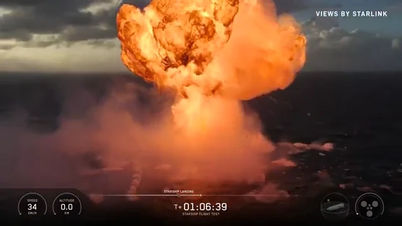
The spacecraft then crashed into the Indian Ocean as planned, despite experiencing some engine malfunctions and catching fire upon impact.
Musk called it an epic flight and congratulated the team for "scoring a goal for mankind."
This was the 12th test flight of the Starship rocket – a system that SpaceX hopes will take humans to Mars in the future, initially serving NASA's Artemis program to return to the Moon.
NASA Administrator Jared Isaacman was also present at the scene, noting that Starship had moved closer to its target.
The new version was launched from a brand-new launch pad at Starbase, near the Mexican border, after the May 21 launch attempt was canceled due to technical problems.
Compared to previous test flights—which had experienced mid-air explosions—this flight recorded no explosions until the final stage.
Despite a smooth liftoff, some engines malfunctioned when the booster stage returned. The spacecraft also flew with fewer engines than expected, but still reached an altitude of approximately 194 km and continued its journey eastward.
Two upgraded Starlink satellites, equipped with cameras, provide rare images from flight.
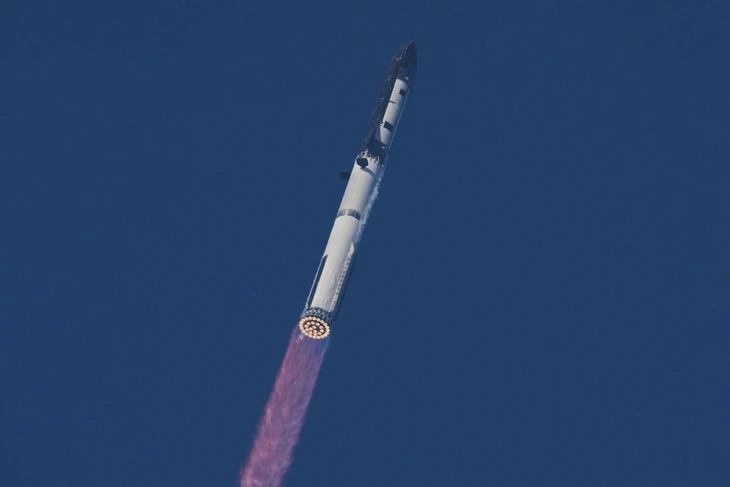
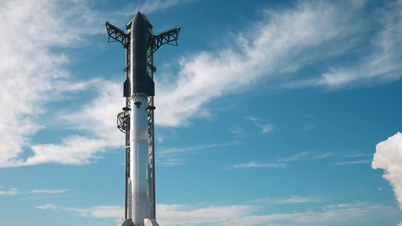
SpaceX's massive Starship rocket conducts a test flight from Starbase, Texas - Photo: AP
At 124 meters tall, the new generation Starship rocket is larger and more powerful than its predecessors. The booster stage has been improved with larger control fins and a more durable fuel delivery system for its 33 main engines.
The stainless steel spacecraft also received comprehensive upgrades to its navigation systems, computers, and connectivity ports for future docking missions.
Starship is designed to be completely reusable, with giant mechanical arms at the launch pad used to recapture the rocket stages upon return.
However, none of the components were recovered in this latest test. The booster stage fell into the Gulf of Mexico, and the spacecraft ended its journey in the Indian Ocean.
NASA is currently investing billions of dollars in Musk's SpaceX and Jeff Bezos' Blue Origin to develop lunar landers for the Artemis program.
While the Starship rocket has repeatedly approached the edge of space, Blue Origin's Blue Moon lander has yet to conduct a test flight, although a prototype is being prepared for a lunar mission later this year.
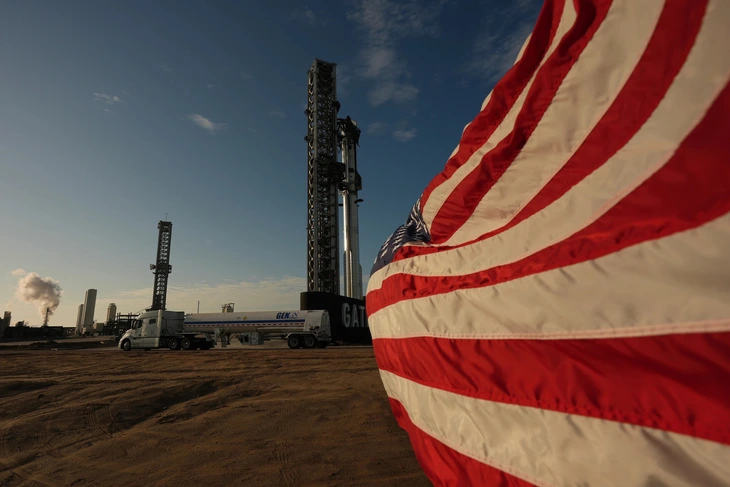
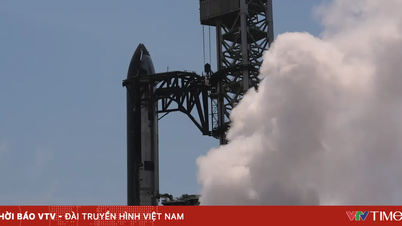
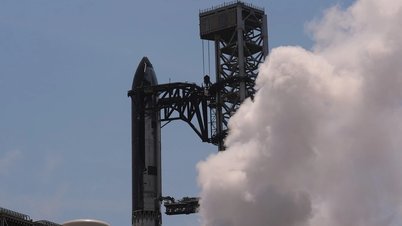
Nitrogen gas tankers are used to prepare SpaceX's giant Starship rocket for its test flight - Photo: AP
Source: https://tuoitre.vn/spacex-phong-thu-ten-lua-starship-lon-nhat-manh-nhat-tu-truoc-den-nay-20260523141228153.htm

![[Image] Hanoi's urban life under the challenge of a "scorching hot" environment](https://vphoto.vietnam.vn/thumb/1200x675/vietnam/resource/IMAGE/2026/05/25/1779706979265_nang-nong-t5-2026-minh-duy-7-4636-jpg.webp)


![[Image] Close-up view of the interchange connecting the two expressways and Long Thanh Airport.](https://vphoto.vietnam.vn/thumb/1200x675/vietnam/resource/IMAGE/2026/05/25/1779703378210_ndo_br_z7863716673926-224453a31600126cce10622af6290afd-4549-jpg.webp)



























































































Comment (0)