

According to the agricultural sector, fertilizers play a very important role in increasing the yield and quality of agricultural products.
For crops in general, simply providing sufficient and balanced nutrients will yield the best results. Especially during the rainy season, crops tend to grow vigorously, but their root systems are more susceptible to weakening and their ability to absorb fertilizers is reduced compared to the dry season, so appropriate fertilization methods are necessary.
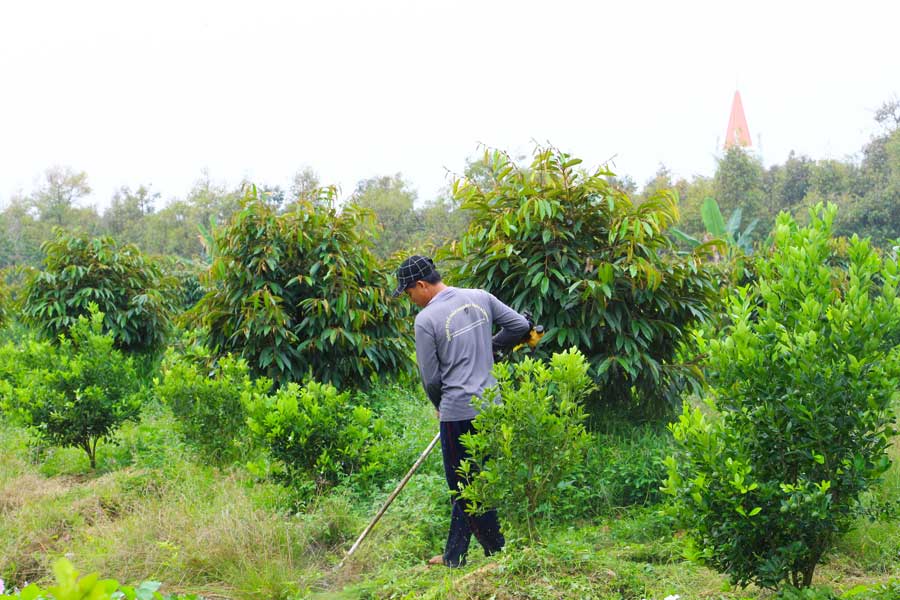 |
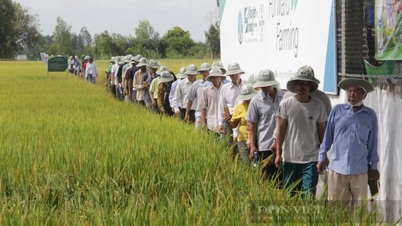
| Farmers need to apply fertilizer properly and care for their crops effectively during the rainy season. |
At the beginning of the rainy season, fruit trees usually sprout vigorously, but their roots are weakened because heavy rains cause the soil to become anaerobic, reducing its ability to absorb fertilizers. The rainy season also makes it easier for pests and diseases to break out, further weakening the trees. Therefore, farmers proactively implement measures to care for and protect their crops, especially in fertilization methods.
While mowing the grass in his 4-acre durian orchard, Mr. Tran Van Trung (An Binh commune) said: “During the rainy season, the amount of water supplied to the orchard can be continuous and prolonged. Therefore, I dug many auxiliary ditches to allow rainwater to drain quickly into the raised beds, preventing the orchard from being flooded.”
Importantly, before the rainy season, I prioritized using well-rotted organic fertilizers such as manure, green manure, and microbial fertilizers to improve soil structure and prevent rapid erosion. In addition, I mowed the lawn to improve air circulation and reduce pests and diseases, rather than killing weeds to retain soil.”
With 5 acres of jackfruit trees, Mr. Truong Van Thai (Cai Nhum commune) said: “During this season, if you apply too much fertilizer, the trees will have difficulty absorbing it, wasting money and causing excess poisoning for the trees and environmental pollution. Therefore, during the rainy season, I divide the fertilizer into many small applications so that the fertilizer dissolves slowly, minimizing the risk of leaching and allowing the trees to absorb it better. I also reinforce the embankments and minimize foot traffic in the orchard to prevent the trees from being disturbed at the roots and to prevent the soil from compacting.”
According to the Vietnam Academy of Agricultural Sciences , fertilizer efficiency in Vietnam is very low, reaching only about 45-50% for nitrogen fertilizers, 25-35% for phosphate fertilizers, and about 60% for potassium fertilizers. This is because fertilizers are often lost through various means such as runoff, seepage, fixation in the soil, or evaporation.
Therefore, during the rainy season, it is necessary to choose the appropriate type of fertilizer and apply it according to the manufacturer's recommendations. In particular, the method of application should also include measures to prevent runoff and deep infiltration. During the rainy season, plants grow and develop very vigorously, so they need a lot of nutrients, but it is also when orchards are frequently flooded.
Only inorganic fertilizers should be used, and organic or microbial fertilizers should be avoided. Applying organic fertilizers (especially uncomposted ones) will lead to the decomposition of organic matter by microorganisms in the soil, depleting oxygen and potentially causing plants to suffer from oxygen deficiency.
Organic fertilizers should only be applied at the beginning of the dry season or before the rainy season begins, combined with the use of antagonistic fungi such as Trichoderma to enhance the activity of beneficial microorganisms in the soil, helping to balance the soil ecosystem and limit pathogenic fungi.
During the rainy season, pay attention to the weather before fertilizing. It's best to fertilize in the morning to avoid afternoon rain, or to prevent leaching or runoff by lightly tilling the garden before applying fertilizer to minimize fertilizer loss. However, avoid tilling too deeply to prevent damage to the plant's root system.
For fruit trees, you can dig trenches around the base of the tree and fill them back in with soil after applying fertilizer; or you can divide the fertilizer into smaller amounts to apply at different times, which will also reduce leaching compared to using a large amount at once.
When plants have root diseases, absolutely do not apply fertilizer at the base of the plant. When plants have leaf diseases related to fungal infections, absolutely do not use foliar fertilizers containing high levels of mineral nutrients.
The agricultural sector advises that during periods of heavy rainfall and high water levels in rivers and canals (usually from August to November each year), flood control measures must be implemented. Balanced fertilization should be applied, using fertilizers with a balanced NPK (nitrogen, phosphorus, potassium) composition and those supplemented with macro and micronutrients.
Fertilizers that are effective during the rainy season are usually slow-release fertilizers, which prevent plants from growing too quickly but maintain their health and nourish the fruit well. For fruit-bearing plants that bear fruit seasonally, fertilization should be tailored to their growth and development stages to be effective.
Mr. Nguyen Thanh Binh, Head of the Crop Production and Plant Protection Sub-Department, said: The Sub-Department continues to monitor the pest situation on crops, especially in the current rainy conditions. Farmers need to be wary of certain diseases affecting rice, vegetables, and fruit trees. During the rainy season, plant roots are often weakened due to waterlogging, which creates anaerobic conditions in the soil.
On the other hand, heavy rainfall also facilitates pest and disease outbreaks, so it is necessary to apply fertilizers with a balanced nutrient ratio. If floods cause waterlogging in the orchard, it is necessary to quickly pump all the water out through the embankments to prevent prolonged flooding. It is also necessary to increase lime application at the beginning of the rainy season because lime helps release nutrients held tightly by soil colloids and provides calcium directly to the plants to improve fruit quality.
Text and photos: NGUYEN KHANG
Source: https://baovinhlong.com.vn/kinh-te/nong-nghiep/202508/su-dung-phan-bon-trong-mua-mua-5ab15d0/


![[Photo] General Secretary and President To Lam presides over the meeting to approve the draft report on the results of the second inspection by the Politburo of the Standing Committee of the Hanoi City Party Committee.](https://vphoto.vietnam.vn/thumb/1200x675/vietnam/resource/IMAGE/2026/05/26/1779789811432_a2-bnd-4430-9620-jpg.webp)



















































































Comment (0)