

Recent research suggests that frequent asteroid collisions with early Earth not only caused devastation but may also have created an ideal environment for the emergence of life.
A research team from Rutgers University in the US has discovered that the high temperatures and pressures created by meteorite impacts may have formed hydrothermal vents, providing the chemical energy and stable conditions necessary for early life.
Research suggests that, approximately 4 billion years ago, frequent meteorite impacts on the Earth's surface released enormous amounts of energy, melting rocks and creating fissures that fostered environments similar to hydrothermal vents at the bottom of the deep sea.
Using simulation models and analyzing geological evidence, scientists believe that these hydrothermal systems provided stable temperatures and chemical signatures, allowing organic molecules to accumulate and undergo chemical reactions, gradually evolving into the earliest forms of microbial life.
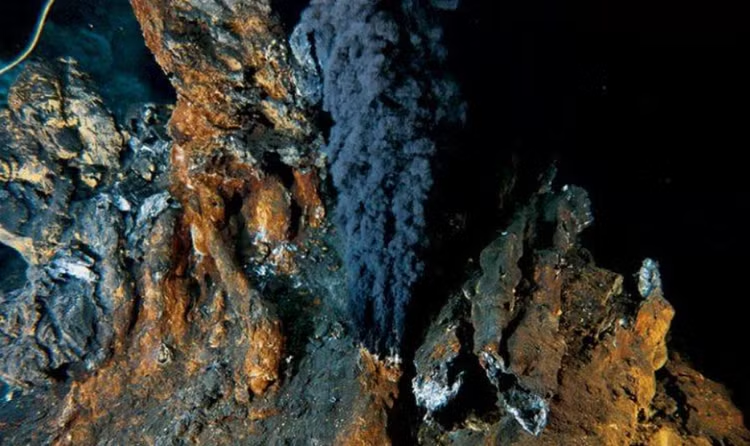
A research team from Rutgers University has shown that hydrothermal systems resulting from asteroid impacts provide localized high-energy environments, and these concentrated energy conditions can promote the aggregation and chemical evolution of organic molecules. While the impacts themselves are destructive, these hydrothermal environments can simultaneously provide the energy and chemical conditions necessary for the origin of life, creating a potential "breeding ground" for early life.
The study also emphasizes that these environments may have stabilized primitive chemicals, allowing them to accumulate under harsh conditions and increasing the likelihood of forming complex organic molecules. In other words, meteorite impacts may have provided the crucial conditions necessary for the formation of life, rather than simply being destructive events.
This research not only provides a new perspective on the origins of life on Earth, but also offers a reference for the search for extraterrestrial life: similar hydrothermal collision systems on other planets or moons may also have conditions to support life.
Although this research is still largely based on chemical modeling and theoretical analysis, and requires more on-site geological evidence to support it, it clearly shows that high-energy impact events may have created the environment necessary for life on early Earth. Meteorite impacts—this seemingly destructive phenomenon—may have been a major driving force in the emergence of life on Earth.
Source: https://khoahocdoisong.vn/su-that-thu-vi-ve-va-cham-thien-thach-va-nguon-goc-su-song-post2149100102.html




















![[GALLERY] Amazon shocked by $200 billion AI scam, employees rush to build bots.](https://vphoto.vietnam.vn/thumb/402x226/vietnam/resource/IMAGE/2026/06/01/1780307801611_am-1-png.webp)




![[GALLERY] 5 email habits that boost work efficiency](https://vphoto.vietnam.vn/thumb/402x226/vietnam/resource/IMAGE/2026/06/01/1780291585408_g-1-png.webp)
![[Photo] Reception to welcome General Secretary and President To Lam and his wife on their State visit to the Philippines](https://vphoto.vietnam.vn/thumb/1200x675/vietnam/resource/IMAGE/2026/06/01/1780295488620_vna-potal-chieu-dai-chao-mung-tong-bi-thu-chu-tich-nuoc-to-lam-va-phu-nhan-tham-cap-nha-nuoc-toi-philippines-8798060-7855-jpg.webp)




































































Comment (0)