

 |
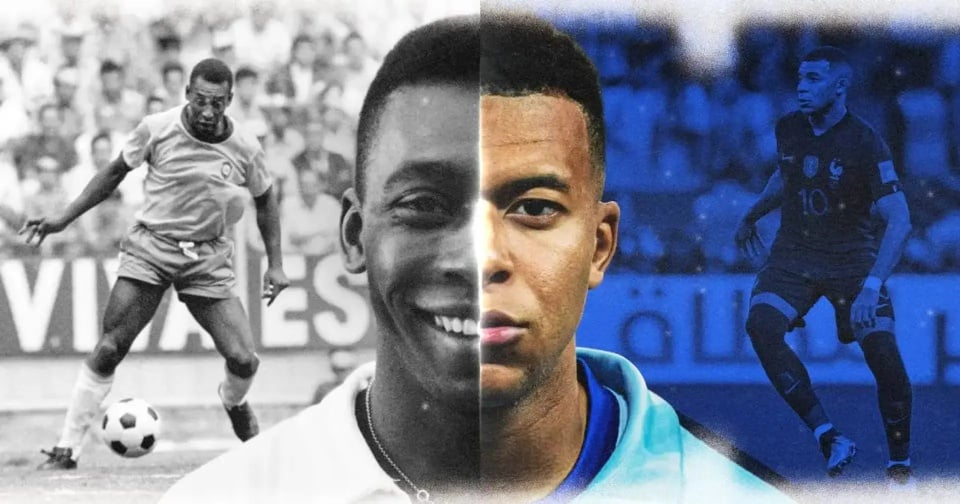
Pele and Mbappe, two generations elevated to iconic status by the World Cup. |
In 1958, a skinny 17-year-old boy stepped onto the World Cup stage in Sweden with nothing but his innate talent and a dream of a better life. That boy was Pele.
Before becoming "King of Football," Pele played on the dusty streets of Bauru, Sao Paulo, with a ball sewn from old socks, stuffed with newspaper and scraps of cloth. His family was so poor they couldn't afford a proper football. Yet, that very teenager rose to the top of the world , opening a completely new chapter in football history.
Pele, the last street genius of football?
Nearly 70 years later, FIFA predicts that the World Cup, once conquered by Pele, will generate approximately $13 billion in revenue by 2026. The gap between the two eras is not just about money. It reflects a comprehensive transformation of football, from how talent is discovered and players are trained to the commercialization of the sport .
What makes Pele's story so special is that it is almost impossible to replicate in modern football.
In his time, children grew up playing street football. They learned to dribble, be creative, and solve problems without the need for lesson plans or analytical data. Pele, Garrincha, and Didi were products of that freedom. They played football more instinctively than anything else.
 |
From a ball stuffed with paper, Pele rose to the throne of world football. |
Today, exceptional talent is often discovered as early as 10-12 years old. Scouting systems are global, and academies utilize biometric tracking technology, data analysis, nutrition, sports psychology, and personalized training programs. A promising player has virtually no chance of developing in secrecy anymore.
Before making their first-team debuts, players like Lamine Yamal, Jude Bellingham, and even Cristiano Ronaldo's son were already widely known to the media and fans. If Pele had been born in this era, perhaps videos of his skills would have been flooding TikTok from the age of 13, and major European clubs would have been vying for his signature from a very young age.
But the biggest change wasn't in the training ground. It was in the enormous scale that the World Cup became.
When Pele lifted the World Cup trophy in 1958, FIFA was still primarily an organization that governed football. The World Cup was simply a tournament for the best teams on the planet. Things began to change in the 1970s.
The 1970 World Cup in Mexico became the first tournament to be broadcast in color globally. Millions of viewers saw Pele and the Brazilian team in vivid images for the first time. Television stations recognized the immense appeal of football. Sponsors saw a business opportunity. And FIFA understood they had a "gold mine".
From then on, the World Cup was no longer just a football tournament. It became a global product.
Sponsorship deals with Adidas, Coca-Cola, and numerous multinational corporations emerged. Television broadcasting rights increased exponentially. FIFA's revenue soared from a few million dollars to billions of dollars.
The 2026 World Cup and the rise of commercial football.
The 2026 World Cup in the USA, Canada, and Mexico will feature 48 teams, 104 matches, and is expected to generate nearly $13 billion in revenue. That scale far exceeds the wildest dreams of young Pele. Along with the expansion of the World Cup comes a change in the players themselves.
Today, stars represent not only their national teams but also global brands. Ronaldo earns the majority of his income from endorsements and commercial deals rather than his playing salary. Lionel Messi, Kylian Mbappe, and Erling Haaland all have sponsorship networks spanning from fashion and technology to video games.
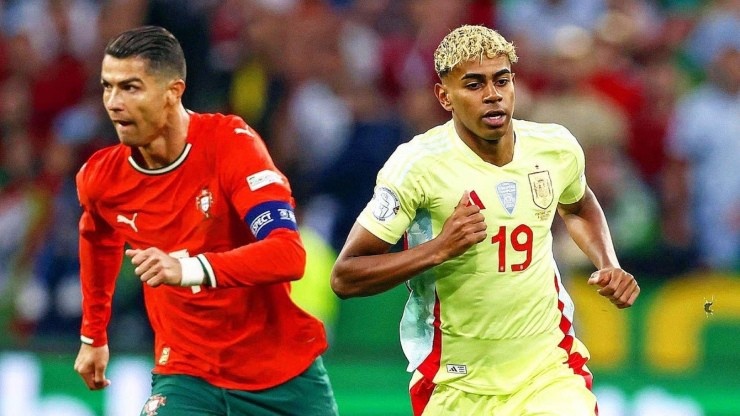 |
Ronaldo, Messi, and Yamal are gradually becoming icons of the billion-dollar era of football. |
A successful World Cup can change a player's entire career. James Rodriguez went from a promising star to a blockbuster signing for Real Madrid after the 2014 World Cup. Mbappe became a global superstar after just a few weeks of shining in Russia in 2018.
In the modern world, the World Cup is more than just a trophy. It also generates enormous commercial value.
However, amidst all that data, algorithms, and billion-dollar contracts, football still presents an intriguing question: Can today's world still produce another Pele?
Modern football is better than ever at discovering and nurturing talent. But this very strict control sometimes causes the sport to lose some of the wildness that once produced unique geniuses.
Pele grew up on the streets of poverty, playing with newspaper-stuffed balls and matches without tactics. He was a product of an era full of improvisation.
Today, players are superior in terms of physical prowess, science, and tactics. But geniuses with an innate talent like Pele, Garrincha, or Ronaldinho seem to be appearing less frequently.
From Sweden 1958 to North America 2026, the World Cup has come a long way from a playground of idyllic dreams to a massive commercial machine of global sport.
But no matter how football changes, the story of young Pele and his paper-stuffed ball shows that the core values of the beautiful game have never changed. There, dreams are nurtured from the simplest things.
Source: https://znews.vn/tai-sao-bong-da-ngay-nay-khong-con-pele-post1656031.html




![[Photo] General Secretary and President To Lam presides over a meeting on preparations for the review of one year of operation of the three-tiered government system.](https://vphoto.vietnam.vn/thumb/1200x675/vietnam/resource/IMAGE/2026/06/02/1780391821195_a1-bnd-4595-9717-jpg.webp)




































































Comment (0)